Summary: The mythical scenes depicted on a silver goblet discovered in ancient Canaan may be the oldest known depiction of creation.
In the beginning God created the heaven and the earth. And the earth was without form, and void; and darkness was upon the face of the deep. And the Spirit of God moved upon the face of the waters. – Genesis 1:1-2 (KJV)
A Unique Artifact From an Ancient Tomb
A team of researchers have reinterpreted the mythical scenes of deities, snakes and sun images hammered and etched into a unique and famous silver goblet that was discovered in the Judean highlands decades ago. They claim this may be the oldest known depiction of the theme ‘order coming from chaos,’ the activity of cosmic creation that was commonly believed to have been going on since the beginning of time by those living in the ancient Near East.
While the scenes are mythical, they connect in surprising ways to the Bible’s account of creation and the early events of history.
The chalice was found in 1970 in the double tomb of a high-ranking individual near the village of ˁAin Samiya. The site is northwest of Jericho, about 10 miles northeast of the town of Ramallah, and near the foot of Tell Asur, one of the highest peaks of the Judean mountains with an elevation of 3335 feet.
The Ain Samiya goblet stands a little over three inches tall and is made of sheet silver. Pottery found with it connects to the first part of the Middle Bronze period, conventionally dated to around 2,200 BC.
Information on the history of the goblet and the new proposed interpretation were published in the paper The Earliest Cosmological Depictions: Reconsidering the Imagery on the ˁAin Samiya Goblet in the Journal of the Ancient Near Eastern Society ‘Ex oriente lux’ (Vol. 49, pp. 49–84, 2025), Zenodo: in press. Project leader Eberhard Zangger was assisted by researchers Daniel Sarlo and Fabienne Haas Dantes.
From the onset, the goblet was viewed as a completely unique artifact from this period of Canaan’s history. “It is the only luxury or elite grave good to have ever been found in the southern Levant,” the researchers wrote. The main sources of silver were from the far away Caucasus mountains, Anatolia (modern Turkey), and Greece.
The paper noted that silver goblets are only rarely found as burial offerings in this region at this time, but it is the artwork from so early a period that really sets it apart. “It is considered the only example of genuine art from this period in the Levant,” they wrote.

Motifs of Cosmic Creation
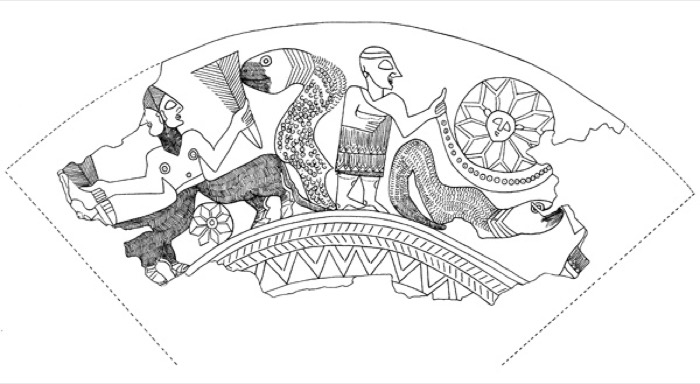
The imagery on the Ain Samiya goblet can be divided into two two distinct scenes, each taking up about half the space with the mythological figures facing each other in each. Above the bottom band of geometric patterns, the scene conventionally described as being on the left has a chimera; a commonly seen figure in ancient scenes. They were hybrid creatures of mixed animal forms, or human and animal features, who were also of divine lineage and often female. Its conjoined twin body has a bull’s lower part and a single human upper body. The head of the figure is often described as a split “Janus-face,” but only the right side is preserved. Its two hands each hold out a large plant in the form of a palm frond. Below the body of the chimera is a rosetta (or sun-symbol), which appears to be a smaller version of the sun found in the other scene, but lacking a face. To this figure’s right stands a huge snake, with its large head at eye level with the head of the chimera and touching one of the plants the chimera is holding.
The similar-sized scene to the right shows two human-like figures facing each other who may have been depicted similarly, though the right figure has only the tip of an elbow and part of a tunic preserved. They wear a domed headdress and a tunic that covers the lower part of the torso to above the knees. They each hold an end of a crescent-shaped object with an eleven-petalled rosette that has a human face above it. Below the two figures and the crescent shape with the sun is another snake; this one not standing up, but laid out. It looks similar to the snake in the left scene, though the appearance of his skin is a bit different.
Soon after its discovery the famous Israeli archaeologist Yigael Yadin interpreted the scenes on the goblet as depicting the cosmic battle between order and chaos described in a Babylonian creation myth known as Enuma Elish that tells the tale of the chief god of the city of Babylon, Marduk. Marduk defeats the goddess Tiamat in a violent conflict and brings order to chaos, becoming the chief god.
Enuma Elish has several distinct similarities to the scenes on the goblet. In the left scene the monster of chaos stands upright to fight Marduk (endowed with a double godhead in the Enuma Elish myth). But Marduk holds up a plant to counter the monster’s venom – an element in both the myth and goblet. In the right scene, Marduk’s final victory is shown, matching the myth’s story of the monster being split in two to form the heavens above and the earth below. In the goblet, Yadin believed guards hold a rod from the body of the monster to seal off her face, thought to be represented by a sun disk.
Yadin’s interpretation was popular among scholars, but some objections were raised. These were echoed by the authors of the recent study who point out that while there are similarities between the two, there are also several dissimilarities and no violent battle depicted on the goblet as in the Enuma Elish myth. Also, the Babylonian myth was not written down until a thousand years after the dates for the goblet’s construction and burial.
Zangger and his colleagues instead propose a new interpretation. They believe the Ain Samiya goblet does show a type of creation story, but one that shows creation as well as the ongoing maintenance of cosmic order. They also think it depicts a creation story far older that better fits a Sumerian context – the time period contemporary with the goblet. The best indication of this is the depiction of the deity figure that is in human form in the right-hand scene. Similar looking depictions are seen in many other seals and seal impressions from the period before 2000 BC. The profile attitude, the way the face is drawn on the goblet, and the clothing are all the standard way of showing a god in human form in Sumerian art.
Added to this are the celestial bodies seen between deity figures in Sumerian art, just as on the goblet. Many ancient seals from Sumer show similar deity figures with a “Celestial Boat” between them that carried heavenly bodies such as the sun on their journey across the skies.

The goblets’s two sides tell a two-part story, with chaos reigning in the form of a monstrous snake at first. The chimera represents a weak god, fused with the animals. Beneath its legs is a weak sun. In the second scene, order and the sun have emerged peacefully from the chaos. The gods have become powerful humanoid figures. And they hold the now-powerful and enlarged sun up in a “celestial boat,” separating the heavens from the earth. The same monstrous serpent, as the enemy of the sun god, now lies defeated under their feet.
Unlike the Enuma Elish story, the process in this interpretation is peaceful, not violent (an aspect of the older story that more closely fits the Bible). The celestial “boat of light” is also seen in many other depictions in Near Eastern art. It transports the sun across the sky, which is the ongoing cycle of defeating chaos and renewing the world by providing day and night, seasons, lunar phases, and all the rhythms of nature.
‘The purpose of the burial object was to connect the soul of the deceased with the journey of the sun, ultimately to heaven,’ the study declares.
They believe their interpretation is supported by another artifact containing similar motifs on a 3,800-year-old prism excavated in the 1980s at Lidar Höyük in Turkey. It is currently unpublished, but also includes a crescent Celestial Boat and a celestial body laid out in a similar way.

The burial chambers were accessed by a shaft more than 12 feet deep. Although partially looted in ancient times, the chamber containing the goblet still contained 13 ceramic vessels: two four-spout pottery lamps and 11 hand-made jars, an arrowhead, a spear shaft, and amber beads.
The paper from the Zangger group believes the uniqueness of the goblet in this region indicates that it must have traveled from elsewhere. The crude silverwork combined with the exquisite artwork lead them to propose a designer of the goblet’s scenes from the Akkadian Empire and its production in northern Syria, before traveling to Canaan along common caravan routes to end up in the tomb of its owner. However, when thinking about last week’s article on ships in the desert in Egypt, we should also allow for other possibilities.
Biblical Connections
While scholars disagree about the details of the best interpretation of the Ain Samiya goblet, something that is widely observed are the intriguing connections among all of these creation myths and the Bible’s account of creation and the events that soon followed.
For one, the division between chaos and order, and light banishing chaos, reflects what is seen in the opening verses of Genesis after saying the earth was without form, and void:
And God said, Let there be light: and there was light. And God saw the light, that it was good: and God divided the light from the darkness. And God called the light Day, and the darkness he called Night. And the evening and the morning were the first day. – Genesis 1:3-5
Another parallel is the serpent who represents chaos fighting against the order of creation. This fits the garden of Eden where the serpent, opposing God’s commands, tempted Eve. The paper notes that in ancient Near Eastern cosmology, there is close association between plants, serpents, and a mother goddess – or the daughter of a mother goddess – including an inscription from Ugarit. This resonates with the idea of a woman (Eve) in confrontation with a serpent regarding the fruit of a plant (the tree of the knowledge of good and evil).
While the imagery and many of the details of the ancients differs from the Bible’s account, scholars seeing these striking parallels often suggest they may all draw from a single, even older myth. In this thinking the Bible is just a later, more developed, offshoot of these origin myths.
However, there is another explanation that fits the facts. The different variations of creation stories among the Sumerians, Babylonians, and other cultures of the Near East may contain parallels because they all reflect aspects of historical events that really happened. As the stories were passed down over the generations, the stories became distorted as elements were forgotten and new aspects were added, all while echoes of the actual history were retained. When God revealed himself to Moses at Mount Sinai, he provided the revelation of what had happened in the beginning, restoring the accurate view of events.
Conclusion
Without more evidence, the details of many scholars’ proposals include a lot of speculation. But the decorative representations on the Ain Samiya goblet seem to give us a picture of what people living more about 4,000 years ago thought about creation and chaos.
It shows that people have been preoccupied with these important questions for all time. The Bible’s answer is that God spoke every created thing into existence, and sustains those things, by the word of his power. No other proposal provides a better explanation. Keep Thinking!
TOP PHOTO: A drawing of the scenes depicted on the silver goblet from Ain Samiya. (Nattering Nabob of Nanofabrication, CC BY-SA 4.0, via Wikimedia Commons)


