Summary: DNA expert Dr. Rob Carter gives amazing genetic evidence that supports the Bible’s account of history. Part 1 of a 2-part series.
These are the families of the sons of Noah, after their generations, in their nations: and by these were the nations divided in the earth after the flood. – Genesis 10:32 (KJV)
Genetics and Bible History
This week we feature a conversation between Tim Mahoney and DNA scientist Dr. Rob Carter. They cover some amazing evidence from the world of DNA that is underreported, yet provides a remarkable fit with the history reported in the Bible. You can listen to the full dialogue at the Patterns of Evidence podcast on your favorite platform. Let’s get right to the discussion.
TIM MAHONEY: I am so excited to have Dr. Robert Carter back with us. He is from Creation Ministries International (CMI) and we’ve gotten to become friends, and he’s actually come to Minnesota in the past. And one of the things that I think we both were surprised by is that we both love music and folk music. We were doing some music together the last time, but we’re going to be talking about Biblical genetics. Rob, how in the world does genetics fit into the Bible?
ROB CARTER: Being that the Bible claims to be a book of history and being that genetics, one aspect of it, allows us to peer back into history, the two had better agree or we’ve got problems. And so I think our conversation today is going to be a lot about how the science of genetics fits in with the history of the Bible, because they’re both studies of history.
The Genetic Age of Species
TIM MAHONEY: Right. And in a previous conversation with Dr. Carter, we discussed genetic evidence for Adam and Eve, and Noah’s flood, and how Neanderthals fit into the Biblical narrative. We’re kind of carrying on from there. Could you just sort of recap evidence pointing to Noah’s flood?
ROB CARTER: There’s something in the world called genetic barcoding. And when I first heard about it, I was like, “Oh, that’s weird.” And in fact, I thought it was kind of ridiculous for a while. But there’s one particular gene in mitochondria. Mitochondria are things in our cells that have a little piece of DNA. And this one particular gene mutates just fast enough that you can tell species apart, but just slow enough so that all the individuals in the same species have the same sequence of that gene. Well, when they started sequencing these genes from all these different species around the world, they discovered that most species are the same age. And it doesn’t matter what group you’re talking about, mammals, plants, you name it. Most all species are the same age – and they’re young.
They’re not hundreds of thousands of years old. In the evolutionary model, they’re only a few tens of thousands of years old. That puts everything very much in the Biblical ballpark, and it tells us that everything got reset, restarted just a few thousand years ago. So this is the aftereffects of the flood. Dogs, wolves, dingoes, and jackals, which are all dogs, they’re all about the same age because they started from a parent population and split as they speciated, as they spread out on the earth after the flood.

TIM MAHONEY: That’s absolutely fascinating. When you talk about this stuff I get so excited. So you’re saying that all these genetic markers are showing that everything on the planet basically is showing that it’s from a younger time period than what evolutionists would say.
ROB CARTER: Yeah. I can’t say everything on the planet because in science there’s always exceptions, but most species go back to about the same timeframe, and it’s a young timeframe.
TIM MAHONEY: What do evolutionists have to say about that?
ROB CARTER: They’re going to try to stretch the time out. When we measure mutation rates today, and we say, “Okay, here’s how many mutations happen in the mitochondria or happen in Y chromosomes.” And if you use that rate and look at all the people in the world, you realize that all the people in the world go back to Adam and Eve in Genesis, 4-5,000 years ago.
And they’ll say, “Oh, no, no, no. Either mutation rate is much slower than you creationists say,” (but we’re just getting them from their laboratory experiments), or they say, “Well, most mutations don’t matter because they just accidentally get lost over time. And so the accumulation rate is a lot slower than the mutation rate,” which isn’t true even in their own mathematics. That’s the two “outs” that they try to use.
TIM MAHONEY: Does that work? Is that an out, or does it not really answer the question?
ROB CARTER: It doesn’t answer the question because in genetics, say you have a population, there’s’ mutations happening. A lot of mutations will get lost – that’s true. Because what if I didn’t have a son? Then if I had a mutation in my Y chromosome, it doesn’t get passed on. It has disappeared. And over time, lots and lots of mutations will get lost. But given that all these people in the population are all accumulating mutations, even if a lot of them are lost, the long-term accumulation rate is about the same as the mutation rate.
So if we have one mutation per Y chromosome per generation, in 6,000 years, that’s like 200 generations, you’d expect about 200 mutations to separate all the men in the world. And that’s about as many mutations that separate all the men in the world. We’ve got a lot of genetic data for humans, and long-term, like family trees with thousands of people that go back to a common ancestor and we can look at their genetics.
Long Lifespans and the Decay Curve
TIM MAHONEY: The Bible has long lifespans of the early patriarchs in Genesis, people living for multiple centuries. But then there appears to be this gradual decline in lifespans as the narrative unfolds, especially after the flood. And you have a former colleague, Dr. John Sanford. He modeled this describing the results as a decay curve, linking to something called genetic entropy. What does that mean?
ROB CARTER: The answer is multi-part because it depends on which we’re talking about. First, how do people live that long – 900 years? That’s the first question. I mean, that sounds ridiculous, right? Well, we can change a single letter in a mouse genome and that mouse will live twice as long. We can modify the diet of all sorts of different animals and get them to live a lot longer. We can double lifespans using diet or genetics. Combine those and you’re going to have things live a lot longer. Consider also Adam and Eve had no mutations. There hadn’t been time in history for bad things to start happening to their genomes.
So they didn’t have something hereditary that might trigger diabetes in midlife or something like that. And so they had a perfect genome, they had a perfect diet and they had a great environment. Those three things together will make things live longer.

TIM MAHONEY: So tell me about this exponential decay curve then.
ROB CARTER: When you look at the lifespans of the early patriarchs, but before the flood, you had very high lifespans, except for Enoch, but very long lifespans. And then after the flood, you had this beautiful decay curve and it’s exponential. It’s very scientific looking. And this is weird because you wouldn’t expect random dates to fit a nice, beautiful curve. And nobody in the ancient world, as far as anybody knows, was plotting exponential decay curves.That’s a new thing. And it’s even worse because it’s not just the age of the patriarchs in Genesis five, going from Noah down to Terah. It goes way further. If you just go to Abraham, Isaac and Jacob, you can go to Joseph, you can go to Moses, you can go to David. In fact, the last person in the Bible, as far as I know, who we know how old that person was when he died and we know how many generations he was from Noah, was King Manasseh.
Manasseh was twelve years old when he began to reign, and he reigned fifty and five years in Jerusalem: – 2 Chronicles 33:1
That’s a long time, and he fits the curve. All the other people after Genesis five, they all fit that beautiful slope, and it’s very clear and very tight. And I’ve run scientific experiments where I expected to get an exponential decay curve and I got worse data than we see in Genesis, and Exodus, and Kings and Chronicles. I think it’s accurate because it’s real.
Genetic Entropy and Mutation rates
TIM MAHONEY: So why is genetic entropy important to the book of Genesis?
ROB CARTER: When God cursed the universe, it was very clear that it was the whole universe in Romans eight, just read that for backup. But in Genesis, when God curses the universe, that includes everything in the universe. That includes Adam’s body, includes his DNA. And this is the point at which, generationally, mutations are starting to pop up. Because every time a cell divides, it has to copy three to six billion letters of DNA and the little machines that make the copying aren’t perfect. There are mutagens in our environment that can affect the cells that are passed down to the next generation. And generation after generation, those things build up. So that’s genetic entropy. And we don’t see the real effects of that until after Noah’s flood. Why? Because the inbreeding that would’ve happened after the flood. I mean, you know it’s not a good idea to marry your cousin, right?
You get mutant little children, you don’t want to marry someone closely related. But Shem Ham and Japheth’s children would have had to marry their cousins. We had 1500 or 1600 years of building up mutations and in an inbreeding event. And when that happens, the lifespan plummets. That’s exactly what we would expect from an inbreeding event from any size population.
ROB CARTER: If you look at any scientific system, it doesn’t matter what it is, over time, as chemical reactions are happening, you get more disorder. Always. Things go from a higher order state to a lower order state. Consider life. Life is taking in photons from the sun, high-energy photons like blue light. And it goes into a plant. And it takes that blue light and it takes pieces out of it, or energy packages out of it, and it makes sugar. We burn the sugar and what comes out of us? Heat, infrared light comes out of our bodies. So biology converts this high-energy packet into multiple low energy packets. So we are taking higher order and converting it to more disorder. And that happens everywhere. Everything increases disorder. And so even in information systems, the law of entropy can be applied to not just thermodynamics, it can be applied to everything.
And so information systems like DNA, which is a set of instructions, it’s information. Over time, as the genes are scrambling and mutations are happening and radiation is hitting us and things like that, the information gets scrambled. Entropy can be applied to the genome.
TIM MAHONEY: Well, in the last series, you shared about a theory you put forth called Patriarchal Drive. How does that tie together with the things we’ve just discussed?
ROB CARTER: This is amazing and cool and fun. Who’s the oldest father in the Bible? The oldest known father in the Bible? Adam’s 130 when Seth was born. We don’t know how old he was when any of his other children were born. But there’s one father we know was older than that, when his children were born. It’s Noah. He’s over 500 years old when Sham, Ham, and Japheth are born. The other people could have lived longer than that. We don’t know how old they were when the children were born.
So that’s pretty extreme. Interestingly, a lot of females, a lot of women are worried about having children after the age of 40, because they worry about Down syndrome and other chromosomal abnormalities. That’s true. The rate of chromosomal abnormalities goes up with a lady’s age. But most mutations come from the man, and the older a man is, the more mutations he passes on because an egg cell in the ovary is non-dividing.
It’s held in protective stasis sometimes for 40 or more years. And because the chromosomes aren’t being copied, there’s no DNA repair happening. So you can get a broken chromosome and all of a sudden you have a Down syndrome baby or something like that. So it’s a real thing. You do have higher rates of chromosomal breakage in the eggs.
ROB CARTER: But in men, after puberty, our little reproductive cells start dividing and they don’t stop dividing until we die. And so the older the man is, the more generations his reproductive cells have gone through. And we can measure this. We can look at a family tree and you can calculate how old the father was when the son was born. And you can see that over time you get an increase in the number of mutations based on the age of the father. A lot of mutations don’t do anything, but enough mutations do bad things that we can just say most mutations are bad.
Either it has an effect, there’s lots of genetic diseases out there, or it’s something that’s not measurable. But we can just sequence the DNA and say, “Hey, wait a minute. The son’s DNA is different than the father’s DNA. There’s an A there. The father has a T. Where did that A come from?” Well, as the DNA copying machine got to that letter, it made a mistake and now there’s an A. If we can measure mutations going up with the age of the father, in our studies maybe 60 years old, 70 years old. And we know those men have passed out more mutations than a 20-year-old father. So what happens if you extend that out to like 500 years? You’re talking about a lot of mutations and all of a sudden Noah is genetic poison.

ROB CARTER: Noah would pass on more mutations to his sons Shem, Ham, and Japheth than all the mutations that accumulated in the human race between Adam and Noah. I mean, it’s potentially a massive problem. And then as Shem, Ham, and Japheth are having children, they’re going to have children young, sure. But then they might also have children when they’re a lot older. And being that they’re patriarchs, you kind of expect them to be polygamists. So maybe Mrs. Ham gets old and stops having children. Well, what’s to prevent Ham from picking up a younger wife? That’s kind of expected when you’re in that patriarchal sort of society. And therefore Ham could probably keep on having children up until he dies and he might die at the age of five, six, or 700, continually adding massive amounts of mutations in the population.
And so in my population model that I ran, I didn’t know how many mutations would happen as they age, so I used three different models. But when I applied that to a population growth scenario, what I saw was that the average number of mutations per generation went way up in the years after the flood. And then as the patriarch started dying out and the average age started getting less and less, then the mutation rate went way down again. And so it goes up and it goes down and eventually reaches the modern level. So, in the first couple hundred years after the flood, we expect a much higher mutation rate than we see today.
Great Genetic Variation in a Short Time Period
TIM MAHONEY: When we look at the population of the earth and you look at all the different types of people, if there were only eight people on the ark, all these genetic modifications had to have been in that group in the boat.
ROB CARTER: I have another article on that on creation.com. I’m criticizing the Bio Logos group, Francis Collins, Dennis Venema and others who have claimed that there’s no way you can get this amount of variation just starting with one or two people, Adam and Eve. And it’s simply not true. There’s actually not much variation amongst people. In fact, we have shockingly little genetic diversity across the planet, and chimpanzees have five to six times more genetic diversity than all the humans. So it’s easy to put it into Adam and Eve.
Actually I had my genome sequenced. It was a Black Friday special for Dante Labs. I had it done for $175. It’s like, wow, I got my whole genome on a memory stick. And there were about three million places where the letters of my two chromosomes are different. So the letter I got from my mom is different from the letter I got from my dad. There’s only about 10 million places like that in DNA across the world. So I have one third of the world’s genetic diversity, just in my body. The average person is about one third of the world. You take nine or ten Europeans, you’re talking about 99% of the world’s genetic diversity. Eight or nine people from Africa, and you got 99% of the world’s genetic diversity. Easy to put all that into Adam. Really easy.
TIM MAHONEY: This is pretty mind-blowing stuff when you think about what you’ve learned. This is more philosophical, but has the study of genetics had an impact on people who don’t believe in God because they’re looking at this and going, wow, or do they find an excuse for not believing?
ROB CARTER: There are definitely people who have come to faith because of revelations in genetics. I know that it’s a work of the Holy Spirit and the Holy Spirit doesn’t give us all the answers. I get that. But there are some people who come to faith because of science and a lot of them work at CMI now, honestly. And we hear testimonies of this from people all the time.
It’s answering the scientific questions and they say, oh, then maybe the Bible is true after all. The fact that Adam and Eve did not live tens of thousands of years ago, but only a few thousand years ago. The amount of genetic diversity in humans, the rate of mutations, the fact that populations can’t live for millions of years without going extinct, the mutation rates are too high. I mean, we will go extinct. We haven’t been here for millions of years. Those sorts of things have taken a toll on the lack of faith. It’s funny how other people just dig their heels in and refuse to acknowledge even some basic simple facts.
Conclusion
Stay tuned for next week when we conclude this fascinating talk about genetic evidence matching the Bible’s account of history. Until then, keep thinking!
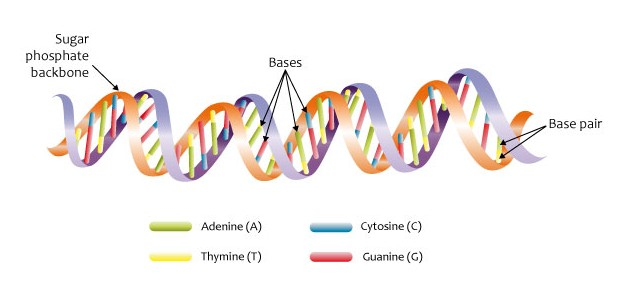
TOP PHOTO: The structure of the DNA double helix. (Genomics Education Programme, CC BY 2.0, via Wikimedia Commons)


.jpg)
.jpg)