Summary: Part 2 reveals more amazing artifact discoveries from ancient Persia that fit the Bible’s story of Esther.
For if you keep silent at this time, relief and deliverance will rise for the Jews from another place, but you and your father’s house will perish. And who knows whether you have not come to the kingdom for such a time as this?” – Esther 4:14 (ESV)
Antisemitism Revealed in Esther
Let’s get right into the conclusion of our 2-part series on evidence matching the Bible’s Esther story. Excerpts are highlighted from a podcast discussion between Tim Mahoney and Dr. Todd Bolen, whose website BiblePlaces.com has thousands of amazing high-quality photos of Biblical sites and artifacts. You can also catch up on Part 1 of this article.
TIM MAHONEY: Could you help us set up the next stage of the book of Esther?
TODD BOLEN: Haman’s plot was to eliminate the Jews. That’s the conflict of the book on which everything is based, this question of how are the Jewish people going to be spared from genocide? I mean the order that Haman is able to convince Xerxes to issue calls for the slaughter of Jews all over the Persian empire. And you think about that in relation to descriptions in the Book of Esther of how vast the Persian empire is. So on one level we can say, “Wow, the Persians are so great.” But on another level we know that all the Jews are going to be dead, because the kingdom of Persia spreads out even south of Egypt – we know of Jewish people living in Egypt, and Jeremiah was carried off there – but all the way over even to India. And so this threat is very real. It’s very scary.
Now, what actually provokes it? And that’s an interesting question. Obviously, you mentioned the prophecies that we have from Moses, and we have prophecies of later prophets. Isaiah talks about the exile and suffering, and Jeremiah and Ezekiel are living through it. It really is demonic, right? This is Satan’s agenda since the beginning, right? And we see it manifest in different ways over time. I mean, you have the Amalekites who are really, this is like a satanic agenda to murder the Israelites as they’re coming out of Egypt. You have Queen Athaliah, she’d be another interesting example, almost wipes out the House of David. And of course the Babylonians, the archetypal from the tower of Babel, and the Babylonians are this enemy throughout history, all the way even into the future with Revelation, but now here we have Haman.
There’s just this antisemitic hatred. And of course, into the 20th century with the Holocaust and then even today we’re seeing tragic episodes of antisemitism around the world, but that’s just part of this pattern of Satan’s agenda to destroy the Jewish people. And then even to Revelation 12, we’re talking about that. And here’s why, because if Satan can wipe out the Jewish people, he can prevent God fulfilling his promises to them. And that makes God a liar and the plan is bust. And so when Jesus was born there was Herod slaughtering all the babies in Bethlehem two years old and younger. And like in the days of Haman, Satan could also have intended to get rid of the messianic line, the line of the seed to destroy God’s redemptive plan.
TIM MAHONEY: Todd, there is a story that’s happening and unfolding. They say history is his story. In other words, God is ordaining events.
TODD BOLEN: So the book of Esther, everyone acknowledges this, believer, unbeliever, everyone says this story is brilliant. It is crafted so well. The Jewish people celebrate Purim every year. It is God’s salvation of his people in natural ways. But the thing is, you don’t think God’s there, you don’t see the Red Sea parting, you don’t see plagues or whatever. We sometimes think we have to have something supernatural. And God’s like, “No, no, no, I’m here. I’m working.” And too, the book of Esther famously never mentions God by name, but there’s no doubt, right? He’s doing it all.
If you connect this to our own lives, right? I mean, it’s no different now. God is working just as much in our lives to accomplish his purposes. We don’t necessarily see him, don’t have supernatural events or whatever, but we know that he is working everything out for his purpose. Everything is right on time, right on track.
Conspiracies and Unique Names Fit History
TIM MAHONEY: I wanted to ask you about the historical veracity of conspiracies against the king at that time. Are there any other examples of that? I suppose all kings, ancient kings, were worried about assassination attempts.

TODD BOLEN: Right. You have one famous one recorded in the Bible. Senacherib, this Assyrian king before in the time of Hezekiah who attacked Judah, but then ended up not being able to conquer Jerusalem. He goes back home and the Bible records that his sons rose up against him and assassinated him. In the case of Xerxes, the king’s life is spared thanks to Mordecai [Esther’s guardian uncle] who was in the King’s gate. He overheard the conspiracy there and reported it. And those men were given justice.
Interestingly enough, 20 years later or so, there was another conspiracy against Xerxes’ life. And this time, we don’t have the record. This is after the book of Esther ends, but presumably Mordecai is not around. Maybe he’s died by this point, and the conspiracy is not caught, and the king is killed. So that’s actually how Xerxes’ life eventually ends, with an undiscovered conspiracy against the throne.

TIM MAHONEY: Are some of the names of people that we read in the book of Esther, do they seem to match the specific time Esther is said to have been written?
TODD BOLEN: Yes. These crazy names of these Persian guys, these conspirators, Bigtha or Harbona or whatever, nobody names their kids that anymore. Here’s one other way we see this near the end of the book. The author gives us the name of Haman’s 10 sons and those names, not only are they weird, like to us today, but they were weird shortly thereafter. That is to say they were popular for a short window of time. That is the time of the book of Esther and not later. And here’s the takeaway. Some of those who are more critical of the Bible would say, “Oh, this story’s too good to be true. It must have been written a hundred years later or something.” An author a hundred years later is not going to know about the names that were in use for just this short period of time. So it’s another attestation to the historicity of Esther.

Archaeological Remains of King’s Palace Fit the Esther Account
TIM MAHONEY: I found that to be the case in other Biblical investigations too, that there are certain words that were used at certain times. The holiday too, the Jewish holiday of Purim has come out of that, where they remember this event that had happened. And the other thing is that you talked about the fact that these places in the Bible, an outer court of the king’s palace, and then there’s an audience hall and garden areas that were discovered at Susa, how they would align with the Biblical narrative, right? So it says here that, ‘the king said, “Who is in the court?” Now Haman had just entered the outer court of the king’s palace to speak to the King’ [Esther 6:4].
As we look at this palace, tell me a little bit about the connections that you see.

TODD BOLEN: Yes. So we have the Reception Hall. That’s the public area. There’s 36 massive columns, creating really a forest of columns, this massive hall. Actually, that reminds us of the palace of Solomon, where he had a Hall of the Forest of Lebanon. And so this is a theme that ancient kings like to do, just really awe the visitors and the king would welcome dignitaries.


TODD BOLEN: This is going to be the place where Xerxes is going to welcome foreign delegations. And we know a good bit about that, because we have reliefs that are found at one of the other Persian capitals, that of Persepolis. Those reliefs are marvelous. They show delegations coming from all over the world. So that reception hall is going to be the setting where the book of Esther opens. So he has this amazing banquet and the author of Esther kind of waxes eloquent with the description of the palace and the wall hangings and all this stuff, like how great this king is.
Of course, the irony is that he’s really just a pawn in the hands of the Lord. He thinks he’s great, but God’s sovereign over him. So that’s described there in Esther. And then we have the King’s Gate. So we’ve talked about that, and the archeologists have found that gate and you can walk through that gate and it’s huge.
Now there’s not … just in general with Susa, we’re looking at foundations. So the archeologists found foundations because the city was destroyed in antiquity, even famously by Alexander the Great. He came through, pillaged the city, and carried off a lot of loot. So we don’t have the tall walls standing to great heights like we do at Persepolis or like in Egypt or something, but we have the foundations. So we can see all the wall lines, we can see the column bases, the King’s Gate as well. We see the layout of that very nicely, and then to the palace itself. There we have the outer courtyard, and so we’re picturing Haman in there that night when the king can’t sleep and he’s going to be brought in.

TODD BOLEN: I haven’t said much about the women’s quarters. So the archaeologists found, right next to the King’s Chamber, they found a series of five, I think the word they used was apartments. But they’re very large dwellings that are connected together, all part of this one large palace. It would be nice to know which one of those five is like where Esther did her makeup, or whatever. We don’t know that, and we don’t have an inscription or something which says, “I, Esther, this is my bedroom.” But it’s within that space, we can picture how Esther’s going to go to visit the king. And of course in that dramatic day, we know where the halls are, we know where the guard chambers are, we have the tiles.
TODD BOLEN: So the floor is preserved. So we don’t have the ceilings, but we have the floors. And so you can see that the design of the very floors where Esther walked, where Mordecai passed, after he was of course elevated at the end of the story.
“For Such a Time as This”
TIM MAHONEY: The Bible speaks about these places in the palace. One of them is a harem in the king’s palace, right? So they obviously were connected. So probably all ancient kings had a place where he had many women that he could choose from. And it speaks about that. Esther was a part of this harem. Well, she had no choice. In the evening Esther would go in and in the morning she would return to the second harem in the custody of the king’s eunuch, who was in charge of the concubines.
And she would not go into the king again unless the king delighted in her and she was summoned by name. And so Esther 5:1-5 reads as follows. “On the third day, Esther put on her royal robes and stood in the inner court of the palace across from the king’s quarters. The king was sitting on his royal throne in the royal courtroom facing the entrance. As soon as the king saw Queen Esther standing in the court, she found favor in his sight and the king extended the gold scepter in his hand toward Esther, and she approached and touched the tip of the scepter.”

So there’s a lot of formality, and we’re advancing this because Esther realized that if she appeared without being asked, I think that was the big challenge. We probably have no idea of what the culture was, but she could not approach without being asked. And if she did the precedent was she had a disobedient queen that was taken out of being a queen, and Esther replaced Vashti, right? So Vashti was a rebellious queen. What Esther did could’ve been considered probably on par with what Vashti did, in a sense, pressing the bounds of coming and doing something in an arrogant way, possibly being seen as so arrogant that the king could have said,” I don’t want her to be queen. She’s not respecting the protocols of our kingdom.” But she had to tell the king something, so Esther was at a place where she had to make a major decision.
TODD BOLEN: Exactly. And so that was the big risk. And that’s why she was fasting, why she appealed to Mordecai to tell the people to fast because, yeah, my life could be forfeit. I mean, just like today, you’re not just going to walk into the Oval Office and say, “Hey, here I am. Can you do me a favor?” The risk is immense. And here again, here’s what we’re seeing behind the scenes, not named directly, but the Lord is working. Ahasuerus woke up on the right side of the bed that morning because of the Lord. And so he is favorably disposed toward her, so he doesn’t act in a rage. He doesn’t order her execution or banishment or whatever. But of course, in the providence God, to extend the scepter so that Esther can then make her first request to invite him to the banquet she prepares.

TIM MAHONEY: There’s a verse that says God calls nations into being and people to live in certain times and places. We’re looking back now and seeing God calling Esther at a particular time and place. And we’ve been called right now to this particular time and place to exist. And we have this little window of existence. And it’s interesting when you look at a tombstone, you see the time that person was born and then the time that they lived. And then there’s that little dash and we’re all living in that little dash right now. And I was just thinking about, ‘what have you done during this period of time?’
TODD BOLEN: God put Esther, and you, in this place for right now, “for such a time as this.” Trust him and obey. And that’s for us today.
Standing on the Palace Floor in Susa
TIM MAHONEY: And Todd, as you look at the fact that you were providentially allowed to go into Iran and go to this place, what did it feel like taking these photographs, realizing that this was King Xerxes’ palace and that Esther would’ve been there and Haman would’ve been there. And you’re standing in those spots. What was that like?
TODD BOLEN: Yeah, it was amazing. I mean, so on the one hand, and here’s kind of a curious… I don’t know if paradox is the word, but not many tourists go to Susa now. No American tourists go to Iran at all. But there are tourists in Iran from other countries, not a lot, but on the standard tourist itinerary, not Susa. So, there are other places to go, especially Persepolis, which is just so well preserved. So, on the one hand, if you were to ask your average tourist, “What’s your favorite site in Persia?” Nobody’s going to say Susa. But I am. Because it’s the Bible, and I love the Bible. And yeah, I’m standing there and the guard was able to arrange for permission to actually enter into the palace itself. So I’m walking through all these places.

I’m standing on the tiles that were there in the time of Mordecai that he passed on and Esther. And just thinking through the story and thinking about just how God’s always in control, even in the far off distant reaches, so far away from the land of Israel. And people wonder, “Has God forgotten his people?” Nope, right there from Moses in those key chapters, Deuteronomy 29 and Deuteronomy 30. And it’s just so descriptive there talking about the judgment that God’s going to bring upon his people, but then the restoration, the covenant renewal, he says, “I will circumcise your hearts.” That’s talking about the new covenant.
And now, Esther is kind of a signpost along the way. That may be a good way to think of it because it’s not the fulfillment of the restoration from exile, but it is the Lord preserving his people in the midst of exile lest you couldn’t have that fulfillment in the future when he brings them back to live in the land with new hearts, with worshiping the son of David, the King Messiah, reigning in Jerusalem, all these glorious prophecies that we see in Psalms and Isaiah, none of that would happen if the Lord hadn’t quietly, providentially preserved his people through Mordecai and Esther.
TIM MAHONEY: Well, I just want to thank you for what you’re doing with BiblePlaces.com. Is that the best place for people to really connect with you?
TODD BOLEN: Yeah, that’s a great place to kind of see the pictures that I’ve taken along with some of my teammates and our resources that we have available. My day job, I’m a professor at the Master’s University, so I have a presence there. And if any of our listeners have children who are interested in a great Bible education, we’re a Christian liberal arts college. So we have a fantastic school that really is seeking to serve the Lord, to honor Scripture. We teach the Bible is absolutely true. We even started our own campus in Israel. That’s where I was living and teaching in the first part of my career. And so our students can go live outside Jerusalem, spend a semester there studying. And there’s some great opportunities that I’d be happy to talk about.
Conclusion
TIM MAHONEY: If we look at the pattern of evidence, what would you say as we wrap this up?
TODD BOLEN: I just see confirmation of Scripture. We don’t have, again, like the graffiti on the wall. But do we really need that? What we have is a setting in which everything fits. I mean, everything … even this curious thing. Why did Haman build gallows that were 75 feet high? That doesn’t make any sense. Well, it does actually. If you look at the city of Susa, it’s built on a podium platform that’s 60 feet high. So Haman’s building the gallows off the edge of this platform off the outside of the royal Acropolis, and the gallows was high enough so that from the palace, he can see Mordecai’s body dangling there.
That fits perfectly. Of course, it wasn’t Mordecai’s body that ended up on those gallows in one of those reversals. But yeah, everything just fits in so nicely and just very compatible. And that’s not to say that there can be more evidence to be discovered if excavations were somehow to resume. The way things work is the more we discover, the more confirmation we have of the historicity of Scripture. And so I find here, in this distant place that we don’t think about a whole lot, just a great attestation to the reliability of God’s word.
Keep Thinking!
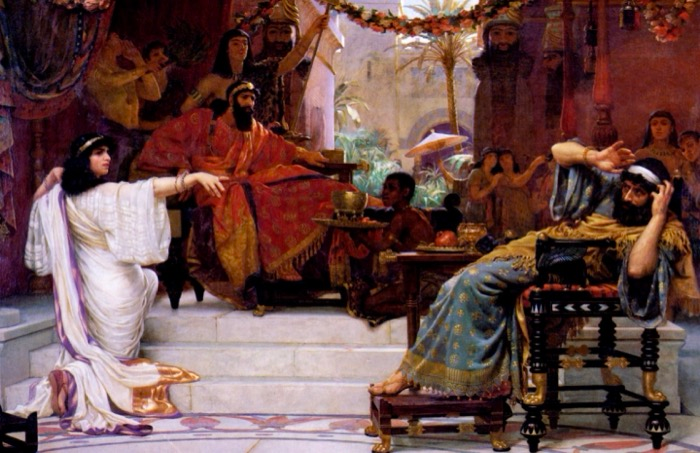
TOP PHOTO: Esther Denouncings Haman, 1888 Ernest Normand. (public domain via BiblePlaces.com)


