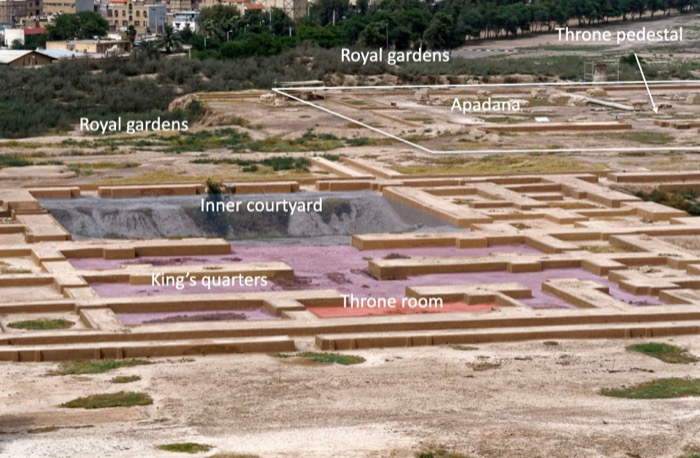
Summary: Archaeological finds from a royal palace at ancient Susa in Iran, give abundant support for the Bible’s Esther account.
“Go, gather all the Jews to be found in Susa, and hold a fast on my behalf, and do not eat or drink for three days, night or day. I and my young women will also fast as you do. Then I will go to the king, though it is against the law, and if I perish, I perish.” – Esther 4:16 (ESV)
A Passion to Document Biblical Sites and Artifacts
A favorite story of faith, courage, and God’s providence is found in the Bible’s book of Esther. But is there any solid evidence for the historical reality of this account? This week’s Thinker Update features excerpts from a podcast discussion between Tim Mahoney and archaeologist and Professor Dr. Todd Bolen. In this 2-part series, Dr. Bolen shares a surprisingly robust set of discoveries that align with this epic narrative. Let’s get right to the discussion.
TIM MAHONEY: Hello, Thinkers. Many of you are aware that our most recent Patterns of Evidence film is The Israel Dilemma: Part 1. In the film, we covered archeological evidence for the prophecies of Moses related to Israel’s future as a nation. In the persecution step of the pattern, and we briefly mentioned the story of Esther where the providential hand of God saved the Jewish people from a Persian official named Haman, who sought to eliminate the Jewish people throughout the empire.
Because we could only cover so much information in that film, we didn’t get into the elaborate story of Esther at all. And that’s why we’re excited to have our guest today, Dr. Todd Bolen, who’s extremely knowledgeable in these matters and he is going to give us a deep dive into the book of Esther, particularly the archeological remains that have been discovered at ancient Susa, where the events recorded in Esther took place. So welcome, Dr. Bolen. It’s so good to have you with us.
TODD BOLEN: Thank you. It’s good to be with you.
TIM MAHONEY: Tell us a bit about yourself. How did you become an archaeologist?
TODD BOLEN: When I went to college at the Master’s University in California, I had a chance to go study in Israel, and that really was a pivot for my life. I helped start an extension campus for the Masters University there, so I was living in Israel and having many opportunities to travel to sites throughout the Middle East, and began taking photographs. I never thought I’d have the chance to go to the place that we’re talking about today because it’s in Iran. And as everybody knows, the relationship between Iran and Israel is not real friendly, but the Lord in his providence made it possible. And I was able to visit and study and learn a lot about the setting of the book of Esther.
TIM MAHONEY: Some people might be aware of Todd’s work, BiblePlaces.com. I think that it is such an important site that you created. And like you said, there’s some Bible places that are difficult to get to, and God allowed you to get to Iran because significant parts of the Bible happened there. For background, tell us a little more about BiblePlaces.com because that is such a great resource.
TODD BOLEN: Sure. So I’m living in Israel. This was the year 2000 when the first photo collections came out. And the thought was simply, I’m living there traveling to these places again and again. Digital cameras had come out and so I could take vast quantities of pictures for free basically, and had the background with my study and teaching to know what was most important, have opportunities to go to those places and to create photo collections. So that’s what we’ve been doing. We have a lot of photographs that are in books and magazines and study Bibles and such, but really the heart of our work has always been to provide serious Bible students and teachers with large collections of photographs that illustrate the Bible.
So we started with a regional approach – we had a photo collection for Galilee. But more recently, we’re developing photo collections related to books of the Bible. So we have one for the book of Esther, and another for the book of Daniel, and all of the New Testament. So at our website there is kind of a hub to learn more about it, to take advantage of our resources.
The Jews in Persia
TIM MAHONEY: Let’s just talk about a couple Biblical characters in this area, because they weren’t in Israel. We think about them as being a part of the Bible, but what part of the world were Daniel and Esther in?
TODD BOLEN: So, with the destruction of Judah, the burning down of the Temple and the city of Jerusalem, the Israelites were taken into exile. They’re carried off by Babylon to Babylon. So that’s where we find Daniel. But then 70 years later, as the prophecy said, the kingdom of Babylon fell. Daniel was counting the days. I mean, he’s praising in Daniel 9, the time he thinks is coming to an end of the 70 years, and the Lord’s going to give him a new revelation of the seventy sevens. And that is related then to the collapse of Babylon and the coming of the Persian empire. So that’s where we find Esther. She’s living a little bit after the time of Daniel, now under Persian rule. And in fact, when she becomes the wife of the Persian king, she’s going to be brought to one of the capital cities, the city of Susa.

TIM MAHONEY: So Todd, the nations around the nation of Israel have a lot of Biblical narrative happening in them, don’t they?
TODD BOLEN: They do. I mean, Israel really is the center. That’s where God’s promises are made and where the people live, but yeah, the nations are having an impact. So we have the Assyrians coming from Mesopotamia, as well as the Babylonians, the Persians. But of course you have the Egyptians to the south and then the Hittites and other people groups up in the north in Turkey. And when the 10 tribes are carried off from the northern kingdom of Israel, and Judah’s carried off by the Babylonians in 586 BC, they’re carried off to these places, or some of them will actually run there themselves. Like remember in the book of Jeremiah when they flee down to Egypt. We have Jewish colonies in Egypt, we have Jewish colonies in Turkey, and of course lots of Jewish colonies in Babylon.
And these are going to be of interest for a bunch of reasons. One is that on the day of Pentecost in Jerusalem, shortly after the resurrection, you have a list of Jewish people there. It’s really an amazing list in Acts 2 of all these different places where Jewish people had been living and they came up to Jerusalem for the feast. And of course, then that’s going to motivate Paul for the missionary journeys. He’s going to be traveling to share the good news of the Jewish Messiah to Jewish people in their synagogues. And of course, Paul’s going to what’s today the countries of Turkey and Greece and beyond. But yeah, there’s a whole lot of important Biblical events and people going on in these lands around Israel.
TIM MAHONEY: I never connected those dots before. The fact that in what would be modern-day Iran, and in Turkey, and in other countries, there were Jewish diaspora from the time when they were scattered that didn’t return. When the story in Acts about the outpouring of the Holy Spirit comes, that’s the reason there were so many different people there. And then they heard their message in their own language. What area today would the Persians have been in?
TODD BOLEN: So the Persians are in what’s Iran today, although the city of Susa, here’s just a curious little thing since we’re talking about Esther and the city of Susa, it’s not actually in the Persian homeland, although it became one of the Persian capitals, it’s on the Mesopotamian plain.

TIM MAHONEY: Who was the Persian king that chose Esther as his wife and queen?
TODD BOLEN: So he has a Persian name, which comes into Greek as Xerxes. Probably a lot of our listeners are familiar with him in Greek history because Xerxes fought a famous battle against the Greeks. But in the Hebrew it’s rendered “Ahasuerus.” The King James, and translations based on the King James, they use the name Ahasuerus. But the key is that it’s the same guy. And I use him interchangeably, Ahasuerus or Xerxes, but that’s the man who’s going to marry Esther.
The Hand of God in the Book of Esther
TIM MAHONEY: To me, the events in Esther fulfill one of the prophetic words of Moses, that when they’re in exile they will be persecuted. They were planning on just eliminating the entire Jewish population for this demonic idea that they should kill them all. Some people might not know the overall story, but Haman hates the Jewish people and he wants them to be executed. He convinces the king, how did he do that?
TODD BOLEN: There’s two stories that are kind of similar. Daniel and Esther both were living in exile and they both had close proximity to the king. And in both cases we have an advisor, or advisors, kind of using the king to accomplish their own purposes. So yeah, that’s what Haman is doing there, Haman has an agenda. And one of the things in the background is that there’s this Jewish man, Mordecai [Esther’s guardian uncle], who won’t bow down and give Haman the great glory that he “deserves.” And so this is just one of those things under Haman’s skin.
And so Haman persuades King Xerxes, “Hey, what do you have to lose? You’re going to get all this money because I’ll put a vast amount of money into your treasury.” And the King’s like, “Well, fine.” Of course, he doesn’t know. This is crucial to the story, because Mordecai has told Esther, “Don’t reveal your identity. Don’t tell him you’re Jewish.” So the King issues a decree, “Slaughter all the Jewish people,” not knowing that his own wife is Jewish. And so that’s going to come out later at a critical juncture, to the audience’s delight, when we see how God brings that together to expose Haman for the manipulator, schemer, scoundrel that he is, and bring great deliverance to God’s people.

TIM MAHONEY: What time in history did this happen?
TODD BOLEN: Early 5th century BC. Here’s where that kind of fits into the rest of the historical narrative. It’s right in between Ezra chapter 6 and Ezra chapter 7. which is kind of interesting, but there’s a big break of 60 years between those two chapters. When Zerubbable’s building the temple, 60-year break, and then Ezra comes on the scene, Ezra chapter 7. So in that interim, there’s this grave threat to the Jewish people, but God’s on it. It’s really such a marvelous thing, how some Jewish girl ended up on the throne as the queen where she could have the ability to walk in and ask him, that’s just like, you can say it’s unbelievable, but it’s our God. So it happened, but we have this really interesting story there at the beginning of Esther where the queen, Vashti gets fired. And I mean, how often does that happen?
But the Lord’s sovereign over that. And when King Xerxes summons Vashti into his presence wearing her crown and she refuses, that’s going to be the impetus for the king to say, “I’m replacing you. Find me a new wife.” And that’s how you get Esther there just at the right time, in the right place for God to bring about not a miraculous, there’s no miracles per se, but a providential circumstance, right? A providential deliverance of God’s people working through seemingly natural events done by normal people as it were to bring a great salvation to the Jews.
Excavations at Susa
TIM MAHONEY: If we look at the excavation work done at the site of the city of Susa. Who did this archeology and how large is the site? Because I understand it’s a big one.
TODD BOLEN: It is. I think a lot of people in our circles and the American church don’t know much about the archeology of the Book of Esther. One big reason is the Iranian Revolution in 1979 with Ayatollah Khomeini putting the American prisoners there in the embassy. And so it’s been off limits. And the neat thing was I had the opportunity to visit Iran and explore Susa and see what the French had done. So this might be another reason why it’s less known. One is we can’t visit there for the last, whatever, 40 years now, but another is the archeologists were French. And so they’re publishing their work in the French language, and they were not like on a Biblical mission. And so it’s not getting as much attention maybe by believers in the United States. The French could spend a hundred years there and they did. I think it was just under 100 years the French were excavating until the Iranian Revolution, that’s what ended it.

TIM MAHONEY: For a hundred years, they were uncovering treasures of that kingdom. And I think that they were taking them off to the Louvre and other places. So they built a fortress, right? They were there for a long time.
TODD BOLEN: They were. So when you think about archeological projects, a lot of times we’ll stay in a nearby kibbutz if it’s in Israel, or a hotel. Or sometimes maybe they’ll build, like the Americans did at Meggido, they’ll build little houses there on the premises. But the French, you’re right, they built this castle. I took advantage of that when I was there because I was able to get up on the parapet and you have a nice view looking down. And so to see the ruins there from that kind of bird’s eye view. That’s one thing that is unique about Susa, they built that fortress. One, they’re there so long. And two, the people there were sometimes hostile, so they wanted to have that protection.

TODD BOLEN: And the site’s huge. I mean, it’s bigger than, name your ancient tell in Israel. It’s bigger than every one of them. I mean, it’s bigger than Jerusalem, bigger than Ashkelon, bigger than Hazor – that’s the largest one in Israel, 200 acres. The site of Susa is 750 acres. So just an enormous site, and that means they’re going to be digging in different areas of the site over those decades, finding things.

TODD BOLEN: So you mentioned the Louvre, and I know people have mixed feelings about this today, about how archeologists will go and excavate in one country, and then they’ll bring some of the discoveries into another museum like the British Museum, or in this case, the Louvre. For Westerners who can’t go to Iran, and they have great stuff in the Iranian museums from Susa and other places, both on site at the Susa Museum, also in the museum in Tehran, really phenomenal. But there’s a lot of great things in Paris. So we can go to the Louvre today and see a lot of the discoveries that they made in Susa and get a really good visual of the extraordinary decorations of the palace built by Xerxes’ father, Darius.
Archaeology in Line With the Esther Account
TIM MAHONEY: How does any of that archaeology relate to the story of Esther then?
TODD BOLEN: So the city, like I said, is huge, but the royal compound, that’s a much smaller area. And so part of their work was focused on that. For me as a student of the Bible, that’s where I am most interested. In this area of the Royal Palace, there’s the King’s Gate, there is the reception hall – that’s phenomenal with these massive columns and Nehemiah was there. So I don’t know if we’ve mentioned Nehemiah, but the cup bearer of Xerxes’ son Artaxerxes in the book of Nehemiah, yeah, he’s in the same place. He’s in the city of Susa where he’s going to ask to be able to go back and rebuild Jerusalem. The other main feature of this royal compound is the palace itself. And so that is for me, it’s exciting because I’m thinking about Xerxes living there. I’m thinking about Esther in the women’s quarters.

TODD BOLEN: She’s brought there. She’s living there. And then as the queen, I’m thinking about her approaching the throne. That’s at the dramatic moment where she, we’re all waiting to know, is the king going to hold out as scepter or not? And so yeah, the archaeology has found the palace where this all took place. And I don’t know that there’s any real debate about this. I mean, you know that in different eras and different events, somebody has this view, and somebody has a contrary view or whatever, I don’t know that there’s a contrary view in this. I think the evidence is pretty clear that we have no doubt this is the palace. It’s the palace of Esther’s husband and the rooms all match. We have Haman mentioned as being in the outer courtyard. They found it. We have the outer courtyard, and it’s huge and it was decorated with these beautiful reliefs.
And we have the middle courtyard. That’s not mentioned in the Bible directly, but it’s typical of a palace of that style. And then we have the inner courtyard, which is mentioned, and Esther’s going to pass through that who knows how many times, but of course the dramatic time is on her way to ask for the king’s favor. She’s going to ask him to come to her banquet.
Conclusion
This is where we will have to end today. You can catch the full discussion at your favorite podcast platform. Stay tuned for next week’s conclusion which will cover the exciting details of what’s been found in ancient Persia. Until then, keep thinking!
TOP PHOTO: The ancient remains of the Persian royal palace at Susa (Apadana = Great Hall). (© BiblePlaces.com)


