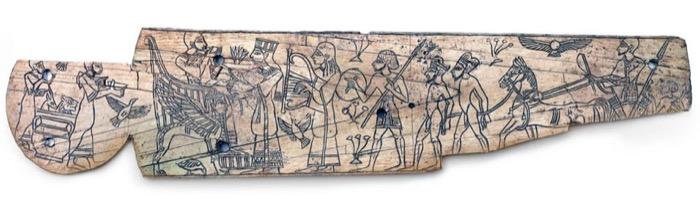
Summary: Analysis of 1,500 artifacts from ancient Canaan and Israel reveals an ivory trade network matching Biblical descriptions.
Now the rest of the acts of Ahab and all that he did, and the ivory house that he built and all the cities that he built, are they not written in the Book of the Chronicles of the Kings of Israel? – 1 Kings 22:39 (ESV)
Ivory in Israel
Ivory was a luxury item in Israel during Biblical times, reserved for kings and the elite. In the 8th century BC, the prophet Amos chastised the pride of those living lives of luxury and extravagance in Zion (Judah) and Samaria (the northern kingdom of Israel) while not being grieved over the ruinous moral state in the land. Ivory is one of the lavish items mentioned in his rebuke.
“Woe to those who are at ease in Zion,
and to those who feel secure on the mountain of Samaria …
“Woe to those who lie on beds of ivory
and stretch themselves out on their couches,
and eat lambs from the flockand calves from the midst of the stall,” – Amos 6:1, 4
But where did Israel’s ivory come from? In a recent study, ivory artifacts were analyzed from across Israel over a period of a thousand years. The surprising results showed that despite political upheavals in all areas involved, ivory was exclusively imported from sub-Saharan Africa throughout the period, and not from potential Asian sources.
This situation just happens to match the Bible’s descriptions of a trade route reaching south of Israel during that time.

Results of the Ivory Study
Based on archaeological finds, for most of the period being studied, ivory was mostly seen in royal and ritual contexts, being used in luxury items such as cosmetic boxes, combs, and votive (religious) objects. Over time, ivory became more common in everyday objects, such as spindles, knife handles, and buttons. At the end of the period, in important political centers during the second half of the Iron Age, numerous pieces of furniture have been found decorated with inlays of elaborate ivory carvings. This was the very period when Amos was criticizing those who laid on beds and couches inlaid with ivory.
The in-depth study published in the Journal of Archaeological Science was led by Dr. Harel Shochat from the school of Archaeology and Maritime Cultures at Haifa University. He and his team evaluated over 1,500 ivory-related artifacts excavated from 46 sites in the land of Israel during a thousand year period from about 1,600 – 600 BC.
While items made of ivory had previously been studied regarding their artistry and style, scientific analysis has been lacking. Molecular investigation of the collagen via proteomic (protein structure) analysis determined what species were involved – elephant or hippo tusks, and Asian varieties vs. African. Then isotopic analysis was used to match the carbon and nitrogen patterns in the teeth and bones with soils in different geographic regions that are picked up and stored by animals’ diets.

According to the study, possible sources for Israel’s ivory included hippos from the area that inhabited various inland aquatic ecosystems in Canaan until about the 10th century BC, boar tusks (for smaller items) that were, and still are, indigenous to parts of the region, and elephants. Although elephants were present in the area in the distant past, they were extinct by the time period under investigation, but some scholars believe a type of Asian elephant may still have been roaming parts of Syria and eastern Anatolia (modern Turkey) at the time. While these conceivably could have been a source of Israel’s elephant ivory, the main potential sources would have been Asian elephant tusks imported from India where they were common, and African tusks. Either of these main sources would have required long distance trade.
The study found that about 85% of the ivory items were made of elephant tusks, 15% were from hippos, and three items were made from boar tusks. A further result was that all the elephant ivory studied belonged to African elephants (not Asian). The isotopic composition of the ivory matched the sub-Saharan woodland-savanna of the White Nile basin (south of Khartoum in modern Sudan), which was part of ancient Nubia located south of Egypt.

The scholars were surprised to see that the southern flow of ivory did not change over time, despite the numerous changes in the political landscape of the area; especially the end of unified power in Egypt after the collapse of the New Kingdom. The consistent source of ivory being sub-Saharan Africa remained over the entire period. The previously held consensus view was that when Egyptian influence faded and the eastern power of Assyria began to dominate the region, ivory imports likely began coming from Asia in the east rather than Africa to the south. Now that thinking must change.
“The persistence of ivory sourced from this region …suggests that Nubians actively asserted their monopoly over the procurement and distribution of lucrative ivory independent of Egyptian control and prestige economies,” the study states.
The authors of the study shared that ivory objects in the land of Canaan/Israel (southern Levant) were largely absent in previous periods but then appeared at the beginning of the Late Bronze Age (mid 1500s BC by standard dating). Most of the items sampled were from the middle and later portions of the thousand-year span of the study. It should be noted that the majority-view among scholars is for an Exodus event happening at the time of Pharaoh Ramesses II and Joshua’s conquest of Canaan following that (though most doubt the Bible’s version of the account) – meaning the Israelites entering Canaan around 1,200 BC by conventional dating. However, Biblical dating information points to the Exodus and Conquest occurring a couple centuries prior to 1,200 BC.
Add to that the possibility of a 2-3 century timeshift needed for the the Egyptian and Canaanite timelines (as seen in the Patterns of Evidence: the Exodus film) and it can be seen that many items labeled as “Canaanite” by scholars, especially with conventional dates of 1600-1200 BC, may actually be “Israelite” remains.

(public domain – Israel Museum, CC0, via wikimedia commons)
Solomon’s Great Wealth and the Southern Trade Route
One place the Bible mentions ivory’s prominence is with the great wealth of King Solomon and the means by which the precious materials came to him.
The king also made a great ivory throne and overlaid it with the finest gold… For the king had a fleet of ships of Tarshish at sea with the fleet of Hiram. Once every three years the fleet of ships of Tarshish used to come bringing gold, silver, ivory, apes, and peacocks. – 1 Kings 10:18, 22
Solomon’s fleet of ships is portrayed as using a trade network reaching south of Israel from a port at Ezion-Geber (near modern Eilat), which was located on the Red Sea’s Gulf of Aqaba.
King Solomon built a fleet of ships at Ezion-geber, which is near Eloth on the shore of the Red Sea, in the land of Edom. And Hiram sent with the fleet his servants, seamen who were familiar with the sea, together with the servants of Solomon. – 1 Kings 9:26-27
This same international trade network would have linked Israel with the Nubian traders of African ivory, as well as spread Solomon’s fame to the southern Arabian Peninsula and the queen of the land of Sheba, which most scholars connect with the modern land of Yemen.
Now when the queen of Sheba heard of the fame of Solomon, she came to Jerusalem to test him with hard questions, having a very great retinue and camels bearing spices and very much gold and precious stones. And when she came to Solomon, she told him all that was on her mind. – 2 Chronicles 9:1
Jesus confirmed that Sheba lay to the south.
The queen of the South will rise up at the judgment with this generation and condemn it, for she came from the ends of the earth to hear the wisdom of Solomon, and behold, something greater than Solomon is here. – Matthew 12:42

Another Biblical confirmation of the prominence of this trade route to the south, rather than the east, is Solomon’s trade of horses from Egypt. Chariots and horses were brought to Israel from Egypt and then distributed to the northern lands of Syria and the Hittites north of Israel, even though those lands were much closer to Mesopotamian sources to the east.
And Solomon had horses brought out of Egypt, and linen yarn: the king’s merchants received the linen yarn at a price. And they fetched up, and brought forth out of Egypt a chariot for six hundred shekels of silver, and an horse for an hundred and fifty: and so brought they out horses for all the kings of the Hittites, and for the kings of Syria, by their means. – 2 Chronicles 1:16-17 (KJV)
The study’s results along with these Biblical records also support the idea that the flow of goods, people, and ideas from Mesopotamia that birthed Dynastic Egypt came primarily from the south via the Red Sea rather than across land from the east. This waterway trade network apparently persisted through the three Kingdom periods of Egypt (Old, Middle, and New) and the intermediate periods that followed, and through changes in Israel during the Judges and monarchy periods of Israel and Judah. The Nubian ivory traders maintained their control despite varying political realities in both regions.
Evidence for abundant international trade during the kingdoms of Israel and Judah, counters many scholars’ beliefs that the Bible exaggerates the extent of their wealth, power, and reach during this period.
The authors of the study noted a dearth of ivory remains from around 600-500 BC. This may reflect the kingdom under duress as the Babylonians repeatedly invaded Judah, finally conquering it in 586 BC. Ivory usage would increase again under Persian control in the 5th century BC.
Conclusion
The study of ivory artifacts from ancient Israel originating in sub-Saharan Africa confirms the prominence of the southern trade network portrayed in the Bible as the source of luxury goods for kings such as Solomon and Ahab, and facilitating the visit from the Queen of Sheba to Jerusalem. Even in very specific questions that may seem like minutia, archaeological study continues to verify details found in the Bible, regardless of academic paradigms that may claim otherwise. Keep Thinking!
TOP PHOTO: Ivory piece from Megiddo by an unknown engraver, traditionally dated to 1350-1150 BC. (public domain via wikimedia commons)


.jpg)

.jpg)

