Summary: The second of a 2-part series, where the connection between Egypt and Mesopotamia is seen in mysterious ships etched into desert rocks.
The sons of Ham: Cush, Egypt, Put, and Canaan. – Genesis 10:6 (ESV)
The Birth of Egypt’s Dynastic Civilization
What were the origins of the first pharaohs? Last week we saw the DNA analysis of an Egyptian man living early in the Dynastic period showing that 20% of his heritage was Mesopotamian (the land of the Tigris and Euphrates rivers mostly in modern Iraq that witnessed the birth of the world’s first great civilization of Sumer). The man from Nuwayrat was likely a potter who was himself buried in a large ceramic pot. For more details on the study, refer to Part 1 of this article.
This was seen by the authors of the study as more evidence of the exchanges between the two cultures that led to the rise of Egypt. However, Egyptologist David Rohl embraces a different idea – that the genesis of Egypt’s dynastic civilization was instituted by a long sea voyage conducted by the descendants of Ham, the son of Noah. This voyage was not a trading venture, but a full-scale invasion of Egypt.
This legendary journey took place before the pyramids were built, and before the unification of Egypt under King Narmer. Clues to its reality come from the middle of a desert where early Egyptologists discovered unusual rock art of ships. Many of these depictions had been lost. It was the quest to rediscover these ancient rock drawings that drew David Rohl to launch several expeditions into the desert in the late 1990s to rediscover the evidence for one of history’s great mysteries.
Ships in the Desert
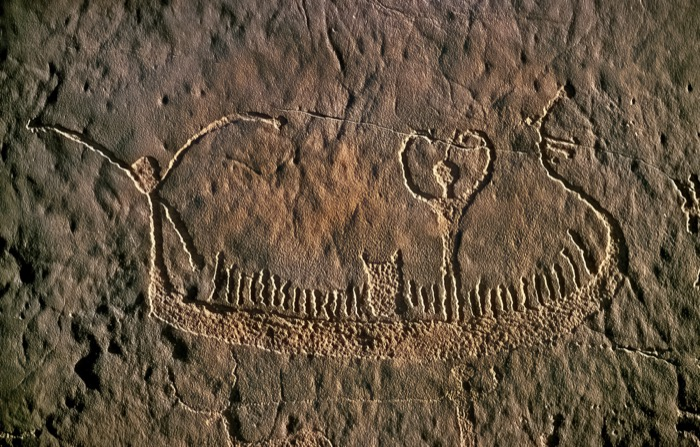
Archaeologist Arthur Weigall in the early 1900s, and German ethnographer and explorer Hans Winkler in the 1930s, had recorded many examples of art scrawled onto the rock faces of Egypt’s large Eastern Desert, which lies between the Nile Valley and the Red Sea. Included in their discoveries were depictions of ships that were not typical boats of the Nile familiar from Egyptian art, but long flat-bottomed boats with very high prows and sterns. They were called ‘square boats’ because of their distinctive shape.
One of the most prolific spots where these designs were found was what Winkler labeled ‘Site 26’ in a place dubbed the valley of the boats. However, the location of the finds had been subsequently lost, with only brief descriptions and a few photos and sketches by the early scholars remaining.
David Rohl tells the story of original discovery of these ships in the desert and his eventual rediscovery of ‘Site 26’ in his 1998 book Legend – The Genesis of Civilization
(Arrow Books). David has identified himself as an agnostic who is not convinced that the Bible is the word of God, but he believes it contains significant truth in the historical accounts it records. He notes that in the past, scholars who studied Sumer used archaeological and literary evidence from their own discipline in an attempt to throw new light on the early Biblical tradition. But he asks what if we try to work things the other way around? What if the book of Genesis can provide some of the answers archaeologists seek in their quest to understand the origins of civilization, including the Sumerians and Egyptians?

After two failed attempts amid the maze of canyons and desert dunes in 1997, David and his team’s third attempt succeeded in reaching Winkler’s Site 26 more than 60 miles east of Luxor in February of 1998.
It quickly became clear that this was a site of major archaeological importance. The valley of the boats revealed numerous depictions of god-like figures carried in high-prowed ships with high plumes on their heads and armed with pear-shaped maces. Many of the ships had dancing ‘goddess’ figures on the deck with hands raised in praise. Importantly, on the prow of one ship stood a Horus falcon, one of the clearest emblems of the earliest pharaohs.
One of the most shocking things depicted in some of the scenes are rows of men grasping a rope tied to the prow of the vessel, pulling it across the desert landscape. Apparently this invasion fleet had pulled their archetypal Sumerian ships, made of bundled reeds and covered in pitch, across nearly 150 miles of desert valleys from the Red Sea to reach the Nile River. Some of the boat scenes show crews of up to 60 or 70 oarsmen.

Scholars had long believed that the Sumerians took long trading voyages in these types of ships from the Persian Gulf to the Indus River Valley or around the Arabian Peninsula to reach Africa. Early interpretations of the Eastern Desert ships were that they showed an invasion force, which seemed to be supported by other archaeological evidence in the Nile Valley (see the next section). If the event took place at the peak of the Nile’s annual inundation it would have shaved many miles off the trek.
The invasion-after-a-sea-voyage interpretation also aligned with several ancient sources. For instance one entry on the Sumerian king’s list from this period says He – ‘ journeyed across the sea and came ashore in a mountainous land.’ In the First Century Jewish historian Flavius Josephus’ account of Nimrod’s Tower of Babel and the subsequent confusion of tongues, he goes on to explain that the posterity of Noah (including Ham’s sons and their followers) journeyed to their new homes across the sea.
After this they (Noah’s descendants) were dispersed abroad, on account of their languages, and went out by colonies everywhere … some also passed over the sea in ships and inhabited the islands: and some of those nations still retain the names which were given them by their first founders. (Jewish Antiquities, Book I, Chapter 5 (120-121))
Dynastic Egypt Bursts Onto the Scene
The idea that the followers of Horus who manned the desert ships represented a foreign invasion by elite forces with a Sumerian culture was not first proposed by David Rohl. David lays out how this proposal was put forward by early Egyptologists such as Sir Flinders Petrie (the father of Egyptian archaeology) based on many finds made along the Nile River.
Petrie in 1895 uncovered a cemetery near the village of Nakada, 16 miles north of Luxor. Thousands of low burial mounds covered the site that were found to come from two periods at the dawn of what scholars call the ‘Predynastic Period,’ just before the 1st Dynasty. The earlier period (‘Nakada I’) contained simple grave items associated with earlier times and no writing. Those from the later period (‘Nakada II’) showed a stark contrast with more elaborate tombs made of mudbrick, high quality articles – some in the form of lapis lazuli, the exotic blue stone that was prized in Sumer and imported from the Indus Valley via Dilman (Bahrain), and a new type of weapon, the ‘pear-shaped mace,” also seen in the squareboat rock art.
A new type of pottery was also seen in the Nakada II graves that matched styles from the Sumerian civilization and was painted with Sumerian-styled motifs, along with designs of boats matching the square boats seen in the rock art of the Eastern Desert. The archaeological evidence convinced him that while things like basic agriculture may have had a long history of development due to exchange between the two cultures, the birth of Dynastic Egypt was something far different.
The next more recent layer yielded evidence for the cylinder seal, the first hieroglyphic writing, and unique brick architecture, all known to have originated in Sumer. The rapid transition to the new culture that occurred between Nakada I and II is conventionally dated to a few centuries older than 3,000 BC based on radiocarbon dating (14C) results. However David Rohl puts the date closer to 2900 BC.
We reached out to David for his response to these matters. He voiced his skepticism of the radiometric numbers where scholars do not use the raw results of the tests, but rather numbers that have had a “calibration curve” applied to them, which is now the standard for all published results. The calibration curve is based on a number of factors that have been questioned by many archaeologists.
“I do not rely on calibrated radiocarbon dating for this period as it has been shown to be considerably older than the historical dating [which Rohl favors]. However, the archaeological context puts the Nuwayrat man in the late predynastic to very early dynastic era, which is when we see clear evidence of Mesopotamian contact in the Nile Valley. This was not long after the Eastern Desert rock carvings of the high-prowed boats between the Red Sea and the Nile.
“Complex agricultural systems on a large scale seem to have originated in Mesopotamia. Writing also appears in Mesopotamia before it does in Egypt, no matter what the Egyptologists have to say in recent years. The first Egyptian hieroglyphs from Abydos have been dated via radiocarbon dating, which I have already argued is older than the previous historical dating, whereas Mesopotamian dating primarily continues to be based on our original historical dating. The relative dating between Mesopotamia and Egypt shows that the former used writing for record-keeping before Egypt and that the concept of writing was likely introduced into Egypt by the Mesopotamians.”

Other connections to the Predynastic boat people come from two important artifacts. The first is the Gebel el-Arak Knife from the same era as the Nakad I to II transition. One side of the knife handle shows battle scenes where men with pear-shaped maces are overcoming their foes and two square boats overpowering a fleet of smaller boats of the typical Nile type at the bottom. The flip side shows a hero in Sumerian-style attire overpowering a pair of lions, which David connects to the common Mesopotamian motif of ‘Master of Animals’ which in turn may be linked to the Bible’s Nimrod who is said to be a great hunter in Genesis 10:9.
“This suggests something more than just trade, with Mesopotamians arriving in the Nile Valley as a military force at some point. Then we have niched-facade architecture appearing in Egypt in the 1st Dynasty, with precursors of this unique architectural feature existing in Mesopotamia at Uruk and Eridu. Furthermore, recent evidence of Mesopotamian cone mosaic architectural decoration – as featured in the temple of Inanna in Uruk – has been unearthed in the Egyptian delta at a predynastic site. Such a unique form of decoration could hardly have been invented in two widely separated places at the same time. Logic requires us to believe that this technique was invented in Mesopotamia and introduced into Egypt by Mesopotamian settlers.
“This is all direct evidence of contact between the two nascent civilisations … but with the contact happening in only one direction – from southern Mesopotamia to (initially) southern Egypt via the Eastern Desert, the high-prowed ships having sailed around the Arabian Peninsula and into the Red Sea, before crossing the desert into the Nile Valley of southern Egypt. The new DNA evidence is now confirming that initial contact and Mesopotamian settlement in predynastic Egypt through modern science.”

The second important artifact is the famous Narmer Palette from the founder of Egypt’s First Dynasty, perhaps a few generations after the initial invasion. It displays Narmer with a pear-shaped mace amid other Mesopotamian motifs. Above lines of vanquished foes, a high-prowed boat identical to the reed craft illustrated in the Eastern Desert rock art is seen (on the upper right of the back side).
One objection to the invasion model is that there is no account indicating such an event found in Egyptian literature. But David spends three chapters showing how many mythological gods of Egypt have strong connections to Mesopotamian counterparts. He also points out that the high-prowed ships closely resemble the solar barques painted on the walls of pharaoh’s tombs, which were vessels believed to carry them on their journey into the afterlife. The destination of this resurrection journey was believed to be the sacred Isle of the Flame on the eastern horizon. David thinks this mythical journey may be a return to the homeland of the squareboat tribes in the Persian Gulf, and to the sacred island of Bahrain (the center of ancient Dilmun) where more than 350,000 ancient burial mounds have been discovered.

While some may be skeptical of dragging ships such distances, from Egyptian recorded history we hear of the resourceful transportation of boats by the army of Thutmose III from the Mediterranean across a hundred miles of land in Syria to reach the Euphrates River so they could raid the kingdom of Mitanni on the far shore.
The Land of Punt and the Phoenicians
Egypt may not have been the only land to have its history shaped by seafarers from the Red Sea. The Bible lists the four sons of Ham as Cush, Egypt (Mizraim), Put, and Canaan (Gen. 10:6). Cush is thought to have settled in the lands south of Egypt in Sudan and Ethiopia. This would have been along the trade routes followed by the high-prowed square ships. But what about the other two clans of Put and Canaan?
Throughout their history Egyptians referred to a mysterious far off land called Punt. They also called it God’s land, where exotic produce needed for temple worship and the ceremonies connected to kingship were procured. Egyptian texts and reliefs illustrate items from Punt – frankincense, myrrh, ebony, gum resin, elephant ivory, monkeys, baboons, and panther and cheetah skins. Evidence points to Punt being the horn of Africa and southern Arabia at the south end of the Red Sea.

David Rohl explains that since “t” endings in Egyptian were left unpronounced unless followed by a vowel, Punt would have been vocalized something like “Pun” or “Poen.” During the Punic Wars between Phoenician Carthage and Rome, the Phoenician people were also referred to as the Pun or Poen (‘Poen’ linking to ‘Phoen,’ mirroring the first part of the name ‘Phoenician’).
The idea that the Phoenicians came from the Red Sea and far-off Bahrain in the Persian Gulf to found cities in Canaan on the Eastern Mediterranean coast was attested by the classical writers Justin, Pliny, Ptolemy, and Strabo – and it is story also told in Lebanese Christian communities today about their Phoenician ancestors. The ancients’ concept of the Red Sea was much broader than today. It was the south sea that encompassed what we know of as the Red Sea as well as the Persian Gulf and the Indian Ocean.
If this is true, it means the descendants of Canaan did not arrive there by gradually filtering across Syria, but rather through an epic sea journey around Arabia to Egypt and then north via the Nile River into the Mediterranean Sea. Josephus wrote that the other clan of Put (or Phut) was the founder of Libya.
The Bible’s Table of Nations records two sons of Canaan who match two Phoenician cities.
Canaan fathered Sidon his firstborn and Heth, and the Jebusites, the Amorites, the Girgashites, the Hivites, the Arkites, the Sinites, the Arvadites, the Zemarites, and the Hamathites… – Genesis 10:15-18
The city of Arvad (Arwad) was one of the major Phoenician cities located on an island just off the coast near Tartus. Two of the islands of Bahrain were originally called Aradus and Tylos (or Tyros), forms of the same names as the two greatest Phoenician island cities – Arvad and Tyre.
In 1939 Flinders Petrie was also convinced that the invaders who arrived in Egypt prior to the founding of the 1st Dynasty were the same as the Pun (Puntites), one branch of which went on to become the founders of Phoenicia.
Others went on to Syria and founded Tyre, Sidon, and Aradus, named after their home islands in the Persian Gulf. (Flinders Petrie in Rice, M. – 1994: The Archaeology of the Arabian Gulf c. 5000-323 BC (London))
The Phoenicians were recognized as the master sea traders of the ancient world. Archaeological evidence shows this sea trade going back to the Egyptian Old Kingdom when excavations have demonstrated a close trading and political relationship between Egypt and the Lebanese seaport of Byblos.
In Byblos, the archaeology shows a new people arriving with new technology such as metal-working and the potter’s wheel – and they buried their dead in large storage jars (bringing to mind the Nuwaret man from the DNA study). When did these new people arrive in Byblos? Around the conventional date of 3,000 BC – precisely the time when the foreign elite first appear in the archaeological record of Egypt.
David also points out that Solomon used Phoenician sailors sent by Hiram of Tyre to help navigate to the distant land of Ophir (possibly India) from his port on the Gulf of Aqaba (1 Kings 9:26-28). This may have not only been because they were practiced sailors but because they were familiar with the currents and treacherous coral reefs of the Red Sea, having sailed them for centuries prior to Solomon’s reign.

Large Catastrophic Events
There is a strong tendency for modern historians to downplay the scale of catastrophic events in the past. Like the idea for the long development Sumerian technology in Egypt by native Egyptians, they view changes in the past as gradual and not as turbulent as the Bible and other historical records paint them. One can think of many examples from Biblical history, but David Rohl in his book zeroed in on one specific category of this tendency – conquests.
By the 1970s the trend was to dismiss or downgrade conquests and invasions of the dim and distant past, many of the best-known ancient historical ‘events’ were either watered down or completely denied. The Hyksos conquest of Egypt, described by Manetho as a traumatic episode in his country’s history, became a gradual and peaceful infiltration of foreigners into the eastern Delta; the Dorian invasion of Greece was never as dramatic and far-reaching as we had been led to believe by the ancient writings; …the conquest of the Promised Land by the Israelites – as narrated in the Book of Joshua – never really happened.
So, the modern approach is to downplay unpalatable conflicts – especially victories by ‘barbarians’ over ‘civilized’ nations – and to reject what might be called the traditional histories of such events in favor of archaeological evidence – or rather the absence of such evidence. But archeology rarely reveals direct evidence of conflict and invasion… By their very nature battles are ephemeral. They occur suddenly with great violence, but the scar of the conflict is soon healed by nature, leaving only human memory to carry the wounds. (Legend: The Genesis of Civilization, p. 336-37)
Conclusion
When considering what caused Egypt’s dynastic culture to burst forth, the new DNA study of the Nuwayrat man and the ships in the desert appear to match ancient accounts and the archaeological evidence to vindicate David Rohl’s ideas, which largely follow the conclusions of early Egyptologists. The spread of nations after the Tower of Babel appears to have been far more adventurous and mysterious than many have envisioned, and leads us to keep thinking.
TOP PHOTO: A typical high-prowed square boat design seen in the rock art of Egypt’s Eastern Desert. (© David Rohl, used with permission)


