Summary: Part 2 of a 3-part series where Tim Mahoney interviews Dr. Rob Carter about genetic evidence for the creation account in Genesis.
These are the generations of the heavens and the earth when they were created, in the day that the Lord God made the earth and the heavens. – Genesis 2:4 (ESV)
Genetic Evidence for Adam and Eve
In last week’s article, which you can find here if you missed it, Dr. Rob Carter finished with the point that the modern mutation rate in genes points to everyone having a single female ancestor who lived only a few thousand years ago. However, evolutionists give a date for an Eve-like figure at 200-300,000 years ago by using a ridiculously low mutation rate that is nowhere seen in the evidence. “But they have to do that because they can’t have a Biblical Eve.” We pick up the conversion from there.
Dr. Rob Carter:
The same is true for Adam. There is one Y chromosome in every single man on the planet. In fact, scientists just fully sequenced the chimpanzee Y chromosome last summer. There’s like a 30% similarity between a chimpanzee Y chromosome and the human Y chromosome. So, they’re completely different from one another. Yet, all men in the world have a Y chromosome that is very similar. If you look at the number of differences between men to figure out the mutation rate from father to son, Adam ends up being only a few thousand years ago.
Timothy Mahoney:
What you’re saying is that through genetics you’re able to see that there is a link all the way back to one female and to one male, and these genetic links aren’t anywhere close to chimpanzees or some type of an ape?
Dr. Rob Carter:
Yes, and when we try to put a timeframe on them, there are thousands, not tens and not hundreds of thousands of years ago. Consider the fact that the Bible demands an Adam and Eve and genetics tells us there was an Adam and Eve. There’s only one Y chromosome and one mitochondrial lineage. That is a very Biblical proposition.
The Evolution Model
Timothy Mahoney:
So the evolutionary storyline is more fantasy than reality. Is this accepted, that basically all humans have come from these two?
Dr. Rob Carter:
Yes, but the evolutionary model doesn’t have Adam and Eve as a couple. They say, in Africa hundreds of thousands years ago, our population got very small and nearly went extinct. In small populations you have a lot of inbreeding, and in the inbred population, the branches of the family tree tend to get pruned. Diversity is lost, and given enough time, a very long time in a small population, eventually only one Y chromosome survives. All the others get lost. So, in the evolutionary model, Adam isn’t the founder of the human race. He’s just a person who’s alive in a small population and through dumb luck, his Y chromosome happens to be the only one passed on.
Timothy Mahoney:
So the evolutionary explanation is that this struggle to become human took a very, very long time and by dumb luck, this Y chromosome made its way through the channel that became the Y chromosome found today. Similar to the dumb luck that this planet, which is incredibly refined, just happened to evolve into all the complex species, including humans with emotions and feelings, art and beauty, and love. It just all happened. So when were these findings introduced, that the genetics of all people go back to one man and one woman?
Dr. Rob Carter:
It was 1987 when Cann, Wilson and Stoneking wrote their first paper on mitochondrial genetics. They concluded that we came out of Africa, and in order to do that, we had to have a bottleneck. The “out of Africa theory” was already believed by a lot of people, but this actually gave them genetic evidence for it.

The Biblical Model
Timothy Mahoney:
Explain what you think really happened.
Dr. Rob Carter:
The Biblical account is clear. We started from a couple named Adam and Eve. The population grew for about 1,600 to 1,700 years to some unknown number. The Bible says the Earth was full of violence; I assume a lot of murder, a lot of death. God got frustrated with the world. Apparently, a man named Noah was the only righteous person left. God told him to build a big ship. Then God sent a great flood that destroyed every single person and all the land-based animals that weren’t on the ark. After the flood, the people and the animals from the ark repopulated the world. There were only eight people: Noah, his wife, their three sons, and their three daughters-in-law.
Adam, Eve, and Noah’s flood are statements on genetics because they limit the number of people, the amount of diversity, and the timeframe for when these things could have happened. From there, we have to explain Neanderthals, and the similarity of chimps and humans. We have to explain all sorts of things, and we can. A lot of work has been done already but there is a lot of work still to be done. But we have answered some giant questions and published the answers.

Finished Genome
Timothy Mahoney:
One of the things that I’ve been looking at, as I have been working with the Biblical narrative for our films, is understanding that we are created in the image of God, and with that comes the ability to think. There’s a time when we reach an awareness of our existence and ask, how did I get here? Tell us more about what your genetic research has shown.
Dr. Rob Carter:
I’ll tell you that as a geneticist, I’m consistently frustrated with bad data. There are very few gene sequences that I can trust because the machines make mistakes. And the humans in charge of collating the information coming out of the machines have to make decisions about good or bad sequences. So, on the first chimpanzee genome they
ever made, they actually used the human genome as a guide to construct it. They didn’t build it on its own genome but on the human genome. That’s frustrating. That means they humanized the sequence.
Finally, just recently, a laboratory published a full length chimpanzee genome that was made from scratch. It took over 20 years to make, after the first genome was published. And the first finished human genome, the Y chromosome was just finished recently as well. So for the first time, we have high quality, full length genomes. I’ve been working with them a lot lately, and I’m very happy with the quality. So all the time before when scientists were talking about genetics, evolution, and human history they were using bad data. It’s not until, literally this year, that we actually have something to work with that’s accurate.
In our cells, we have something called DNA deoxyribonucleic acid. It has four chemical components: adenine (A), guanine (G), cytosine (C), and thymine (T). They are basically an encyclopedia of us, our genetic information. So there’s an encyclopedia of Robert Carter. There’s an encyclopedia of Tim Mahoney. They’re similar because apparently we have similar ethnographic backgrounds. Your ancestors obviously came from Northern Europe, just by looking at you. My ancestors came from Europe, and anyone could tell just by looking at me. So the letters in my encyclopedia spell out a five-foot-eleven, skinny guy with light skin and brown eyes, who loses his hair at age 50. All those kinds of things about me are spelled out in that encyclopedia that we call a genome. It’s the compilation of all my genes that are written out on DNA.
Timothy Mahoney:
DNA information is literally how we are able to identify individuals since everybody has unique DNA, right? It’s connected all the way back through ancestry. That’s the reason why ancestry platforms can find out where you came from.

One Human Race
Dr. Rob Carter:
There’s something really interesting about that. Scientists only look at select letters because some 99.99% of the genome of all our three billion letters is exactly the same in every person on earth. So most of the time, all the people in the world have the same letters. When we look at racial groups such as African, Chinese, Native Americans, Northern Europeans, we find only about 10 million out of three billion letters will vary. All those variations are found in every population. So, it’s really hard to find a letter that’s only found in Europe and when you find one, it’s not found in every European, and when you find something that’s only found in Africa, it’s not found in every African.
That means we came from a common population. All the races in the world, all the people in the world, came from a single founding population that got divided as we spread out on the earth. Then, over the last several thousand years, some mutations have happened, like blue eyes in Europe or sickle cell anemia in Africa. Unique things have popped up occasionally in these populations. It’s actually really hard to separate people genetically.
Those ancestry companies, they’re not perfect because we share so much DNA since there is only one human race because we really did come from Adam and Eve. We’re all the same race, the human race.
Now, I don’t want to belittle the experience of minority groups. People have been really mean to other people throughout all of our history, very bigoted and very biased. It’s only now in modern times when people are saying, we need to treat each other the same. The Christian community should have been pushing that before. It’s something we have failed at in a lot of ways. But it was the Christian community, specifically in England, that got rid of slavery because of William Wilberforce and his cadre of people.
The idea that we all came from Adam and Eve means we’re all equal. That should have been more clear in theology over the centuries. Unfortunately, when Europeans found people of different color in different places around the world, they struggled to explain it because of their myopic view. They assumed Adam and Eve would’ve looked like them. So they asked, where did black people come from, or Native Americans come from? Some people said they were from different origins, that God created them separately. That’s not good because that means they’re not related and if you’re not related to Jesus, you can’t be saved. So clearly, that was bad theology, but a lot of people in the 1700s and 1800s thought along those lines.

Conclusion
Timothy Mahoney:
This is fascinating. There’s a certain boldness that all of us need to have, where we feel more confident in our faith. A man told me, after The Exodus film came out, that he was thankful for the film because it made him bold. There’s a lot of young people today that have questions. Rob, how would you encourage people that are wondering about Christianity and have more questions?
Dr. Rob Carter:
I would suggest two resources that people can find on creation.com. One of them is a small book called How To Graduate With Your Faith Intact. It’s an excellent read. It’s 40 or 50 pages, and it hits some really hard questions. It is designed for someone in that 18 to 20ish range who’s really wrestling. We also have a documentary that is only 35 minutes long, called Fallout. We interviewed hundreds of students from five or six college campuses about their faith. The formula is clear. If we don’t have our basic questions about origins answered, we end up asking, what’s the point of Christianity?
Timothy Mahoney:
This is really important. The other thing that I’ve seen is that Biblical archeology helps show the credibility of the Bible and many people haven’t heard of the discoveries. When we come back, we will talk more to Robert Carter from Creation Ministries International about Biblical genetics. Keep on thinking.
To hear the full podcast episodes these articles summarize, check out this link and click “Load more episodes” until you see the 4-part series on Biblical Genetics.
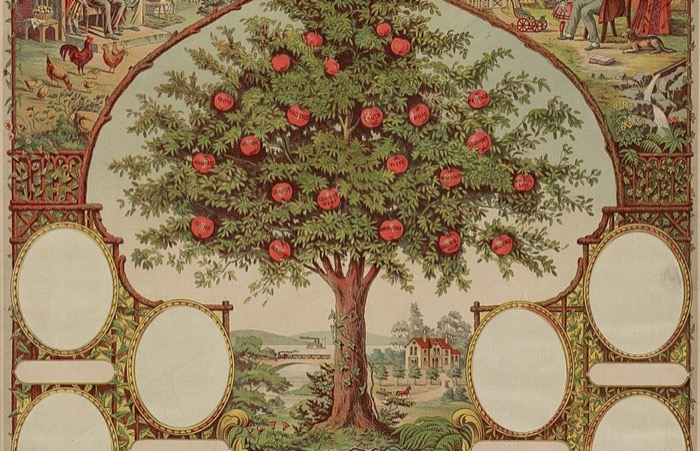
TOP PHOTO: Family Tree Popular Graphic Arts, Public domain, via Wikimedia Commons


