Summary: Tim Mahoney’s podcast interview with Dr. Rob Carter from Creation Ministries International covered some fascinating genetic evidence for the creation account in Genesis. This is the 1st of a 3-part series summarizing the podcast.
In the beginning, God created the heavens and the earth. – Genesis 1:1-2 (ESV)
Meet Dr. Rob Carter
Timothy Mahoney:
Hello Thinkers, I’m Timothy Mahoney. We’re here for a very exciting podcast. Today we’re going to be talking about Biblical genetics with Dr. Rob Carter who was featured in our film, The Red Sea Miracle. Share with us a little bit about your background, Rob.
Dr. Rob Carter:
I am trained as a marine biologist. I’ve had PhD level courses in marine physics, marine chemistry, marine geology and coral reef ecology. I got my doctorate working on genetics, pulling genes out of corals and putting them into fish to make them green and red. I am a speaker, writer and scientist for Creation Ministries International (CMI). I am the membership secretary of the Creation Research Society and I have a YouTube channel called Biblical Genetics.
Timothy Mahoney:
You have also been in a documentary called Is Genesis History? and another one called Dismantled, a Scientific Deconstruction of the Theory of Evolution.
Dr. Rob Carter:
Yes and Evolution’s Achilles Heels. That was my brainchild that CMI produced about 10 years ago.

Evolution to Creation
Timothy Mahoney:
You’ve got a lot of experience and present evidence that affirms the reliability of Genesis. But you used to be an evolutionist, right?
Dr. Rob Carter:
As a young man, I was an evolutionist. I had never heard of anyone who didn’t believe in evolution until I was 18 or 19 years old. I had thought those people were crazy.
Timothy Mahoney:
What caused you to move from being an evolutionary thinker to a person today with a PhD who says, there is a scientific connection to a Creator?
Dr. Rob Carter:
When I got to college, I fell in with a group of dedicated Christians who started challenging me. The penny-drop moment for me was a conversation with a friend where I said evolution was a fact and she asked me why I thought that. I said something that I thought, at the time, was the greatest evidence of evolution ever, Pakicetus. I had the image in my head from National Geographic of this perfectly formed transitional fossil diving down in paddle-like flipper feet. It was supposed to be halfway between a cow and a whale. That’s all the evidence for evolution I needed. Then, my friend told me they had just found the rest of the skeleton. I said, what?
It turns out that Pakicetus, if you see a depiction today, looks like a four-foot-long kind of rat or dog with zero transitional features. It doesn’t have paddle-like flippers, it has legs. It doesn’t have a flat tail, it has a regular tail. I mean, everything about it is a land-based animal. And I thought, wow, someone pulled the wool over my eyes. What else do I have to unlearn? I was probably about 19 or 20 when that happened. Since then, it’s been a lifetime of unlearning and learning more about the Bible, more about creation science and how things work together.

The Book of Genesis
Timothy Mahoney:
In the future, Patterns of Evidence intends to go into creation in our films because origins are important. I need to have context in order for me to figure out where my compass is. In my films, I’ve been telling stories and understanding the beginning from the end, along with the main plot, is part of what a story does. The Bible talks about creation in the first two verses of Genesis.
In the beginning, God created the heavens and the earth. The earth was without form and void, and darkness was over the face of the deep. And the Spirit of God was hovering over the face of the waters. – Genesis 1:1-2
Dr. Rob Carter:
Yes, in the beginning there is nothing except a ball of water. The Bible doesn’t actually say where it came from. It tells us God made light and then separated the waters above from the waters below, creating the oceans and the heavens. There’s debate amongst us on what the “waters above” mean. Some say it’s just clouds, others say water made the stars and the galaxies.
But, that context of Genesis changes everything. Think about the nature of the universe. If there is a God, we don’t live in a naturalistic universe, ruled only by natural forces. Natural forces are constant because God, who made them, is constant. However, that doesn’t mean that God isn’t allowed to intervene with miracles, such as making the world, life and people.
Enlightenment Period
Timothy Mahoney:
How do secular minds look at things?
Dr. Rob Carter:
Starting around the 1700s, during the Enlightenment Period, philosophers started appealing to a universe that operates according to a set of rules. This actually developed from Christian theology centuries before, where people said, if God is true, then God is the law giver, meaning his universe operates according to law. Well, in the 1700s, they took the law and got rid of God, inventing naturalism, the belief that nature is all there is. The belief that natural processes can explain anything that’s ever happened. So, no miracles or intervention of an outside entity, just physics and chance. From this mindset came the big bang theory, the origin of life, and evolution. But I don’t believe in naturalism. I believe in theism. I believe in God, and if there’s a God, naturalism is not true.
Timothy Mahoney:
I think about the first five books of the Bible and the controversy of “in the beginning” and Moses as the author. Now historians have the documentary hypothesis where four or five authors supposedly wrote the first five books of the Bible over hundreds and hundreds of years after the events. They say the Bible is just mythology. But I really believe, and the Bible tells us, that Moses existed and with God’s inspiration he penned the first five books, including Genesis, which tells us how we began. What is at stake in this debate concerning how we came into being?
Dr. Rob Carter:
Well, that’s a tricky question. I’m not going to say that if you don’t believe in creation, you can’t be a Christian. That’s not true. To be a Christian is simple. You have to believe that Jesus is God, that he died to pay for your sins, and that he rose from the grave. That’s really simple. But those statements are couched upon a history and a structure of thought that includes the entire Old Testament. Jesus quoted from the Old Testament and specifically from Genesis, in John chapter 1, “in the beginning.” Those are the opening words of the scroll of Genesis right there. If Jesus is God, he would’ve known if Genesis is true or not.
In the beginning was the Word, and the Word was with God, and the Word was God. – John 1:1
Jesus quotes, “in the beginning God created the heavens and the earth” and he spoke about Adam, meaning he believed that Adam existed at the beginning of creation. So, he didn’t believe in evolution because evolution requires billions of years to produce homo sapiens making humans come at the end of creation not at the beginning.
And Jesus said to them, “Because of your hardness of heart he wrote you this commandment. But from the beginning of creation, ‘God made them male and female.’ – Mark 10:5-6
Dating the Earth
Timothy Mahoney:
Discussing the topic of origins also brings up several different viewpoints within the overall debate. There are people that believe that God used evolution in creation. There are some people that believe that God created everything, but it took billions of years for us to get to the point where God started creating mankind. So Rob, how should people think about these things? I know that you settled on a literal seven-day creation and a young earth approach. Why do you believe this view?
Dr. Rob Carter:
It raises the question of if the Bible is true or not. The Book of Genesis is written as history. It’s not poetry, although there might be some poetry in it. It’s not prophecy, although there might be some prophecy in it. It is written as historical narrative and as such, we have a hard time adding millions or billions of years to that narrative. There are many ways to express long periods of time in Hebrew, and none of them are used in Genesis one. The later usages of the passages that tell us how old the earth is in Genesis are very clear that the authors believed them to be true. If you wanted to say God created the entire universe in consecutive days, you would write it just like it’s written in Genesis one.
Then there is other history in the Bible, long genealogical lists when added up indicate the Earth is only thousands of years old. I wrote an article on creation.com. It is one of my favorite articles, Biblical Minimum and Maximum Age of the Earth. My coauthor and I looked at all the places in the Bible that have something to do with dating the earth and we could not even get the age of the Earth to 8,000 years. Even If you take the Septuagint Bible, which has longer dates than the Masoretic Bible, which is the basis of our English Bibles, you can get to about 7,500, but if you use a straightforward Masoretic approach you get just a little more than 6,000 years.
The question is, can we deal with that? Can we explain the fossil record? Can we explain carbon dating? Can we explain starlight and time in just thousands of years? Well, the answer is yes, but we have to be very careful as we step through the issues. Typically, people take a very brief reading of Scripture and then try to throw things at it that don’t quite fit and sometimes they don’t even realize it doesn’t work. My first approach was day-age theory. I didn’t know what it was called, but someone said, if each of the days is really a long period of time that gives us millions of years. Years later, someone pointed out that, if plants are created on day three, then how can the sun be created millions of years later on day four? Genesis is set up so that no naturalistic explanation actually works because the order of events is all wrong. We have tried to comprehensively answer all sorts of questions on our website, creation.com. There are articles on the starlight and time issue and on the age of the Earth and more.

Crisis of Faith
Timothy Mahoney:
There are a lot of young people that I’ve met that are illiterate to the big ideas of the Bible and to the evidence of its validity. Supposedly, there is a lot of evidence for evolution but I’ve found it to be very weak. It’s more like a marketing PR campaign than real evidence.
Dr. Rob Carter:
I was that young person who had all these giant questions. At first, my faith was paper thin and I was worried I would lose it all. I struggled with these topics, even after becoming a Christian and learning about the Bible. I went through a dark period in my late twenties where I was doubting everything. You don’t become a Christian and magically know everything and have no doubts. But there are answers. We just have to spend the time working through them.
Timothy Mahoney:
Both of us have had this difficult experience, and right now millions of people are questioning what to believe. How can Biblical genetics help answer some questions? How did you come up with that terminology and what does it mean?
Dr. Rob Carter:
Since I love genetics, genealogy, history, and the Bible, I chose to spend a significant portion of my life studying genetics in relation to Biblical history. Biblical genetics is a natural combination of those two ideas. But before we go anywhere, I want to tell the audience my strategy is to take the most conservative position possible and see if it can be defended. Throughout my career, I’ve done that. I ask myself, does this reasonable hypothesis actually work? Does the data support it? The reason I take that strategy is because if I can defend the most difficult position, the fallback position will be even easier to defend.
Mitochondrial Eve
Timothy Mahoney:
Tell us how your Biblical genetic investigation began?
Dr. Rob Carter:
My first real job out of graduate school was at the Institute for Creation Research, then in California. I was working for Dr. John Sanford, the developer of the gene gun and the theory of genetic entropy. The first task he wanted me to do was look at mitochondria, the piece of DNA we only get from our mothers, and where they’re found in the world to compare them to languages. If the Tower of Babel is true and God separated people according to language, then a different language group should have different female lineages. Well, that project fell flat on its face.
However, I remembered that God didn’t separate the people according to the female lineage, but according to the male lineage. It was a very patriarchal society. So females, if they married across from one family to the other, when they spread out of Babel, each of the groups would have all the different female lines. And that’s pretty much true. Next, I looked at how much diversity we see in this little piece of DNA that everyone in the world has. The answer was, not much. So I asked, how long would it take to accumulate all those mutations based on a normal mutation rate? The answer was five to six thousand years. Therefore, the female ancestor of everyone in the world lived less than six thousand years ago.

Timothy Mahoney:
Are you saying that there is a common female ancestor for all people?
Dr. Rob Carter:
Every single person in the world has a single female ancestor, and that is represented by a little piece of DNA called a mitochondrial chromosome or mitochondrial DNA. It happens to be very different from the chimpanzee mitochondrial DNA, extremely different. And our ancestor lived only a few thousand years ago. Now, you can’t put an exact date on that because what was the mutation rate 3000 years ago? That depends on a lot of things. But, you can take a modern mutation rate, which we can measure by studying families, two parents and a child. If you measure thousands upon thousands of those, you can count the mutation rate, which is about one mutation every five to ten generations. That puts Eve, what we like to call her, just five to six thousand years ago.
Now, the evolutionary date given for Eve is 200-300,000 years ago, but they’re using a ridiculously low mutation rate. That’s not the mutation rate we can measure in the laboratory or in family trees. But they have to do that because they can’t have a Biblical Eve. It doesn’t match their view of history and evolution.
Conclusion
Stay tuned for Part 2 of this Thinker Update series where we delve into genetic evidence matching the Biblical account of Adam and what the human genome says about the human race. Until then, keep thinking.
To hear the full podcast episodes these articles summarize, check out this link and click “Load more episodes” until you see the 4-part series on Biblical Genetics.
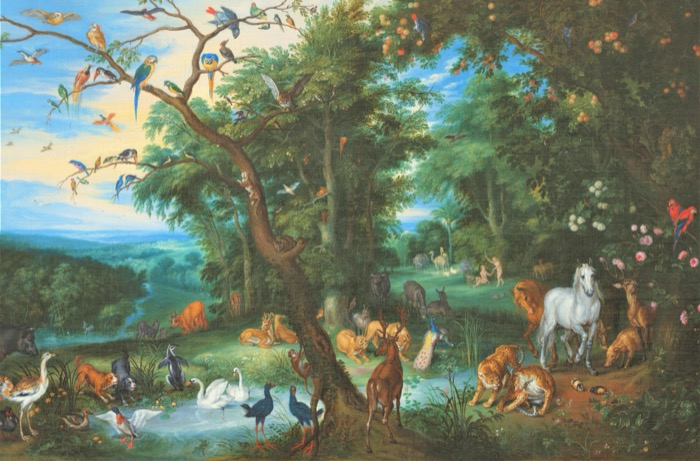
TOP PHOTO: The Garden of Eden. (credit: Izaak van Oosten 1655-1661, Public domain, CC BY-SA 2.0, via Wikimedia Commons)


