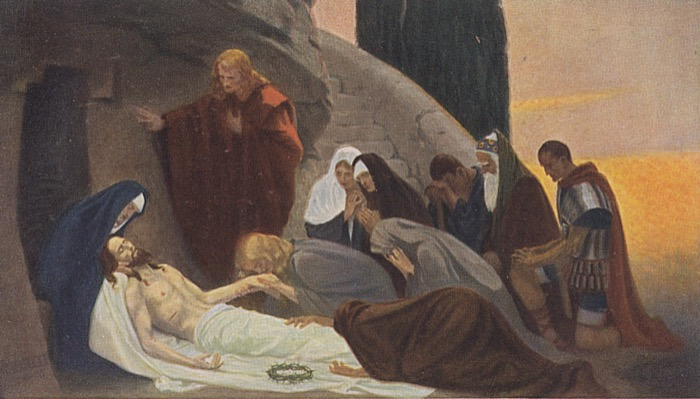
Summary: If Jesus followed the Essene calendar, it could resolve Holy Week confusion.
And he began to teach them that the Son of Man must suffer many things and be rejected by the elders and the chief priests and the scribes and be killed, and after three days rise again. – Mark 8:31 (ESV)
An Answer to Holy Week Challenges
In Part 1, we looked at the seemingly intractable problem of the timing of Holy Week events, the most significant week in Christian history, that have troubled readers of the Gospels for centuries and caused many to wonder whether the accounts are reliable at all. Several influential scholars (including Bart Ehrman) even gave up their very faith because of the apparent inconsistencies within the Gospels, including this particular issue. The multiple challenges include two different days designated for the Passover and not enough time from the traditional Good Friday to Easter morning to fulfill the three days and nights in the tomb that Jesus prophesied as the sign of Jonah.
However, Dr. Thomas B. Tribelhorn, who is an expert on the Jewish background of Jesus and his disciples, proposes that the main reason for the confusion is the loss of knowledge about the original Jewish context of the Scriptures. After working 40+ years on this problem, he offers a powerful solution by restoring an understanding of the Essenes, the mysterious branch of first-century Judaism that developed a calendar separate from the Temple calendar used by the majority of Jews at the time. If some Gospel passages were referring to the Essene calendar while others used the standard Temple calendar, it would explain the discrepancies and allow the true meaning of numerous passages in the Gospel accounts to shine forth.
The question becomes: is there good reason to connect Jesus and his disciples to the Essenes? As we will see, there are several intriguing clues in the Bible that help make this link.
The Jesus – Essenes Link
As covered in Part 1 of this series, although most people today know little about the Essenes, they were one of the primary Jewish sects at the time of Jesus. Josephus wrote that many of them lived in every city. This brings up the question of why the name “Essene” is not mentioned in the New Testament.
The primary first-century accounts of the Essenes come from the Jewish sources Flavious Josephus and Philo, along with the Roman historian Pliny the Elder. When the Dead Sea Scrolls were discovered, they added a wealth of information about the Essenes. Differing descriptions about details of Essene beliefs and practices among these sources reflect a diversity among different subgroups within this sect that strove for holiness through a close study of the Scriptures and a demanding, ascetic lifestyle.
There is some debate over whether the Qumran community really was made up of Essenes, but Pliny the Elder wrote that Ein Gedi was below the Essene headquarters on the western shore of the Dead Sea. This fits Qumran, which is 22 miles north of Ein Gedi. This is not to insist that every single scroll buried in the caves above Qumran was produced by the Essenes, but the archaeological evidence at Qumran points to the strict Jewish sect living there being responsible for the bulk of their production and collection. For instance, Qumran’s latrines were placed precisely 2,000 cubits “outside the camp,“ and there is a lack of women and children buried in its cemeteries, matching a prominent Essene practice of celibacy among adherents.
But since there are clues that Jesus shared background with the Pharisees, is there any reason to think he had an affinity toward the Essenes? One connection between the Essenes and the New Testament are the numerous distinct phrases and sayings found in the Essene writings of the Dead Sea Scrolls that are not common in other Jewish writings from Second Temple Judaism, but that readers of the New Testament would be very familiar with. These phrases include: Sons of Light, Sons of Darkness, the Spirit of Truth, the Holy Spirit, Spirit of Light, Spirit of darkness, and the kingdom of heaven. Dr. Tribelhorn has discovered over 150 of these parallels between texts in the Scrolls and the New Testament.
The descriptions of Essene practices and beliefs seen in the Scrolls also give a fuller background for Jesus’ ministry, and parallel many of his teachings and those of his disciples. They stressed the sovereignty of God, and his providence in all things. Both had a strong opposition to the Sadducees and Temple priesthood, as well as strong criticisms of some groups of the Pharisees. They emphasized the practice of ceremonial baptisms. They were apocalyptic, believing the arrival of the Messiah and the end of days would soon occur. They believed that moral disease could be contracted from associating with the wicked in a city.
Essenes were known for their care of strangers. Essenes traveling from place to place could count on receiving meals, lodging, and clothing from other Essenes who treated each other as family, even if they had never met. For this reason the Essenes did not carry anything with them when they traveled. This matches Jesus’ instructions to the disciples, that they need not take anything with them, when he sent them out. They were peacemakers, concerned with justice, and for the respect of elders. Philo wrote that the Essenes depended on a threefold rule; “the love of God, the love of virtue, and the love of mankind.” (Philo, Every Good Man is Free XII, 87)
Many Essenes lived communally celibate lives, but other sub-communities married and they did not deny the fitness of marriage for the succession of mankind to continue. Unlike the mainstream Jewish leaders, they were strong on the indissolubility of marriage – just as Jesus was.

These first-century understandings of the Essene and how they may relate to the New Testament are rigorously recorded in the book by Dr. Tribelhorn titled, “When” Changes Everything: Restoring the Jewish Foundation and Framework of the Real Crucifixion Week of Jesus. Dr. Tribelhorn is currently Professor Emeritus of Judaic Studies and Education at St. Petersburg Theological Seminary in Florida. After a career researching these questions, he concluded the answers come from understanding the original Jewish context in which the New Testament was written.
One of the strong distinctives of the Essenes was their love for one another, which included their sharing of all they had.
“Riches they despise, and their community of goods is truly admirable, you will not find among them distinguishing by greater opulence than another. They have a law that new members on admission to the sect shall confiscate their property to the order, with the result that you will nowhere to see either abject poverty or inordinate wealth; the individual’s possessions join the common stock and all, like brothers, enjoy a single participation” (The Community Rule also known as The Manual of Discipline).
Accordingly, Josephus reports that because they owned everything in common, the Essenes did not buy or sell anything to one another; they did not loan. They owed no one; those who had no need freely gave to those who were in need, even when it inconvenienced the giver (Josephus, Wars II, 122, 127).
In the book of Acts we find in the organization of Jesus’ earliest followers what could easily pass for a description of the Essene community in Qumran.
Now the full number of those who believed were of one heart and soul, and no one said that any of the things that belonged to him was his own, but they had everything in common. And with great power the apostles were giving their testimony to the resurrection of the Lord Jesus, and great grace was upon them all. There was not a needy person among them, for as many as were owners of lands or houses sold them and brought the proceeds of what was sold and laid it at the apostles’ feet, and it was distributed to each as any had need. – Acts 4:32-35
It should be noted that although the Essenes disappeared from historical narratives in the first centuries AD, various modern-day groups calling themselves Essenes have arisen with very strange influences and beliefs that don’t match their namesakes.
The Key Essene Connection to Crucifixion Week Events
The case laid out by Dr. Tribelhorn for Essene influence powerfully leads up to the timing of Jesus’ final week in Jerusalem. Using the Jewish foundation and framework of Crucifixion Week, his book demonstrates how a correct understanding of its timeline (and how the two calendars overlap) makes all the pieces fit together with the numerous typologies and symbolic parallels of Passover.
For instance, Jesus as the “the Lamb of God, who takes away the sin of the world!” (John 1:29) would have been entering Jerusalem on Palm Sunday that year exactly when the lambs were entering the city for Passover. During the passover meal [Essene calendar timing], Jesus would be offering his body in the bread, just as Passover lambs were offered in sacrifice. When Pontius Pilate was examining Jesus during his trial (“Now it was the day of Preparation of the Passover…” John 19:14), it would have been at the same day that the lambs were being examined for purity to qualify for Passover sacrifice that evening [Temple calendar timing]. The lambs needed to be without spot or blemish according to Old Testament law. Pilate’s declaration concerning Jesus had profound symbolism, “I find no fault with this man.” Jesus would be on the cross at the time when lambs were being slaughtered for the Passover meal [Temple calendar timing].

Although others have considered the alternate Essene calendar as a solution to Holy Week difficulties, what sets Dr. Tribelhorn apart is his focus on matching the Biblical account with related Jewish sources in putting the chronology puzzle together, while carefully documenting and footnoting those sources. His many years of research after being challenged by his professors as a young man, would satisfy his quest for the truth and vindicate the Gospel accounts.
The village of Bethany was predominantly Essene and readily welcomed Jesus. From the Temple Scroll we learn that Bethany (in Hebrew, “house of the poor”) was one of three villages “to the east of the city” designated to provide relief to “lepers and those afflicted with a discharge and men who have an emission” who could not enter Jerusalem. People who could not afford Jerusalem lived in Bethany, and those who had no place to stay in Jerusalem often spent the night there.
Jesus healed Simon the leper and raised Lazarus in Bethany. Throughout his ministry Jesus often lodged in Bethany, so it should come as no surprise that he also did so during his crucifixion week. It was here that the woman anointed him with nard in preparation for his burial (John 12:1-8). And it was from Bethany that Jesus started his triumphal entry traveling on Messiah’s donkey. An excerpt from the book highlights another intriguing connection.
Bethage was also likely an Essene village. Accordingly, the donkey the disciples appropriated for Jesus would have been considered communal property. They took it. They used it. They returned it. This was common practice for the Essenes (Mark 11:1-3). – (“When” Changes Everything, p. 50)
Most historians agree that there was also an Essene community in first-century Jerusalem, probably in the southwest corner of the city. Josephus wrote that a massive earthquake in 31 BC severely damaged Qumran. Herod the Great, who admired the Essenes, gave them a place in the upper city of Jerusalem to establish a replacement monastery. When most of the Essene community returned to Qumran in 4 BC, a small group of men asked to stay in Jerusalem and maintain the monastery, which they viewed as holy. Accordingly, a large part of this Jerusalem monastic community was celibate like those who went back to Qumran.
Josephus says that the Essenes had their own gate, which enabled them to travel undisturbed in and out of the city, not only to their places of prayer but also to the Hinnom Valley, around to the Waddi Kidron and the sources of fresh water that the community needed.

On the day of the last supper, the Gospels of Mark and Luke include a seemingly trivial piece of information that turns out to unlock the correct timing for the Last Week:
And on the first day of Unleavened Bread, when they sacrificed the Passover lamb, his disciples said to him, “Where will you have us go and prepare for you to eat the Passover?” And he sent two of his disciples and said to them, “Go into the city, and a man carrying a jar of water will meet you. Follow him, and wherever he enters, say to the master of the house, ‘The Teacher says, Where is my guest room, where I may eat the Passover with my disciples?’ And he will show you a large upper room furnished and ready; there prepare for us.” And the disciples set out and went to the city and found it just as he had told them, and they prepared the Passover. – Mark 14:12-16
Another excerpt from the book “When” Changes Everything clarifies the situation:
“As you enter the city (Jerusalem), a man carrying a jar of water will meet you.” The water jar (“keramion hydatos” in Greek), was likely an amphora-style container at least two feet long with a tapered bottom that was much like the ancient ones described in Herodotus 6:123. It might have been rounder with two slim loop handles for carrying and to tilt for pouring.
It wasn’t until the Dead Sea Scrolls discovery that it became evident how important this detail from Mark and Luke is. Try to picture what was happening: Following this man meant following him through the Essene Gate, which Herod the Great had made just for them so they could collect water without contaminating themselves with the city people.
Upon going through this special city gate, they entered a monastic celibate community of Essenes. In the first century, men did not usually carry water jars. Cooking and procuring water were household responsibilities and typically the work of the women. Anywhere else, it would be socially improper for a man to carry a water jar. But since this was a monastic community, the men needed to take turns doing these chores. A man would not be caught dead carrying water unless, that is, he was a celibate Essene with his own gate. Unlike all other Jerusalemites, Essene men could be found carrying water on a daily basis…
Here is the point: Jesus instructed the disciples to look for a man carrying water who would have been entering the Essene Gate. This is not trivial; it is vital information. It places the disciples of Jesus in the Essene sector of Jerusalem. There should be no doubt remaining that Jesus and the disciples followed the Essene calendar rather than the Temple calendar. This makes perfect sense since Jesus and the Essenes both opposed the Jerusalem Temple elite. And as such, this means they ate the Passover Seder (Last Supper) on Tuesday evening, because that was when Essenes always celebrated the Passover Seder.” – (“When” Changes Everything, p. 54-56)


Archaeologist Professor Dieter Vieweger believes he has identified the remains of the gate excavated in Jerusalem that Josephus described as the Gate of the Essenes, which was in the first-century wall that lay outside the current wall of Old Jerusalem. The home with the Upper Room would be beyond this gate in the Essene section of the city. Essene homes typically had upper rooms to share with visitors. So this points to Jesus having the last supper in an Essene home.
The Timing of Crucifixion Week
Jesus seems to have had some affinity to the Essenes, and there are several pointers that he was following their calendar. In correspondence with Dr. Tribelhorn, he commented, “It only makes sense that Jesus and his disciples would not follow the calendar of the corrupt Temple elite who wanted to destroy them. Rather than give credibility to this corrupt group, Jesus and his disciples would have lived by the calendar of the Essenes, who also recognized the corruption of the Temple elite. So, the Seder (Last Supper) had to be on a Tuesday evening. Once this start date is historically established all the remaining pieces of the puzzle fit perfectly, the Gospel accounts display their veracity, including the required 72 hours for the Sign of Jonah.” Note that this does not necessarily mean that Jesus believed the Essene calendar was perfect (as the Essenes did). It may be that he knew of weaknesses in both the Temple and Essene calendars.
As it happened that year, the Temple calendar was a day behind the Essene calendar. On the Temple calendar, Passover fell on Thursday; for the Essenes it was Wednesday, as it always was. What would timing for Crucifixion Week look like with this understanding?

There is a wealth of additional evidence and connections addressed by the book in clear detail that goes beyond the scope of this article. One important point that should be mentioned briefly is that some Biblical verses say Jesus would rise after three days, while others indicate he rose on the third day. In the scenario depicted above, Saturday would have been the third day, and the 72 hours in the tomb (the Sign of Jonah) would have been satisfied by sundown.
Thanks to the culturally recognizable picture of the empty tomb painted for us by John, Dr. Tribelhorn thinks the manner in which Jesus folded and placed his prayer shawl that had covered his head during prayers in his life (not a napkin, handkerchief, or face-cloth according to a Jewish framework) indicates that he rose in time to recite the evening Shema, which according to the Jewish sages had to be done before midnight.
As to the question of whether Jesus rose on Saturday or Sunday, if he was resurrected during the twilight after sundown Saturday, then the answer is both. In Judaism, “twilight” is a Torah legal term that is the time when one day touches the next, and rabbis are free to assign the events of twilight to either day or both days. Significantly, in a Jewish framework, twilight is the only time when his resurrection could be said to be both “on” the third day and “after” the third day simultaneously.
For more information on Dr. Tribelhorn’s work, including access to one of his lectures presented in Schonblick, Germany, you can visit his website at tomtribelhorn.com.
Conclusion
As Dr. Tribelhorn writes, the Bible says there were two separate Passover Seders during this week, and we must reconcile them. The only possible reconciliation can be found in the Jewish milieu underlying the text. When we are true to the Jewish foundation and framework of the original Hebrew and Greek texts, many of the so-called contradictions and historical-criticisms similarly evaporate.
Once again, the importance of chronology (the “when” of history) becomes apparent. While not proven with certainty, Dr Tribelhorn’s proposal offers a solution to Crucifixion Week conundrums that powerfully fits first-century Jewish evidence and the Biblical account, while alleviating doubts about the account. It is good to remember that considering the reality of these historic events is more important than which day they are celebrated on today. They drive us toward the central truth presented by the Scriptures for Crucifixion Week.
But he was pierced for our transgressions; he was crushed for our iniquities; upon him was the chastisement that brought us peace, and with his wounds we are healed. – Isaiah 53:5
Keep thinking!
Thomas Tribelhorn, PhD, is Professor Emeritus of Judaic Studies and Education at St. Petersburg Theological Seminary in Florida. – Education. BA (English Bible), Northeastern Bible College, MEd (Education), William Paterson University, MA (Judeo- Christian Studies), Jerusalem University College, (Israel), D.Min (Judeo-Christian Studies), St. Petersburg Theological Seminary, PhD (Judaic Studies), The Netzer David International Yeshiva (St. Petersburg Theological Seminary). AOS: Judaic Studies, Old Testament, New Testament, Education.
TOP PHOTO: 13th station of the Cross in St. Joseph’s Church, Munich. (Gebhard Fugel, 1863-1939, Public domain, via Wikimedia Commons)


_-_James_Tissot.jpg)


