Summary: The timing of events during Holy Week have caused confusion and fueled critics. Has a solution finally been discovered? Part 1 of 2.
And the LORD appointed a great fish to swallow up Jonah. And Jonah was in the belly of the fish three days and three nights. – Jonah 1:17 (ESV)
But he answered them, “An evil and adulterous generation seeks for a sign, but no sign will be given to it except the sign of the prophet Jonah. For just as Jonah was three days and three nights in the belly of the great fish, so will the Son of Man be three days and three nights in the heart of the earth.” – Matthew 12:39-40
Do the Gospels Contradict Each Other?
The timing (chronology) involved in the Gospel accounts of Holy Week have long challenged readers of the Bible. Was the last supper with Jesus and his disciples on Passover evening, as some of the Gospels say, or was Passover the following day, as the book of John seems to be saying? Was Jesus crucified and buried on Friday – or Thursday or Wednesday? Perhaps most importantly, if Jesus was buried around sundown on Friday and was raised sometime early Sunday morning, was he really in the tomb for “three days and three nights” as he had predicted?
These apparent contradictions have been at the top of the list of critics’ charges against the Bible and have caused many to even reject the truthfulness of the Bible and faith in Jesus. This is the most important week of the Christian faith. If the Gospel accounts are actually contradicting each other, and Jesus’ predictions were less than accurate, then this would seem to be good cause for skepticism about his claim to be the messiah, as well as skepticism about all the other teachings of Jesus and the apostles.
But what if we aren’t actually understanding the Biblical accounts correctly, and a true view would clear up the problems? As we will see, the key to unraveling the Biblical information may be dependent on recognizing the role of an enigmatic sect of first century Judaism known as the Essenes.
Understanding the Original Jewish Context of Scripture
When facing these Holy Week difficulties, I had run across the idea that perhaps the crucifixion and burial of Jesus did not happen on Friday, but on Thursday or Wednesday. After all, there were two sabbaths during this week – the weekly seventh-day sabbath on Saturday and the high holy day of Passover. The high feast days were also considered sabbaths when no ordinary work was done (Leviticus chapter 23). This would explain some of the confusion and it might even give enough time for Jesus to be in the tomb three days and nights as he had promised (see top verses in the article).
However, there were some big challenges to this idea. First, there were very many respected voices endorsing the traditional view for a Good Friday burial and an Easter morning resurrection. These voices stated there were good reasons to accept the tradition and they claimed that “three days and three nights” was merely a “Greek idiom” for three days. Also, “a day” could be seen as any fraction of day in Jewish law. Since, in Jewish reckoning, days started at sundown (rather than at midnight as in our system), three separate days could be represented in the following way:
1) A fraction of a day in the tomb on Friday when Jesus was buried just before sundown
2) A full day for Saturday (in Jewish thinking, starting at sundown of our Friday evening and ending at sundown of our Saturday evening)
3) A fraction of a day before Jesus rose sometime during our Saturday night/Sunday morning (in Jewish thinking, sometime during the night portion, or the first half of, Sunday)
Another challenge was that just placing the crucifixion earlier in the week didn’t solve all the problems. Primarily, you still have some texts clearly saying Jesus’ last supper took place on Passover evening, while others said the next day was the preparation for Passover the following evening (John 13:1-2, 18:28, 19:14, 31). A simple conclusion would be that one of these claims was mistaken. Then there was the fact that there didn’t seem to be any direct evidence for a Wednesday or Thursday crucifixion. Was this just a convenient but unwarranted conclusion in order to give Jesus more time in the tomb?
I put the issue on the shelf and turned to other matters. I had a sense that the crucifixion must be earlier in the week, despite the strong tradition, but It just seemed like a tangled web with none of the options being very satisfying.
As so often happens, after several years, a remarkable solution to this troublesome problem was presented to me.
Pieter van der Veen is an ancient historian and inscription expert who has been in Patterns of Evidence films and worked extensively on the team studying the curse tablet from Mount Ebal. Pieter alerted me to a colleague of his who was in the process of publishing a book titled, “When” Changes Everything: Restoring the Jewish Foundation and Framework of the Real Crucifixion Week of Jesus. After a fascinating and inspiring read, I concluded that this book may well have put together the missing pieces needed to solve the mysteries of Passion week.

The author was Thomas B. Tribelhorn, currently Professor Emeritus of Judaic Studies and Education at St. Petersburg Theological Seminary in Florida. Incidentally, it was Professor Tribelhorn who introduced me to the idea of capitalizing the words “Biblical” and “Biblically.” In the past I have followed the Chicago Manual of Style by putting these terms in lower case. But an editor’s note at the front of one Dr. Tribelhorn’s books states “Because the author disagrees with rule 8.102 (i.e. Mishnah–Mishnaic; Koran–Koranic; Talmud–Talmudic; Bible–but biblical), Biblical and Biblically have been capitalized at the author’s request.” I find this so reasonable that I have followed the practice ever since.
As a young graduate student, Dr. Tribelhorn had been confronted by his professors at Jerusalem University College in Israel to explain the Holy Week chronological puzzle. They challenged, “No matter how you try, three days and three nights do not fit between Friday night and Sunday morning.”
This along with other challenges to the Biblical narrative by his professors caused a crisis of faith similar to what Tim Mahoney faced in the initial stages of his Exodus investigation. Strong skepticism about the Bible as a historical document is the majority view among academics and virtually the only position presented in mainstream college textbooks.
Since then, Dr Tribelhorn has spent a lifetime thoroughly researching the Crucifixion Week of Jesus, working extensively from Jewish sources such as the Dead Sea Scrolls. He came to appreciate that this question not only stoked skepticism in the academic community, it was a prime reason given for Jewish rejection of the claims of Jesus. Jesus used the sign of Jonah as proof that he was the predicted Messiah, foreshadowing his future burial and resurrection after three days and three nights in the tomb.
Dr Tribelhorn stresses that Jewish readers know that “three days and three nights” was grounded in the Hebrew of the book of Jonah as Jesus himself states (see top verses) and not in a Greek idiom as supposed. And they also know what the phrase meant in a Jewish cultural context. While the phrase “three days” could mean parts of three days, “three days and three nights” was a clear statement demanding three full days and three full nights. That was the meaning of Jonah 1:17, and that was what Jesus was staking his claim to in Matthew 12:39-34. In their view, if Jesus was only in the tomb from Friday evening until sometime on Saturday night or early Sunday morning, then he was a false prophet and should be rejected based on Moses’ instructions.
And if you say in your heart, ‘How may we know the word that the LORD has not spoken?’— when a prophet speaks in the name of the LORD, if the word does not come to pass or come true, that is a word that the LORD has not spoken; the prophet has spoken it presumptuously. You need not be afraid of him. – Deuteronomy 18:21-22
But over time, a startling thought formed in Dr Tribelhorn’s mind – What if the interpretations of certain Biblical passages have become clouded by modern Western thinking, and regaining the true meaning is dependent on knowing the original first-century Jewish context the Scriptures were written in?
Using training from his PhD in Judaic Studies, along with over 4 decades of research, Dr. Tribelhorn gained a deep understanding of Second Temple Judaism, which in turn also helped better understand a number of passages in the Gospels – some pertaining to Holy Week. The key to unlocking the mystery of the timing came with a discovery from the Dead Sea Scrolls. The Scrolls not only contain early copies of books of the Bible, but also many manuals produced by the Essenes, an enigmatic sect of Judaism that inhabited the site of Qumran, where many of the Dead Sea Scrolls were found.

Some of the scrolls, such as the Damascus Document, contained information about a calendar used by the Essenes that was different from the one used by Temple Judaism. Although the existence of this alternate calendar was known to scholars, few realized its ramifications for the crucifixion-week conundrum – Dr. Tribelhorn did.
The bottom line is, he suggests that the Gospel writers refer to two different calendars in use at that time, namely the Essene calendar (used by Jesus’ circle, including the apostles, Mary, Martha, and Lazarus) and the Jerusalem Temple calendar, used by the Jerusalem religious elite, including the Pharisees and Sadducees. Understanding this fact, he proposes, clears up all the confusion about the timing of events.
The Essenes and Their Calendar
Readers of the New Testament are familiar with two of the main Jewish religious groups of Jesus’ day, the Pharisees and the Sadducees. The Jerusalem Temple’s religious leadership included these two groups, and Jesus harshly criticized their misunderstanding of the Scriptures and their outward piety, while their hearts were full of greed and selfishness. The Zealots are also mentioned. But while the Zealots were religiously motivated, this was more of a political designation (for those fiercely nationalistic Jews who favored direct and violent opposition to Roman occupation) and not strictly a religious sect. Their religious beliefs were in agreement with the Pharisees.
The Essenes were another Jewish group described by first-century Jewish writers Philo and Flavious Josephus. Most people today know the Essenes as the mysterious sect that inhabited Qumran, the desert community east of Jerusalem where the Dead Sea Scrolls were first discovered. According to Josephus however, in his day, Judaism in Israel was actually made up of three main sects, the Pharisees, Sadducees, and the Essenes.
The term “Essene” is not used in the Bible, but this is not because they were insignificant. Josephus wrote that the Essenes had no one city of their own; rather, many of them lived in every city (Wars II, 124). However, Pliny the Elder states that Ein Gedi was below the Essene headquarters on the western shore of the Dead Sea (Natural History 5:73), which fits the site of Qumran.
Dr Tribelhorn has done extensive research on the extremely devout Essenes and their writings. They referred to themselves as yahad (meaning “community”). This was their way of differentiating themselves from the rest of the Jewish population, whom they repeatedly labeled the “Breakers of the Covenant.”
Jesus may have mentioned the Essenes by another name they called themselves within their own circles – the “sons of light” in Luke 16:8. Dr. Tribelhorn thinks Jesus must have known them well enough to refer to them by their “in house” name. This was also confirmed by the late Prof. David Flusser, a scholar from Hebrew University in Jerusalem as referenced in the book, Judaism and the Origins of Christianity (Jerusalem: Magnes Press of the Hebrew University, 1988). Flusser is considered an Orthodox Jewish scholar par excellence and one of the world’s leading authorities on Second Temple Judaism, Jesus, and the Gospels.
The Essenes had separated themselves from mainline Jewish practices and developed a calendar sometime in the period of the Maccabbees (perhaps after 150 BC). The Essenes felt this was so important that it apparently was a major reason for their separating from the Pharisees and Jerusalem Temple worship. They despised the Hellenization of the Sadducees and believed the Pharisees had become corrupted by Babylonian ideas, especially with the lunar calendar and its focus on the moon. This means there were two competing calendars in Judaism at the time of Jesus’ crucifixion.
Calendars, including the days of the week, are essential for the function of Biblical religion. They supply the answers for when to gather for worship, when to perform certain rituals, and when special celebrations and other observances occur. God had specified on what days the sacred feasts were to be celebrated in the Torah, and the Essenes believed the Pharisees had the wrong days. The Essenes’ goal was perfect obedience to God, and a large portion of the calendric scrolls deal with precision timekeeping.

The Essenes thought the solar/lunar calendar of the Pharisees was manmade because it had to be constantly adjusted. In the Temple calendar, each month began by observing the new moon, which came about every 29.5 days. By the end of the 12th month (or 354 days) it was about 11 days short of a solar year, so a way was needed to correct the discrepancy. A 13th month was added every so often, so spring festivals like the Passover remain in the spring and don’t wander back into winter and then fall etc.
In contrast, the solar Essene calendar ignored new moons because the word for “new moon” was literally just “new,” so they applied this to a “new” 30 or 31-day month and not a new moon. Their calendar had 12 months and 52 weeks (so 364 days in most years). While some of the details are disputed, Dr. Tribelhorn believes they may have periodically added an extra week at the end of the year to get it back in sync with the end of a true solar year.
The genius of this system is that because Essene years always had a complete number of weeks, the feast days (and any day of every month) would always fall on the same day of the week, year after year. The 15th day of Nissan in one year would be the same day of the week as the 15th day of Nissan the previous year, and the following year, and forever. The Essenes believed this was a perfect calendar. In the Temple calendar, the 15th of Nissan would wander over different days of the week, just as our Christmas day does today.
The crucial point regarding Holy Week timing is that for the Essenes, Passover was always on a Wednesday. The day of preparation would be on Tuesday with the Passover Seder in the evening (the beginning of the Jewish Wednesday, after sundown). If Jesus was operating in this system, it can be seen how that would mean the last supper was on what we would call Tuesday evening and his crucifixion and burial would have occurred on Wednesday – giving a full three days and three nights before the resurrection happened sometime Saturday night.
For more information on Dr. Tribelhorn’s work, including access to one of his lectures presented in Schonblick, Germany, you can visit his website at tomtribelhorn.com.
Conclusion
Have chronological misunderstandings troubled the faith of many and unintentionally given ammunition to critics for their claims of Biblical errors and contradictions? Looking through a Jewish cultural lens, Dr. Tribelhorn in his book gives evidence for an entirely different understanding of the timing of Holy Week events. This opens up the possibility that Jesus really was in the tomb for a full three days and three nights.
But is there other historical evidence from the first century, and from the Biblical text, that Jesus and the events surrounding the crucifixion actually were connected to the Essenes? The answer is a resounding yes, and in surprisingly strong ways. But for that you will have to wait for the conclusion in Part 2 next week. Until then, keep thinking!
Thomas Tribelhorn, PhD, is Professor Emeritus of Judaic Studies and Education at St. Petersburg Theological Seminary in Florida. – Education. BA (English Bible), Northeastern Bible College, MEd (Education), William Paterson University, MA (Judeo- Christian Studies), Jerusalem University College, (Israel), D.Min (Judeo-Christian Studies), St. Petersburg Theological Seminary, PhD (Judaic Studies), The Netzer David International Yeshiva (St. Petersburg Theological Seminary). AOS: Judaic Studies, Old Testament, New Testament, Education.
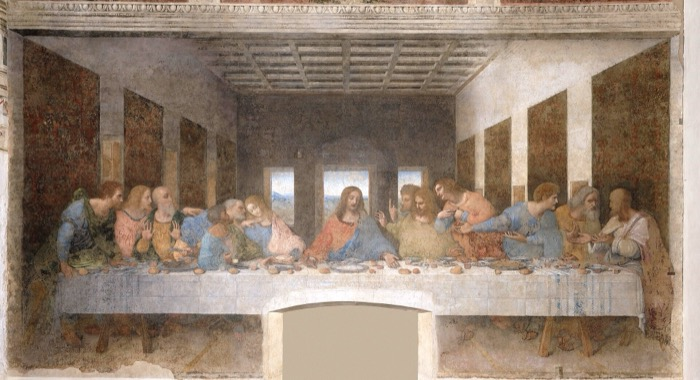
TOP PHOTO: The Last Supper. (Leonardo da Vinci, 1452-1519, Public domain, via Wikimedia Commons)


