Summary: The documentary hypothesis is the standard academic view challenging Moses’ authorship of the Torah. But are they considering all the evidence?
Then the LORD said to Moses, “Write this as a memorial in a book and recite it in the ears of Joshua …” – Ex 17:14 (ESV)
The Torah Written by Moses or by Multiple Authors Centuries Later?
In the ongoing debate over the origin and construction of the Bible’s first books, there is a stark contrast between the majority academic view today and the traditional understanding among Jewish and Christian scholars that was held for millennia. The traditional view has been that Moses was author of the Bible’s first five books (ending with Deuteronomy) sometime around the 15th century BC. In opposition to this, the documentary hypothesis holds that different authors (or schools) wrote different portions of the first books, also known as the Torah, many centuries after Moses. It proposes that the different accounts were then stitched together to form the early books of the Bible as we see them today. These different authors had contradictory views at times regarding historical and theological details, and the compilation did not occur until after the Babylonian captivity – perhaps some time in the 400s BC.
Part 1 of our series on the documentary hypothesis addressed a lynchpin interpretation used by the hypothesis to claim that different names of God present in the Bible shows evidence that multiple authors were involved. In this week’s Part 2 of the series we will examine the Biblical evidence for Moses’ authorship and challenge one of the core claims in the documentary hypothesis’ argument for multiple authors – a claim directly impacted by the discovery of writings from ancient Semitic archives.
One reason this issue is so important is that the Bible seems to make clear that Moses was the author of the Torah. The documentary hypothesis not only challenges this idea, it then goes on to challenge many of the central claims of the Bible, untethering it from the traditional understanding that the Bible is revelation from God. This from a theory that has been the dominant view among mainstream scholars for more than a century.
Moses Wrote the Torah?
Early on, scholars noted that the final chapter of the book of Deuteronomy records Moses’ death and burial, Israel mourning for him afterward, and the statement that no prophet like him has since arisen in Israel. Surely this wasn’t written by Moses himself. Other statements in the Torah also hinted at another hand at work. If these portions were not written by Moses, perhaps none of it was.
Conservative scholars conceded that this last section of Deuteronomy was added by a later writer, perhaps Joshua, but critical scholars continued to develop their theories for multiple authors who wrote as much as a thousand years after the time of Moses. They claimed the idea of Moses writing the Torah is mainly a religious tradition that grew over time.
This widespread skepticism has even tempered the views of Bible believers. So it is critically important to determine whether the critics are correct in saying that Moses’ authorship is merely a tradition, or if the Bible itself establishes that Moses was the writer. A closer look shows that multiple places in the Torah indicate that Moses was writing the words we see in the Bible’s first books.

Then the LORD said to Moses, “Write this as a memorial in a book and recite it in the ears of Joshua …” – Ex 17:14
And Moses wrote down all the words of the LORD. – Ex 24:4
Then he [Moses] took the Book of the Covenant and read it in the hearing of the people. – Ex. 24:7
And the LORD said to Moses, “Write these words, for in accordance with these words I have made a covenant with you and with Israel.” – Ex. 34:27
As for the sons of Merari, you shall list them by their clans and their fathers’ houses… And you shall list by name the objects that they are required to carry… – Num. 4:29, 32
Moses wrote down their starting places, stage by stage, by command of the LORD … – Num. 33:2
Then Moses wrote this law and gave it to the priests, the sons of Levi, who carried the ark of the covenant of the LORD, and to all the elders of Israel. – Deut. 31:9
Now therefore write this song and teach it to the people of Israel… So Moses wrote this song the same day and taught it to the people of Israel. – Deut. 31:19, 22
When Moses had finished writing the words of this law in a book to the very end, Moses commanded the Levites who carried the ark of the covenant of the LORD, “Take this Book of the Law and put it by the side of the ark of the covenant of the LORD your God, that it may be there for a witness against you. – Deut. 31:24-26
IN THE REST OF OLD TESTAMENT
Torah means “law” or “teaching,” and the rest of the Old Testament calls the law (or teaching) found in the early books of the Bible “the Law of Moses,” “the Book of Moses,” “the Book of the Law of Moses” or other variations in dozens of places. Here are just a few examples:
the LORD said to Joshua …This Book of the Law shall not depart from your mouth, but you shall meditate on it day and night, so that you may be careful to do according to all that is written in it. For then you will make your way prosperous, and then you will have good success. – Josh. 1:1, 8
Therefore, be very strong to keep and to do all that is written in the Book of the Law of Moses, turning aside from it neither to the right hand nor to the left – Josh. 23:6
While they were bringing out the money that had been brought into the house of the LORD, Hilkiah the priest found the Book of the Law of the LORD given through Moses. – 2 Chron. 34:14
And all the people gathered as one man into the square before the Water Gate. And they told Ezra the scribe to bring the Book of the Law of Moses that the LORD had commanded Israel. – Neh. 8:1
IN THE NEW TESTAMENT
References in the New Testament to the “Law of Moses, and the Prophets, and the Psalms” are calling out the major divisions of the Old Testament, showing that Moses was also credited for the book of Genesis, which was the first of the five books of the Torah (the Law of Moses). Jesus in all four gospels, Luke, John, Philip, Peter, Stephen, Paul, James, and the writer of Hebrews all singled out Moses as the author of the Torah/ the book of Moses/ the law of Moses. Also note the many references in these verses to specific texts from different books of the Torah.
And Jesus said to him, “See that you say nothing to anyone, but go, show yourself to the priest and offer the gift that Moses commanded, for a proof to them.” – Matt. 8:4 [referencing Lev. 14:1-57]
[Jesus speaking] For Moses said, ‘Honor your father and your mother’; and, ‘Whoever reviles father or mother must surely die.’ – Mark 7:10 [quoting Ex. 20:12, 21:17, Lev. 20:9, and Deut. 5:16]
He [Jesus] answered them, “What did Moses command you?” They said, “Moses allowed a man to write a certificate of divorce and to send her away.” And Jesus said to them, “Because of your hardness of heart he wrote you this commandment. – Mark 10:3-5 [referring to Deut. 24:1-3]
[Jesus speaking] And as for the dead being raised, have you not read in the book of Moses, in the passage about the bush, how God spoke to him, saying, ‘I am the God of Abraham, and the God of Isaac, and the God of Jacob’? – Mark 12:26 [quoting Ex. 3:6]
[Jesus speaking] And beginning with Moses and all the Prophets, he interpreted to them in all the Scriptures the things concerning himself… Then he said to them, “These are my words that I spoke to you while I was still with you, that everything written about me in the Law of Moses and the Prophets and the Psalms must be fulfilled” … – Luke 24:27, 44 [referring to Messianic prophecies, including those by Moses in the Torah beginning in Genesis 3:15, potentially also the entire sacrificial system instituted at Sinai.]
[Jesus speaking] For if you believed Moses, you would believe me; for he wrote of me. But if you do not believe his writings, how will you believe my words?” – John 5:46-47
[Jesus speaking] “Has not Moses given you the law? Yet none of you keeps the law.” – John 7:19
[Luke writing] From morning till evening he [Paul] expounded to them, testifying to the kingdom of God and trying to convince them about Jesus both from the Law of Moses and from the Prophets. – Acts 28:23
[John writing] For the law was given through Moses … – John 1:17
Philip found Nathanael and said to him, “We have found him of whom Moses in the Law and also the prophets wrote, Jesus of Nazareth, the son of Joseph.” – John 1:45
[Peter speaking] “Moses said, ‘The Lord God will raise up for you a prophet like me from your brothers. You shall listen to him in whatever he tells you.’” – Acts 3:22 [quoting Deut. 18:15]
[Stephen speaking] “This is the Moses who said to the Israelites, ‘God will raise up for you a prophet like me from your brothers.’ This is the one who was in the congregation in the wilderness with the angel who spoke to him at Mount Sinai, and with our fathers. He received living oracles to give to us.” – Acts 7:37-38 [quoting Deut. 18:15]
[Paul speaking] “and by him everyone who believes is freed from everything from which you could not be freed by the law of Moses.” – Acts 13:39
[Paul writing] For Moses writes about the righteousness that is based on the law, that the person who does the commandments shall live by them… But I ask, did Israel not understand? First Moses says, “I will make you jealous of those who are not a nation; with a foolish nation I will make you angry.” – Rom. 10:5,19 [quoting and referring to Lev. 18:5, and in the next verses to Deut. 30:11-14 and in verse 19 he is quoting Deut. 32:21]
[Paul writing] For it is written in the Law of Moses, “You shall not muzzle an ox when it treads out the grain.” Is it for oxen that God is concerned? – 1 Cor. 9:9 [quoting Deut. 25:4]
[Paul writing] Yes, to this day whenever Moses is read a veil lies over their hearts. – 2 Cor. 3:15
[James speaking] “For from ancient generations Moses has had in every city those who proclaim him, for he is read every Sabbath in the synagogues.” – Acts 15:21
[the author of Hebrews writing] For when every commandment of the law had been declared by Moses to all the people, he took the blood of calves and goats, with water and scarlet wool and hyssop, and sprinkled both the book itself and all the people, saying, “This is the blood of the covenant that God commanded for you.” And in the same way he sprinkled with the blood both the tent and all the vessels used in worship. – Heb. 9:19-20 [referencing and quoting Ex. 24:7-8, Ex. 30 and 40, and Lev. 8 and 16]
It seems clear that the documentary hypothesis is not merely challenging a religious tradition, but one of the core claims of the Bible itself. The consistent testimony of the entire Bible is that Moses was at least substantially responsible for writing the Torah as it was revealed to him by God. While there is the possibility that a later prophet assembled the writings into their final form, and later additions (like the end of Deuteronomy) and updates to some of the terminology may have occurred, it could truly be said that the Torah was the “Book of the Law of Moses.”
Repetitions in the Text and the Ugaritic Tablets
One of the key claims made in the documentary hypothesis is that the repetitions seen in different sections of the Torah show that those sections come from different sources that were later combined. But is that really a strong argument?
Timothy Mahoney interviewed many scholars for our Moses Controversy film that explored evidence for the world’s first alphabet, which developed in the area of Egypt and the Sinai Peninsula at just the right time to allow Moses to write the Torah. The following exchanges include some excerpts from a bonus feature on the documentary hypothesis found in the Collector’s Edition box set for that film. Represented are Bible scholar and archaeologist Dr. Randall Price, and professors of Old Testament Interpretation Peter Gentry and Duane Garrett.
RANDALL PRICE: I think it’s a mistake, of course. The documentary hypothesis from the beginning of the 19th century and on, which kind of formed the basis in universities and other places for understanding the Bible, was based on a faulty understanding of literary analysis and understanding the text itself. It’s been in many cases discredited and largely moved away from in terms of new literary thinking.

PETER GENTRY: There are many problems with this theory. One of the most important ones is that they were using modern and Western methods of literary analysis to study ancient and Eastern texts. So they were imposing a modern method of analysis, modern ideas about how literature works, upon ancient and Eastern texts.
TIM MAHONEY: And if you took that idea and applied it to other literature… I mean, had anyone ever suggested other literature that was written by multiple authors throughout time?
PETER GENTRY: No, as a matter of fact, scholars who study the documents that have come down to us from the ancient Near East don’t usually analyze other documents from the ancient Near East in the same way.
TIM MAHONEY: So the Bible was given this unique higher criticism?
PETER GENTRY: Yeah, it seems that way. So as a general rule, they don’t treat other things that way, but the problem is they never sat down and said, “well, what were the Hebrews’ own rules for doing literature? What were the Hebrews’ own rules for telling stories?”

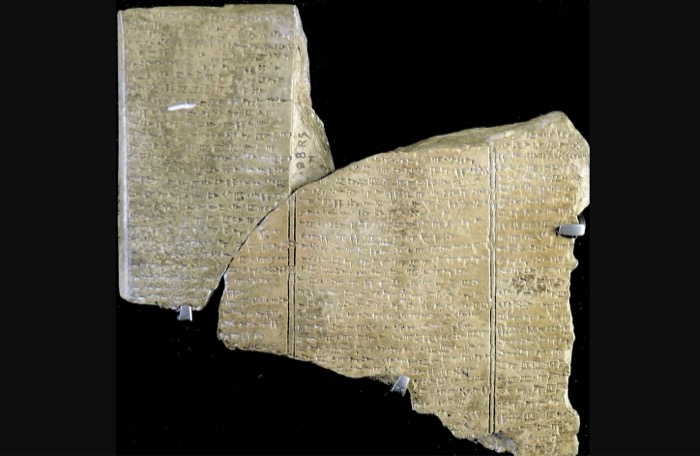
Some of the major findings of archaeology are archives of hundreds of clay tablets from cities in the region of Israel and Syria. Perhaps the most important site for its implications for the documentary hypothesis is the coastal city of Ugarit where archives of over 1,500 tablets written in a Northwest Semitic language were discovered.
The first discoveries were made in 1928, with other major finds taking place there in 1958, 1973, and 1994. Dated to the 13th and 12th centuries BC (the same general era as Moses), the tablets using cuneiform script included poetry, legends and religious texts. Crucially, when considering the style used in many of the documents, it was found that they contained many parallel stories and repetitions of accounts, similar to the style seen in the Bible. Other archives from different sites also confirmed this reality. Tim Mahoney’s conversations touched on the ramifications of this for the documentary hypothesis.
DUANE GARRETT: Now, one thing about the stories of Genesis is that there is a great deal of repetition. Stories are told in parallel. I mean, the most famous example of this is there are three places where a patriarch said that his wife is his sister. So Abraham does it twice and then Isaac does it once. And the three accounts are very similar to each other.
DUANE GARRETT: Now, having parallel stories in the documentary hypothesis is evidence that there are different sources. In my opinion, that’s completely wrong. It is evidence that they’re from the same source because you would want to tell a story in a way that you can remember it, and that your audience can appreciate it. And ancient audiences love stories with parallels, stories in which similar things happen repeatedly. It’s characteristic of a great deal of the literature.
DUANE GARRETT: And so you have these parallel stories which could be evidence of a way of orally making sure that you get the story right because you highlight things that happened that were parallel to each other, that were kind of repeated. And again, it is not an indication of multiple sources, it’s an indication of a single source.
TIM MAHONEY: Was that the idea behind your book Rethinking Genesis?
DUANE GARRETT: That’s a major point of Rethinking Genesis, that the documentary hypothesis would say, well, look, you have one version of a story here, a different version there. They are from two different sources. But I would argue no, the existence of parallels indicates that they’re one source and that they never were thought of as contradictory. They were thought of as all part of the unified parallel whole.
PETER GENTRY: So, these German scholars weren’t paying attention to any of these kinds of patterns in the Hebrew language, that it’s a repetition, but it’s not from a different source. It’s not that an editor had two versions of the same story and he bungled the editing job.
TIM MAHONEY: Yeah.
PETER GENTRY: This is the way Hebrew literature is trying to mark a story that has two different scenes. In a modern movie, all you do is switch the camera. Well, how do you do that when literature is linear by definition?
TIM MAHONEY: Right, and I get it now. It’s almost like a musical theme from a movie soundtrack that repeats itself.
PETER GENTRY: Yes. Many scholars today are just unaware of the latest advances in research on archeology, history, how the Hebrews did their writing, how Hebrew literature works, and all of these things uphold the claims in the text and show that the criteria used to establish the documentary hypothesis are completely false. This theory should’ve become passé many years ago.
Conclusion
The evidence challenging the documentary hypothesis seems to be substantial, so why does it continue to be taught as the standard paradigm in Biblical studies? And do its other primary arguments hold any weight? Find out in the next installment of Thinker Updates. Keep thinking!
TOP PHOTO: Cuneiform tablet of the Baal Cycle from Ugarit. (By Unknown artist – Mbzt, 2013, CC BY-SA 3.0, via Wikimedia Commons)


