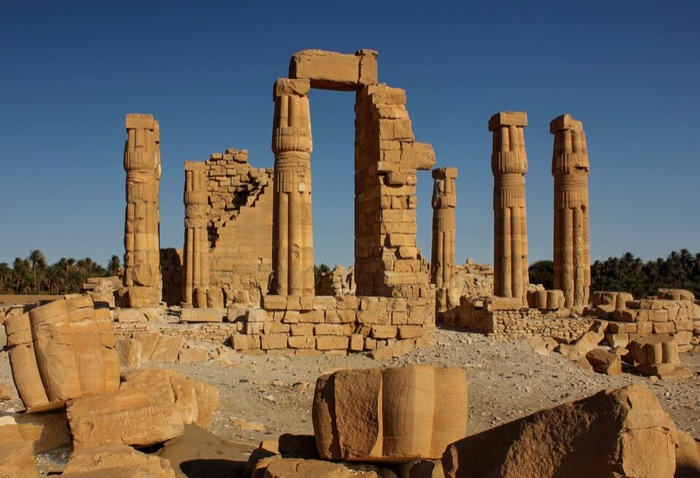
Summary: An Egyptian inscription near the banks of the Nile challenges the standard academic view that claims Moses did not write the Bible’s first books.
Then the LORD said to Moses, “Write this as a memorial in a book and recite it in the ears of Joshua, that I will utterly blot out the memory of Amalek from under heaven.” – Exodus 17:14 (ESV)
The Battle Over the Bible’s First Books
Read any mainstream academic book or enter just about any college classroom today where the humanities or Biblical studies are being taught, and you will hear some form of the Documentary Hypothesis. This theory seeks to explain the origins and composition of the Bible’s first five books: Genesis, Exodus, Leviticus, Numbers, and Deuteronomy. Known as the Torah (in Hebrew) or the Pentateuch (in Greek) these books have traditionally been seen as the writings of Moses, composed at Mount Sinai and during the years of the Israelite wanderings that followed, as the Bible itself indicates.
In contrast, the Documentary Hypothesis proposes that the Bible’s first books were not written by Moses, but by several different writers or schools, who composed their works with different and conflicting perspectives, as much as a thousand years after the time of Moses. The bottom line is that this thinking seeks to deconstruct and unravel Bible authorship, which has led many to view the Bible not as authoritative revelation from God, but rather as a man-made document full of inaccuracies, myths and contradictions.
However, despite the fact that the Documentary Hypothesis has been the dominant view in Western academia for a century or more, there is clear evidence that is wrong. One striking example of this evidence is an Egyptian inscription found at a temple near the banks of the Nile River in northern Sudan.
This article is the first in a series exploring the Documentary Hypothesis, its roots and makeup, as well as criticisms against it. It will be seen that this paradigm has major problems and scholars would do well to reconsider the claims of the Bible itself.
Some Documentary Hypothesis Basics
The roots of the documentary hypothesis go back to the 17th through 19th centuries when scholars noticed certain aspects of the Biblical text that they believed pointed to different versions or sources within the Bible’s first books. One of the first “clues” was that two different names for God were used in different portions of the Genesis creation narrative. Genesis 1:1-2:3 uses the name “Elohim,” which means “mighty” or “supreme,” and is also the common word for god that is used for the false gods worshipped by the nations surrounding Israel.
Genesis 2:4 through chapter 3 uses the name “YHWH,” (or “YHVH”) the covenantal name for God, also known as “Yahweh” or “Jehovah” and often written as “LORD” in English Bibles. Some scholars believed that this signaled two different authors or sources for this historical narrative that were later combined and stitched together in an attempt to create one running account.

This thinking was bolstered by the claim that there were apparent contradictions between the two creation accounts (more on that in a future article), as well as in other parts of the Torah. There were also repetitions of various scenes that seemed completely unnecessary and were explained as an editor or redactor pulling together different accounts from various sources for the same event and making it seem like a running narrative of different events. In time scholars listed the following pillars for their theory:
- The use of different names for God
- Duplications and repetitions
- Supposed contradictions and divergences of view
- Variations in style and language (history, genealogies, laws, poetry, etc.)
- Indications of the stitching together of different sections
When taken together, it was clear to these critical scholars that the Torah was not the product of one author (Moses) but rather different accounts from different sources written over many centuries. These sources often had different perspectives and even contradictory views on everything from historical details to theological convictions.
The classic form of the documentary hypothesis took shape by the late 19th century and proposed that four primary sources were present, which are known by the first letter of each source in chronological order: J, E, D, and P.
J: The Yahwist Source (Hebrew has no letter J, so the “J” can stand for “Jehovah”). The Yahwist source was believed to come from the perspective of Judah. It supposedly was the oldest source, coming from the 900s BC, and can be distinguished by its use of the name “YHWH” for God.
E: The Elohist Source. The Elohist source was believed to be from the perspective of the northern kingdom of Israel and from the 800s BC. It has a moralistic style and uses the name “Elohim” for God.
D: The Deuteronomist Source. The Deuteronomist source was believed to be from the perspective of the Levite clan and was from the 600s BC. It accounts for most of the book of Deuteronomy, is concerned with teaching Mosaic religion, and emphasizes centralized worship at Jerusalem’s Temple. D was supposedly the book planted in the temple and “discovered” in the days of Josiah (2 Kings 22:8). It was later joined to J and E by an unknown redactor.
P: The Priestly Source. The Priestly source was believed to have been composed by Jewish priests in the 500s-400s BC during and after the Babylonian captivity. It emphasizes genealogies and priestly rubrics of holiness and worship. It was supposedly authored by the final editors of the Torah, which largely reached its current form sometime in the 300s BC.
While there have been adjustments to the classic form of the documentary hypothesis, the basic understanding continues to hold that there were several sources for the Torah over a period of centuries, long after the time of Moses. These sources were collected by editors and combined with oral traditions to create a history for Israel that could shape (control) the political and religious beliefs of the people. Certainly, this approach conformed to the modern view that the Bible was not revelation from God, but was a man-made document.
Did the Patriarchs Know the Name “YHWH”
One of the cornerstone passages for the documentary hypothesis is Exodus 6:3, which they believe displays a Biblical contradiction. The standard interpretation of this verse is that God had not made himself known by the name “YHWH” to the patriarchs of Israel, Abraham, Isaac, and Jacob, but this name was first revealed to Moses at the time of the Exodus. This also has ramifications for Egyptian inscription that will be discussed below.

The standard interpretation in Exodus 6 makes it seem that God had only revealed himself as El Shaddai in previous times.
And God spake unto Moses, and said unto him, I am the LORD [YHWH]. I appeared to Abraham, to Isaac, and to Jacob, as God Almighty [El Shaddai], but by my name the LORD [YHWH] I did not make myself known to them. – Exodus 6:2-3
However, the Bible is full of indications that God had revealed himself as “YHWH” in previous generations and that this name was well known. The name for the mother of Moses and Aaron is Jochebed, which seems to be a Yahwistic name form – names that begin or end with some form of “yah/ah” or “Jo.” The Hebrew authority Gesenius gives the definition of Jochebed’s name as, “whose glory is Jehovah.”
The following passages give much clearer indications that the name “YHWH” was known long before the time of Moses and the exodus, including direct quotes from God, the patriarchs, and their servants/relatives.
To Seth also a son was born, and he called his name Enosh. At that time people began to call upon the name of the LORD [YHWH]. – Gen. 4:26
After these things the word of the LORD [YHWH] came to Abram in a vision: “Fear not, Abram, I am your shield; your reward shall be very great.” But Abram said, “O Lord GOD [Adonai YHWH], what will you give me, for I continue childless, and the heir of my house is Eliezer of Damascus?” – Gen. 15:1-2
And he said to him, “I am the LORD [YHWH] who brought you out from Ur of the Chaldeans to give you this land to possess.” But he said, “O Lord GOD [Adonai YHWH], how am I to know that I shall possess it?” – Gen. 15:7-8
“Is anything too hard for the LORD [YHWH]? At the appointed time I will return to you, about this time next year, and Sarah shall have a son.” – Gen. 18:14
So Abraham called the name of that place, “The LORD [YHWH] will provide”; as it is said to this day, “On the mount of the LORD [YHWH] it shall be provided.” – Gen. 22:14
“…that I may make you swear by the LORD [YHWH], the God of heaven and God of the earth, that you will not take a wife for my son from the daughters of the Canaanites, among whom I dwell … The LORD [YHWH], the God of heaven, who took me from my father’s house and from the land of my kindred, and who spoke to me and swore to me … – Gen. 24:3,7
And he [Abraham’s servant] said, “O LORD [YHWH], God of my master Abraham, please grant me success today and show steadfast love to my master Abraham… and said, “Blessed be the LORD [YHWH], the God of my master Abraham, who has not forsaken his steadfast love and his faithfulness toward my master. As for me, the LORD [YHWH] has led me in the way to the house of my master’s kinsmen”… He [Laban] said, “Come in, O blessed of the LORD [YHWH]. Why do you stand outside? For I have prepared the house and a place for the camels.” – Gen. 24:12, 27, 31
Then Laban and Bethuel answered and said, “The thing has come from the LORD [YHWH]; we cannot speak to you bad or good. Behold, Rebekah is before you; take her and go, and let her be the wife of your master’s son, as the LORD [YHWH]; has spoken.” – Gen. 24:50-51 [and more instances in this chapter]
But Isaac said to his son, “How is it that you have found it so quickly, my son?” He answered, “Because the LORD [YHWH]; your God granted me success… And Isaac smelled the smell of his garments and blessed him and said, “See, the smell of my son is as the smell of a field that the LORD [YHWH] has blessed!” – Gen. 27:20, 27
for he [Laban] said, “The LORD [YHWH] watch between you and me, when we are out of one another’s sight. – Gen. 31:49
“I wait for your salvation, O LORD [YHWH].” – Gen. 49:18
Why did God say he didn’t reveal his name “YHWH” to the patriarchs in Exodus 6:3 when many places in Genesis show that he, in fact, did?

Duane A. Garrett is the Chair of the Department of Old Testament at Southern Baptist Theological Seminary. He is also a recognized authority in the use of ancient Hebrew, having authored the book A Modern Grammar for Biblical Hebrew. He was also featured in our films The Moses Controversy and The Red Sea Miracle.
In his book, A Commentary on Exodus, Garrett notes that Exodus 6:3 is regarded as being a P text (the Priestly source preferring to use the name Elohim rather than YHWH) among those holding to the documentary hypothesis. They understand it to mean that the P source believed that the name YHWH was not revealed until the time of the exodus while the J source routinely uses YHWH in Genesis during the patriarchal period, so J believed that the name was revealed much earlier. This sets up a huge contradiction among the two sources and for the claims of the Bible.
A Solution to the Apparent Discrepancy in Exodus 6
Dr. Garrett believes this to be a translation problem, not a textual problem, and that the confusion is entirely based on a mistranslation of Exodus 6:3. In his commentary on the book of Exodus Garrett writes the following:
The repetition of “I am YHWH” in Exodus 6 is certainly not meant to be a revelation of a name that no one had ever heard of before… The main point is not novelty but continuity. He made promises to Abraham, Isaac, and Jacob regarding their offspring in the land of Canaan, and now he is fulfilling those promises. Furthermore, just as he was the fathers’ God, and in covenant with them, now he is the God of all Israel, entering into covenant with them. In fact, one could hardly more badly misread the text than the claim that Exodus 6 is the revelation of something new. It is the completion of something very old. It was no new God that was going to save Israel from Egypt, it was the God the fathers had known…
Garrett sees Exodus 6:2-8 as a poem, which has not been widely recognized. Its poetic features, particularly its A-B-B-A parallelism (often employed in Hebrew poetry), must be taken into account in its translation and interpretation. Referring to the Hebrew grammar in use, the parallelisms in play, along with the context of the poem, his book gives several convincing arguments against the standard translation and for the following translation of Exodus 6:2-3:
- Refrain
- 6:2 I am YHWH
- Stanza 1.1
- 6:3a And I appeared to Abraham, to Isaac, and to Jacob.
- 6:3b As El Shaddai
- 6:3c But my name is YHWH.
- 6:3d Did I not make myself known to them?
Garrett continues by comparing this message with what was told to Moses at the burning bush:
…There is nothing at all here that is new. In fact, the oracle does a little more than repeat what YHWH had already told Moses on Mount Sinai (see Ex. 3:6-10, 12, 15-22). And this is the whole point; Moses did not need some new information about God he needed reassurance. The reassurance was a repetition of the words of faith he had already heard.
Garrett’s translation is a total game changer for the interpretation of this passage. It would mean that God did reveal himself to the Patriarchs as the covenant keeper YHWH (as the book of Genesis makes clear) and that was the basis for why Moses and the Israelites could trust him.
It also explains Exodus 3:14 and forward where God’s answer to Moses’ question about what name he should give the Israelite elders for the God who had sent him. The implication being that when Moses says YHWH had sent him, the elders would recognize and respect the name as the God of their fathers, and not wonder who this new God was.
The Temple of Soleb Inscription Mentions “YHWH”
The first known and accepted mention of the name YHWH outside the Bible is from an Egyptian inscription dated to the reign of Amenhotep III on a pillar of the temple at Soleb. The reign of Amenhotep III is conventionally dated to c. 1390-1353 BC. The pillars of the temple display various name rings, which depict Egypt’s foreign enemies as prisoners – soldiers with their hands bound behind their back.

The name inscribed on one of these name rings has been translated in different ways, one being “Yhw in the land of Shasu,” and another being, “land of the Shasu of Yhw.” “Yhw” is generally accepted as being “YHWH.” Shasu was a term used by the ancient Egyptians for semi-nomadic and nomadic people in the region of the Jordan/Arabah valley. So this seems to be referencing a people in that region who worshiped YHWH.
Egyptologist Donald Redford does not endorse the Bible as divine revelation, but he wrote the following in his book Egypt, Israel and Canaan in Ancient Times (1993).
“Even though Egyptologists accept the appearance of the name Yahweh in these topographical lists at Soleb and Amarah West, the implications of its appearance do not seem to have been fully appreciated by Old Testament scholars.”
One of the distinctives of the Israelites is that they worshipped YHWH. Although Redford may not go so far, it seems clear that some of implications of the Soleb inscription include its description fitting the Israelites either when they were wandering in the wilderness after the exodus, or when they were in Canaan during the Judges period, when many were semi-nomadic shepherds and Israel had not yet taken a king to rule over them or fortify their cities. If the people being referenced were the Israelites, it shows that the Exodus must have occurred long before the time of Ramesses` the Great (c. 1250 BC) who most see as the pharaoh of the exodus.
Perhaps a larger implication relates to the documentary hypothesis. If the name YHWH was not even known to the Israelites until the time of Moses (c. 1250 BC in their view) according to the Priestly source, and the system of worshipping a God named YHWH was not developed until the Yahwist Source composed their portions of the Torah in the 900s BC, what is this inscription with the name YHWH doing on an Egyptian temple from many centuries earlier in time? If the Egyptians at the time were familiar with the name YHWH, how much more were the Israelites?
Conclusion
A central tenet of the documentary hypothesis is that multiple sources many centuries after Moses produced contradictory claims about the use of the name “YHWH” for God. The alternate translation for Exodus 6:3 and the Soleb inscription put major holes in that proposal. But there are many more issues involved.
Does the Bible really claim that Moses wrote its early books or is that just an opinion of some scholars? How did the documentary hypothesis develop and what are the main arguments for and against it? And if it has no real basis, why is it so persistently taught as the standard view today? These are some of the questions to be considered in the rest of our series considering the Bible’s first books. Until then, keep thinking!
TOP PHOTO: The temple of Soleb built during the reign of Amenhotep III and dedicated to the god Amun. (Clemens Schmillen, CC BY-SA 4.0, via Wikimedia Commons)


