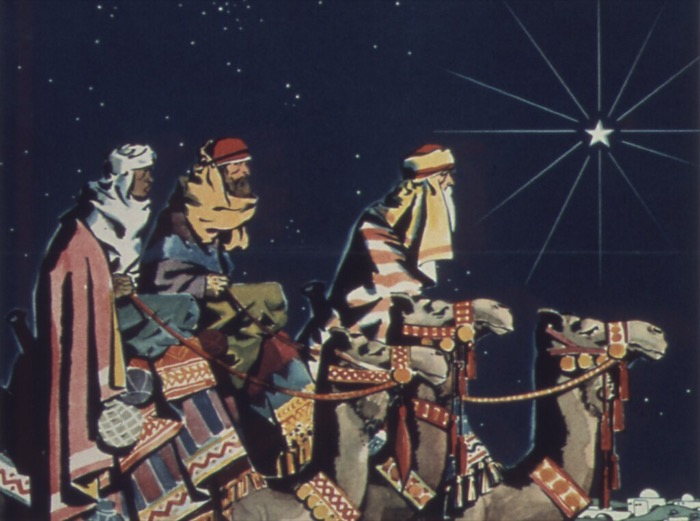
Summary: The gifts brought by the wise men to Bethlehem had surprisingly deep meaning connected to Jesus’ identity and mission.
And when they were come into the house, they saw the young child with Mary his mother, and fell down, and worshipped him: and when they had opened their treasures, they presented unto him gifts; gold, and frankincense, and myrrh. – Matthew 2:11 (KJV)
The Wisemen and Their Gifts
There are many questions surrounding the Bible’s account of the birth of Jesus. Some of them involve the visit of the wise men (or magi) and the gifts they brought.
Commonly referred to as the three ‘kings,’ the Bible never gives their number and never uses the term ‘king’ or ruler of any kind. It calls them by the Greek term ‘magos’ (‘magi’ being the Latin equivalent) which comes from Persian and has a broad meaning including wise men, teachers, priests, physicians, astrologers, oriental scientists, seers, interpreters of dreams, soothsayers, sorcerers, and the like. It is usually translated as ‘wise men’ or ‘magi’ in most English translations.
We don’t get much information about them, but the fact that they are said to have come to worship the king of the Jews after they saw his star rise (Matthew 2:1-2), shows that they were observers of the heavens.
The text also says they came from the east and saw his star in the east, which launched their trek to Jerusalem. This also fits with the Persian source of the word, and points to the likelihood that they came from Persia, which is east of Israel. They may have been of the same order as the wise men or magicians (ḥakîm) mentioned in Daniel Chapter 2 who were brought in to interpret Nebuchadnezzar’s dream, but could not. When the prophet Daniel interpreted the dream, he was made chief over the wise men of Babylon (Daniel 2:48), a kingdom that soon afterward would be conquered by Persia.
Perhaps through Daniel’s influence they learned about the prophecy made by Balaam in the book of Numbers concerning a coming star and Jewish king.
I shall see him, but not now: I shall behold him, but not nigh: there shall come a Star out of Jacob, and a Sceptre shall rise out of Israel, and shall smite the corners of Moab, and destroy all the children of Sheth. – Numbers 24:17
But what about the gifts these wise men brought? While gold is familiar to everyone, many may wonder what exactly frankincense and myrrh are. What were the significance of these items, and what did they communicate in the narrative? There are many different ideas about the purpose of the gifts, but the Bible gives some indicators for their true meaning.
The Gift of Gold
The Gospel of Matthew focuses on presenting Jesus as the coming king predicted throughout the Old Testament. It opens with the genealogy of Jesus which emphasizes that Jesus was the son (descendant) of “David the king” (Matt. 1:6). The wise men then come seeking the recently born “king of the Jews” (Matt 2:2). The teaching and miracles of Jesus astonished the people because of the authority he displayed, even over demons. That same authority threatened Herod, the religious leaders, and Pilate.
When Jesus stood before the Roman governor, Pilate’s question was. “Are you the king of the Jews?” (Matt. 27:11) The sign above Jesus on the cross was, “This is Jesus, the king of the Jews” (Matt. 27:37).

Gold was certainly a gift for a king, and the magi giving Jesus gold is certainly in line with their seeking for the king of the Jews. When the queen of Sheba visited King Solomon, she gave the king a gift of 120 talents of gold (1 Kings 10:10). While the value of gold was determined by weight, the Persians were some of the first to mint coins of a set value, and the Persian daric was the world’s 2nd oldest gold coin with the earliest mintings around 490 BC.
A kingly gift of great value was meant to honor the king by showing that his worth was much greater than the worth of the expensive gift. The furnishings of the tabernacle were of gold as well as the breastplate of the priests, as was the interior of Solomon’s temple (1 Kings 6:21-22). So, gold signified both honor and holiness.
And thou shalt make a plate of pure gold, and grave upon it, like the engravings of a signet, HOLINESS TO THE LORD. – Exodus 28:36
The special promised king of the Old Testament was more than a merely typical human king. He was to reign eternally – a perfect divine king for his people. King David was initially given this promise, couched in a series of promises partially fulfilled by his son Solomon, but as is typical of Biblical prophecies, near-term and far-term predictions were layered together, with some aspects included in the promises that no merely human king could satisfy.
And thine house and thy kingdom shall be established for ever before thee: thy throne shall be established for ever. – 2 Samuel 7:16
The prophet Isaiah takes up this prediction and makes it even more clear that the coming king would be more than just a man, he would also be the son of God.
For unto us a child is born, unto us a son is given: and the government shall be upon his shoulder: and his name shall be called Wonderful, Counsellor, The mighty God, The everlasting Father, The Prince of Peace. Of the increase of his government and peace there shall be no end, upon the throne of David, and upon his kingdom, to order it, and to establish it with judgment and with justice from henceforth even for ever. The zeal of the LORD of hosts will perform this. – Isaiah 9:6-7
That the wise men believed Jesus was this forever king promised in the Old Testament (by the signs and seasons given by Balaam in the book of Numbers and by Daniel in his “70-weeks” prophecy in Daniel 9:24-26) can be seen in their willingness to go on such a long and arduous journey, and to greet and “worship” a foreign king with “exceeding great joy” (Matt. 2:2, 10-11), at a time when Herod was already king of Judea and Caesar was on the throne in Rome. It can also be seen in the words given to Mary by the angel Gabriel.
And, behold, thou shalt conceive in thy womb, and bring forth a son, and shalt call his name JESUS. He shall be great, and shall be called the Son of the Highest: and the Lord God shall give unto him the throne of his father David: And he shall reign over the house of Jacob for ever; and of his kingdom there shall be no end. – Luke 1:31-33
The Timing of the Gift of Gold
In Hollywood depictions it’s common to see aspects of the birth narrative that aren’t exactly Biblical. For instance, Mary is usually seen in labor as she and Joseph desperately search the town of Bethlehem for a place to stay before it’s too late. Yet the text only says, “…while they were there, the days were accomplished that she should be delivered (Luke 2:6).
On Christmas cards the magi are often shown at the stable the night Jesus is born, however there are several indications that this was not the case.

If the wise men were from Persia, it could have been as much as a thousand-mile journey from one of their main centers to Jerusalem. If the star that initiated the wise men’s journey rose when Jesus was born, then it would have taken about two months to arrive, even if they left immediately and traveled in haste.
Additionally, when Herod sought to kill Jesus, he inquired from the wise men when the star had appeared (an indicator that the first rising did, actually, signal his birth), and from that information ordered all the children in the area of Bethlehem up to two-years-old slaughtered (Matthew 2:7, 16). Even if he was giving plenty of leeway on the upper end of the age-range, it is unlikely that Jesus was a newborn at the time.
Another indicator is that when the wise men arrived to worship the child, they saw them in “the house,” not in the stable (Matthew 2:11).
A final clue for a delayed visit involves the gold that was given. After the birth, when the time of Mary’s purification was over, a period of 40 days (Leviticus 12:1-4), Mary and Joseph presented Jesus at the temple according to the law (Luke 2:21-24). The fact that they could only afford a pair of turtledoves or pigeons instead of a lamb shows that 40 days after Jesus’ birth, they were still poor and had not yet received the wealth from the gifts of the wise men. Once they received the gifts, they would have provided for their stay in Egypt after they fled from the wrath of Herod (Matthew 2:13-15).
So just based on the information in the text, the visit of the wise men with their gifts, including gold, was likely sometime between two months and a year or more from Jesus’ birth.
The Gift of Frankincense
According to the Oxford English dictionary, the English word frankincense comes from an Old French expression franc encens, meaning ‘true incense,’ or ‘high quality incense.’ It is an aromatic resin that comes from several varieties of trees in the family Burseraceae and the genus Boswellia, and is used in incense (where it is burnt to produce an aromatic smoke) and perfumes.
These trees grow mainly in the region of modern Yemen, Oman, western Saudi Arabia and Somalia. To obtain the resin-gum, trees are tapped in a process similar to that for maple syrup. However, rather than the free-flowing liquid as with maple syrup, frankincense trees secrete a waxy coagulation, which soon hardens.
In ancient times, the incense trade route (transporting frankincense, spices, and other exotic goods) was very lucrative and important. When Tim Mahoney interviewed the late Juris Zarins (who specialized in the archaeology of Arabia) for the Patterns of Evidence films, he had much to say about the incense trade route. “The Midianites were middlemen who controlled and monopolized the incense trade coming out of south Arabia,” Zarins said. “The incense trade that starts in southern Arabia and works up the spine of Arabia all the way to Gaza and Jerusalem and Egypt, you can pinpoint 10 cities that have been mentioned in the Old Testament. None have been excavated with the exception of Tayma.

“In the story of Joseph in Genesis 37:25 [see different versions] we recall that the Midianites were passing by, it says that they were merchants and it says that they were taking various kinds of myrrh and frankincense to Egypt and that they purchased Joseph for 20 pieces of silver.
“When Moses is told by God that he has to give proper subservience or worship God correctly, then there is that whole system of laws that are handed down that incorporate the showbread and the anointing process that involves frankincense and myrrh. Because of the relationship of Moses to Midian, God required Moses to worship him in such a way as to utilize this frankincense and myrrh.
“So, these are extremely expensive products,” Zarins continued. “And as we know later on, the anointing process extends all the way to Jesus where the legitimization of kingship is an integral part of the use of frankincense and myrrh. When the magi come they bring golden frankincense, the highest grade frankincense there is. They are bringing the legitimization of authority, which is what you get anointed with. Which is this incense. And, what is the word magi? What language is it? ….It’s Parthian, Persian. And, the reason is because the Persians controlled this territory [Yemen/Arabia]. The Romans were to the west, the Persians in the east. The frankincense comes from there.”

The first time we hear of frankincense in the Bible is in Exodus 30:34, where it was mixed with sweet-scented spices to be burned on the altar of incense before the holy of holies. The recipe for the compound was strictly forbidden to be used for common purposes, it was called “most holy.”
Incense was burned to create a sweet odor in the religious rituals of many ancient cultures and the frankincense the wise men brought may have been just as valuable as the gold. Again we have the symbolism of honor and holiness.
The Gift of Myrrh
Myrrh is also a resin taken from a few small tree species from the Burseraceae family. However, these are of the Commiphora genus. Myrrh resin has been used in medicine, perfumes, and incense.

Myrrh is also mentioned in Exodus 30 as part of the recipe for consecrated incense and the sacred anointing oil for use in the tabernacle system of worship. The incense route would have made frankincense and myrrh readily available for their worship while the Israelites were in the wilderness at Mount Sinai and for the next 40 years.
Gold, frankincense, and myrrh were all extremely valuable and appropriate gifts for a king, with frankincense and myrrh being used in anointing oil for royalty and also signifying holiness. The magi are said to have “rejoiced with exceeding great joy” when they saw the star and worshipped the newborn king.
A Second Layer of Meaning
In addition to the honor and holiness associated with the gifts of the magi, they may have a deeper spiritual significance. While the Bible does not explicitly make these connections, many Christian commentators over the centuries have proposed another layer of meaning.
Gold was certainly a symbol of kingship, but the actions of the wise men and the message from the angel show that this was no ordinary king. The holiness associated with the gold in the tabernacle and temple worship also testify to this.
Frankincense was also associated with the divine, and with the prayers of the saints rising to God, as in Revelation 5:8 and 8:3-4. This suggests to many that frankincense also symbolized Jesus’ role as a priest – a mediator between mankind and God, as well as the sacrificer, and the sacrifice itself, that would pay the price for the sins of his people in the crucifixion.

Some have pointed to the medicinal qualities of myrrh to explain the magi’s gift by proposing that they gave it to Jesus to save him from the pain of arthritis and other ailments. But there is a more Biblical connection to be made.
Myrrh was associated with death. It was used as an embalming oil in Egypt and elsewhere to cover the smell of death. Jesus was offered “wine mingled with myrrh” during the crucifixion, perhaps to deaden his pain, but he refused it (Mark 15:23). Nicodemus and Joseph of Arimathea wrapped Jesus’ body with linen clothes and 100-pound mixture of myrrh and aloes (John 19:39).

The myrrh tree is also very spikey, with short branches resembling thorns. This can be tied to the crown of thorns the Bible says Jesus wore during his beating and crucifixion. So myrrh has also been thought to symbolize suffering. Even the common Semitic root for myrrh (m-r-r) means “bitter.” The New Testament teaches that Jesus came on a peace mission from God. He came down from heaven to be born of the flesh to suffer and die as a perfect sacrifice for the sins of his people.
Conclusion
Each of the Magi’s gifts showed he was deserving of honor and praise. They also point to his identity and role as the forever king and son of David, the great high priest, and the dying sacrifice for his people. This places the value of these gifts on a much higher level than they might first appear. May you have a Merry Christmas, as you Keep Thinking!
CLICK HERE to purchase the book Echoes of Ararat (Vol.1)
TOP PHOTO: The three wisemen. (National Archives at College Park, Public domain, via Wikimedia Commons)


.JPG)


