Summary: An investigation into the location of the Garden of Eden. Dr. Carter brings some intriguing flood considerations into view in Part 1 of a 2-part series.
And the LORD God planted a garden eastward in Eden; and there he put the man whom he had formed. – Genesis 2: 8 (KJV)
Where was the Garden of Eden?
Would it even be possible to locate the Garden of Eden today? This week begins a two-part series delving into the questions about geography, geology, and the Biblical account with Dr. Robert Carter, a marine biologist and geneticist from Creation Ministries International. He sat down with Tim Mahoney to record a session for the Patterns of Evidence podcast, excerpts of which were used for this article.
Dr. Carter has some unique perspectives and arguments on this topic based on the catastrophic effects of the flood. In the future look for additional articles profiling the views of scholars who hold different opinions about this question. Now, let’s get right to the discussion.
A History of Investigation
TIM MAHONEY: Dr.Carter, in case there are new people in the audience, would you just tell us a little bit about yourself?
ROB CARTER: When I went to college I had a hard time choosing between biology or history, and I chose biology. And I’m glad I did, but I read a lot of history. And when I look at Biblical history, it’s either true or not. And there’s so much misunderstanding and apprehension about people when they look at this whole account in the Garden of Eden and the pre-flood world and you have archeologists saying, “Oh, that’s the location of Eden.” And I’m like, “What are you talking about? Eden was pre-flood.” And oh, well, they don’t believe in the flood and there’s this whole mixture of things. So yeah, as a nerdy type of a person, I just love digging into things and Biblical history is something I love to dig into.
TIM MAHONEY: There are scholars who really believe they know where the Garden of Eden is today, even though they feel it’s not the same condition that it would have been earlier in the Genesis period. Some have placed Eden in the northern region of ancient Urartu, in the area of modern-day Armenia and Turkey, and others give locations to the south, where modern-day Iraq and Kuwait meet. But you have a different idea where the location of Eden is, which you and your colleague Lita Sanders have written about.
ROB CARTER: We had a two-part article series in the Journal of Creation, Where was Eden? Part 1, examining pre-flood geographical details in a Biblical record. And Part 2, geological considerations, examining pre-flood geographical details in the Biblical record. Kind of sounds similar, but one is more about the names in history and one is more about the geology and the rocks. Both of those things are very important.
But what started us off actually was what you just said. Where’s the location of Eden? And in Beitzel’s, The New Moody Atlas of the Bible, which is a very popular thing, people want Bible maps. I’ve seen this on a lot of pastor shelves. Well, he has on his map of the Middle East two possible locations of Eden, one up north and one down south. And I don’t agree with either of those. I think both of them are a mistake, but that’s what started off this article series. Why do people believe this? Where does this come from? And is there an alternative answer?
TIM MAHONEY: If you get into the scientific evidence, you see why Eden would’ve been buried by the flood if there was a flood, which is what I believe and I know you believe. But first, let’s just talk about the general history of people attempting to locate Eden.
ROB CARTER: Josephus wrote about it trying to guess where it was. I know that Augustine wrote about it, but when he was faced with the fact that there are four rivers and in the Middle East there’s only two main rivers today, he said, “Oh, maybe some of the rivers were subterranean.”
And then John Calvin wrote about it also. He thought that the rivers were there in the Middle East – the Tigris and Euphrates come together, and maybe in ancient times they’d split again. So you have four rivers with a common stream in between, which doesn’t seem very Biblical. But he also rejected the idea that the flood reshaped the geography.
But he’s hundreds of years ago, this is way before we had anything like the modern creationist movement and our understanding of geological history. So I don’t really fault him for it, but there’s a long tradition of people trying to pinpoint the location of the rivers that the Bible describes as emanating from Eden.
Considering the Lay of the Land
TIM MAHONEY: First of all, there was a physical place on this earth. And if we look at Genesis, Genesis 2:10 says, “A river flowed out of Eden to water the garden, and there it divided and became four rivers. The name of the first is the Pishon. It is the one that flowed around the whole land of Havilah where there is gold. And the gold of that land is good. And bdellium and onyx stone are there. The name of the second river is the Gihon. It is the one that flowed around the whole land of Cush. And the name of the third river is the Tigris, which flows east of Assyria, and the fourth river is the Euphrates.”
So rivers flowed out. Where does that put us then? If we have these rivers, is there a map that we can put up that would show this?
ROB CARTER: Well, you can put up a map that has the Tigris and Euphrates on it – the modern Tigris and Euphrates, that’s fine. But I don’t think those are the Edenic Tigris and Euphrates.
I start off by pointing out that I grew up in Southampton, New York, not Southampton, England. So the first thing that Europeans did when they started going around the world, they started naming places after the places they came from. So it would’ve been natural for Noah and his family to name things after things they remembered from before the flood. Whether or not it’s the same river or not, hey, there’s a big river. I’m going to call it the Euphrates, which is a “perath” in Hebrew. Euphrates is the Greek word. So renaming is first.

ROB CARTER: Second, a lot of the names are really generic. Havilah means sandy, a sandy place. So Genesis two mentions the land of Havilah. That’s not a strong description, especially when there’s people named Havilah after the flood and a lot of place names are named after people. But you also mentioned one of the rivers associated with Cush. Where’s Cush?
TIM MAHONEY: I think of Cush being related to Egypt.
ROB CARTER: Yeah, exactly. South of Egypt. It’s in Africa. So some people say, “Oh no, no, it doesn’t mean ‘Cush.’ It’s actually named after this area, and it’s the Kassites,” or something like that. So there’s a lot of entomological wrangling here.
You have to struggle with the Hebrew words, and if there’s a match, and which ones have a match and which ones are just accidents of matching. And what does that word really mean? I mean, “Hiddekel” [interpreted as “Tigris” in most Bible versions] means “arrow,” and the Pishon means ”bubbling,” and the Gihon means “gushing.” So that’s three words. They’re arrow, gushing, and bubbling. They sound like rapid rivers. There are no rapid rivers in southern Mesopotamia.
The Effects of Noah’s Flood
TIM MAHONEY: If we think about the damage that happened with the flood, we don’t even know that the bodies of water were there. What I mean by that is the Mediterranean or any of these bodies of water, it was more like one big landmass, right? The shape of what we see today would not have looked anything like it was earlier.
ROB CARTER: Consider that the entire earth’s surface today is carved by erosion. And there have been places where miles of sediment have been removed. There are places where miles of sediments have been added. It’s been a massive amount of erosion, but the pre-flood world was created by God. It was not an erosional landscape. It could have looked very, very, very different.
TIM MAHONEY: Yeah. And the rivers would’ve been in a completely different place as well.
ROB CARTER: Well, not only that, where did Noah build the ark? It doesn’t say.
TIM MAHONEY: No.
ROB CARTER: We know where it landed. And how long did it float? Five months. Who knows where Noah was when he built it? Who knows what direction they floated? And they just randomly landed amongst the mountains of Ararat. Fine. Okay, we know where he landed. But there’s no geographic connection between Eden and the ark, and the ark’s starting place and the ark’s landing place. So it’s a mistake to try to say, “Oh, Eden must be somewhere near Ararat.” It’s fooey. It’s not true.
You know, like in medieval pictures, you see something that happened in the Bible and all the parts of the story are in the same picture. It’s there so that you can see one picture, and you have the whole story of some account of something that happened. Well, that’s what our brains do, and that’s what my brain did for a long time. You read the stuff, it’s all jumbled together because it all happens. But there’s only a couple of chapters here and all of a sudden we’re after the flood. So all the stuff is in the same area until you start really thinking about it saying, wait a minute, why would Eden be near the Tower of Babel? Why on earth would it be? Who made that assumption?

ROB CARTER: I think this goes back to people like Sir Leonard Woolley who excavated Ur in southeast Mesopotamia and claimed this was Abraham’s Ur. And then he claimed, “Oh, I found a flood layer. That must have been Noah’s flood, which means he completely minimized the effects of the flood. Which means that you still have billions of years of earth history before that. So the fossil record wasn’t produced by the flood. So that minimizing of the Biblical account I think affects a lot of the scholarship today, and therefore a lot of Sunday school lessons, and a lot of the sermons. Because you really have to stop and think through it before you realize that the assumptions aren’t correct.

TIM MAHONEY: Eden would’ve been in this setting.
ROB CARTER: Yeah. So maybe it was like a Pangea or a Gondwana arrangement. I’d be fine with that.
TIM MAHONEY: Yeah. I mean, Pangea makes so much sense when you look at how all the continents would’ve fit together.
ROB CARTER: Yes. That actually also affects our interpretation of where Eden might be. Because as soon as you said that, you just accepted plate tectonics, which I accept also. But the catastrophic version of plate tectonics where the plates move apart about as fast as a person can walk, not as fast as our fingernails grow.
TIM MAHONEY: Yeah.
ROB CARTER: So a very Biblical application of plate tectonics. But the Persian Gulf has had a lot of tectonic activity. It opened up. The Persian Gulf wasn’t there before the flood if plate tectonics opened it up. So trying to identify the rivers that are there now, they’re on top of all this flood-associated geology and sedimentation.

ROB CARTER: If you go to Baghdad today, everything south and east of Baghdad is an alluvial plane. It’s mud that was deposited by the Tigris, the Euphrates, and the Karun River that comes down from Iran. Hundreds of miles of mud, which is now land today. And in a rifting opening Persian Gulf, the rivers would not have looked anything like they look today.
Not only is there, in places, 300-400 feet of mud, beneath that is six miles of sedimentary rock that was deposited during the flood. Six miles deep. If you took a drilling rig and drilled through the rocks, you go six miles down before you hit bedrock. Limestones, shales, sandstones, all sorts of different layers of rock right underneath the modern rivers, six miles of it that’s flood deposited. Why would the rivers today be the same as the rivers before? The landscape is radically different than it was.
TIM MAHONEY: I’ve never conceived of it this way. I mean, I kind of thought that the land was all there, kind of like when you have a flood, let’s say in an area today, because we think of localized flooding from a river or whatever, that the land was there and then the water just was really deep and then it goes away and the land’s still there. But what you’re suggesting is that this cataclysmic flood reshaped the surface of the earth.
ROB CARTER: Yes. Radically reshaped the surface of the earth. Miles of sedimentation, miles of erosion, lots of movement, vertical movement up and down and horizontal movement left and right. Yeah.
TIM MAHONEY: I think it’s so important for people to really take some time and study the flood. A lot of different really good creation organizations have looked at this and Creation Ministries International, you’ve got resources as well, because the flood really sets a lot of things in place, doesn’t it?
ROB CARTER: Yeah, it sets everything in place.

A Garden in the East
TIM MAHONEY: Okay, so how in the world would then you try to come up with the location of Eden?
ROB CARTER: Well, after thinking about it a lot, I’d say that you can’t. Now, if I was going to take a guess, just to be totally speculative, I would say that the Garden of Eden is now underneath Israel, because God’s got a sense of humor and maybe God put a GPS tracker on the crust and he just… But that’s just ridiculously speculating. We cannot actually know.
Eden could have been subducted. It could have been washed away, buried. I mean, there’s no way to tell. In fact, in the geography, if you read these passages in Genesis, the only direction mentioned is “east.” There’s no north, south, or west ever mentioned. It’s just east. And there’s a garden in the east. I don’t know what it is east of. I don’t know how far to the east. I don’t know the shape of this landmass or land masses, but all we know is it’s in the east.
And the Middle East is not in the east. The Middle East is in the middle of Eurasia and Africa. It’s like the geographic center. It’s not east. When you look at the geography, the Tigris, or the Hiddekel, flows east of Assyria [Gen. 2:14]. Well, actually it doesn’t. Assyria spans the Tigris and most of the major cities I think are on the east side of the Tigris, not the West. So even though there’s a loose association between Ashur or Assyria and the Tigris or the Hiddekel, it doesn’t really work. It’s only a loose association.
ROB CARTER: Later on when God’s promising to Abraham to give him all the land from the river of Egypt to the Great River, the Euphrates. In this account, there’s no description of what the Euphrates is. All the other ones get names and where they go and what they wrap around and what you find there. Oh, and then there’s the Euphrates. So why is the biggest river in the region given just an offhand account?
Maybe because the two rivers aren’t the same. The river in early Genesis is not the river in late Genesis. They just named a river Perath again, but it’s not actually the same river. The words are tricky. It’s not as simple as saying, “Oh, the same Hebrew word is used in two places, so it must be describing the same thing.” I mean, the only reason the Tigris is associated with the word “Hiddekel” is used somewhere in Daniel, and where he is located, I guess in Susa or Babylon, it has to be that river. And so Hiddekel is used in Daniel, so therefore, “Aha, the Hiddekel in Genesis must be the same river.” But if that verse in Daniel wasn’t there, we wouldn’t even be able to make that assumption.
TIM MAHONEY: Yeah. For me, it always seemed exciting to think that that could have been the place where it was, but obviously it wasn’t the same anymore. And by finding those rivers, you would be able to track with them. And I think the reason that you would think that way is because a lot of people have written about it.
ROB CARTER: Because as soon as you say, “That is the Pishon and that’s the Gihon,” they’re on top of all the sediments, so Noah’s flood actually does nothing.
Conclusion
That’s where we’ll leave off for now. Next time, Dr. Carter will give additional arguments for us to weigh as we consider the different possibilities and explanations in the debate over the location of the Garden of Eden. Until then, keep thinking!
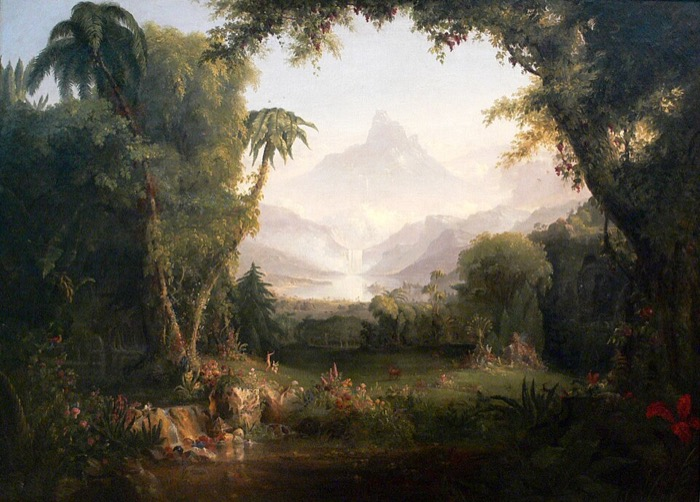
TOP PHOTO: The Garden of Eden. (Thomas Cole, Public domain, via Wikimedia Commons)


