Summary: In Part 2 of our investigation Dr. Carter critiques alternative Eden-location theories and points to the gospel significance of this Biblical account.
And a river went out of Eden to water the garden; and from thence it was parted, and became into four heads. – Genesis 2: 10 (KJV)
The Violence of the Flood
In Part 1 of our series, Dr. Robert Carter from Creation Ministries International (CMI) kicked off our exploration of the question of where the Garden of Eden might be located. He pointed to the effects of Noah’s flood causing a tremendous challenge for that endeavor.
In this conclusion to the series, that highlights excerpts from their podcast discussion, Tim Mahoney and Dr. Carter turn their attention to competing proposals and arrive at the gospel connection to the Eden account. Let’s see what they have to say.
TIM MAHONEY: I’ve been fascinated with things like the Garden of Eden. I think a lot of people have been, as well as the flood. I don’t think a lot of people know what impact that had on the world’s geography and geology and everything, right? But that would’ve been, if it had that big of a significance, then it would’ve wiped out the location of the Garden of Eden. I think that is what your bottom line is.
ROB CARTER: Yeah. Nothing in the world today exists that existed before the flood. Everything is different. The whole land has… I mean, Mount Everest was raised five miles in the air. You can see the stripes on Mount Everest. They’re tilted up. That was underwater at one point. And as Asia and India crashed together, the Himalayas were lifted up out of the oceans and they’re way, way up in the air. Well, with that much of a change in elevation, how can you put your finger anywhere on the map and say, “Oh, that’s where Eden must have been.” You just can’t do it.
TIM MAHONEY: Yeah. And so in other words, what you’re saying too is that because of the layers of sedimentation there’s marine fossils. Fossils in the layers that are up on the top of Mount Everest, right?
ROB CARTER: Yeah. So clearly it used to be under the water, but not a mountain. It was flat sediments laid down during a flood that then buckled up to make the mountain.
TIM MAHONEY: So the violence of the flood was spectacular when you think about it.
ROB CARTER: Yes. Tremendous.

A Southern Eden Location?
TIM MAHONEY: What are some considerations from later historical periods for southern Eden theories? What does the town of Charax founded by Alexander the Great, and the shoreline of the Persian Gulf in his day, tell us about the possibilities?
ROB CARTER: Fascinating, fascinating. So Alexander lived in like 330 BC and he founded a city right near the shore called Charax. And then by the time Pliny the Elder goes there in 70 AD-ish, he died at Vesuvius, the shoreline is 120 miles away from the town. In 400 years the shoreline moved 120 miles. That’s how much mud built up by the rivers dumping into the Persian Gulf. So that’s like a half a kilometer a year, but that’s in Alexander’s time.
If you’re talking about the supposed Babel setting, you’ve got to go back even further in time. All this material’s underwater. You can’t have Babel southeast of Babylon or Baghdad if it’s early, because there’s no land there. It’s underwater at that time.
The Tigris, Euphrates, and the Karun River that comes out of the mountains of Iran joins with the Tigris in Iraq and then the Tigris joins with the Euphrates and together all three dump into the Persian Gulf today. That wasn’t true in the past, but that is today. But back in Alexander’s time, the Tigris and Euphrates weren’t together. They emptied into a lake separately. And before that in history, they probably weren’t connected at all.
ROB CARTER: In fact, in our paper, we look at some satellite photos and you can see the old paths of the rivers. They’re right there in the sands, and the Tigris and Euphrates didn’t connect. They flowed into the Persian Gulf separately. So that raises the question. In fact, this is one of the arguments that we make about the geography. The Bible describes not four rivers, but five rivers. Because you have the river in the garden, the garden river that splits into four rivers. Wait, there’s no river in the world today that splits into four rivers and goes in different directions. There’s one example I know of, I think there’s another, the fire hole river in Yellowstone National Park. It splits and one branch flows to the Mississippi and one branch flows to the Pacific Ocean. So a common source goes in two directions.
They’re extremely rare in the world, but four-rivers-from-one exists nowhere on earth today. And so if you want to say, “Oh, this is the Tigris, that is Euphrates,” that’s a problem because those rivers flow together. The Bible says they separate from a common source. So the Tigris, Euphrates can’t be the rivers. And you can look around for other rivers. Most people are saying, oh yeah, this river and that river and this gully in Arabia, that must be the fourth river. But they’re describing things coming together, which is the opposite of what the Bible describes. So again, the southern Iraq Eden, it just doesn’t work. It breaks. Anytime you look at it, it breaks.
Connections to a Tower of Babel Location?
TIM MAHONEY: Right after that, do we have a sense of where the Tower of Babel might have been?
ROB CARTER: That’s really tricky also because it depends on when Babel was. If Peleg is named “division,” his name means division. If Babel happened when he was born, that’s only about one hundred years after the flood. So there’s not a lot of people around yet. They could not have built a ziggurat, for example. There just weren’t enough people to do something like that.
And unto Eber were born two sons: the name of one was Peleg; for in his days was the earth divided; and his brother’s name was Joktan. – Genesis 10:25
ROB CARTER: But Peleg lived over 200 years so if that division happened during his lifespan, we could have more people. I think it’s pretty early. So where were the people living at the time? Well, nothing southeast of Baghdad because that’s underwater. In fact, before the Ice Age really picked up, most of Iraq in general would have been underwater. Iraq is a really low lying country, a lot of it.
And the water levels are 80 feet higher than they are today. In fact, where I live in Georgia, there’s a line of sandbars with shark teeth and things that goes right across the middle of our state, the whole state, because that was the old shoreline. After the flood for several hundred years, that’s where the beach was. And then the Ice Age starts, water levels drop 400 feet. When the ice starts melting, it comes back up 300 feet. So at one point Iraq is underwater. At one point, the Persian Gulf is dry land and now we have the Persian Gulf again when the water starts coming back in. Lots and lots of changes.

TIM MAHONEY: So that goes back to this big, I guess I would call it the debate between a worldwide flood or a local flood. Because I think the people that want to argue that the rivers mark the location of the Garden of Eden would have to have a local flood. In other words, something that would be hundreds of miles as opposed to something that would be the whole world, the whole surface of the world.
ROB CARTER: But the wording in Hebrew, in the flood narrative, it’s clear. And when it says every hill under all the heavens were covered, that’s a double use of the word “all.” The Hebrew word is kol, K-O-L. It’s all and all. That’s an imperative. It’s all comprehensive. It’s everything on heaven and earth. Well, if I said heaven and earth, that means everything, right? So that’s what Hebrew is using. He says everything was covered by the water.
Plus a local flood makes no sense in a million different ways. I mean, the ark floated for five months. Water always flows downhill. In five months, the ark would have been washed out into the ocean. And if it landed anywhere, it would have landed on a beach, not the mountains of Ararat. So there’s nothing in the story that hints of a local flood or gentle flood or that Eden is connected to the Tower of Babel or the rivers afterwards. We’ve got to think past those things.
A Northern Eden Location?
TIM MAHONEY: There’s another location, right? That’s the northern Eden location that people are suggesting for the Garden of Eden.
ROB CARTER: Yeah. Since the southern location has so many problems, what if the Garden of Eden was in modern day Turkey near where the Tigris and Euphrates River start? Yeah, but what about the other two rivers? There’s four rivers mentioned and you have a single river that splits into four that doesn’t exist anywhere in that area. And yeah, the drainage basins of the Tigris and Euphrates, they have a long border where you can be on a hill and look that way and it goes to the Tigris and look the other way, it goes to the Euphrates. But if you go to the black forest in Germany, the same thing happens between the Rhine and the Danube. On one side it’s the Rhine, and the other side is the Danube. The Rhine goes to the Atlantic, the Danube goes to the Black Sea. So if you map out the drainage basin of two rivers, they’re going to have a common border, but that doesn’t mean they start in the same place.
In fact, the headwaters of the Tigris and Euphrates aren’t anywhere close together. Yeah, the drainage basin has a common border, but the headwaters are far apart. They don’t come from the same place. So just geographically, it doesn’t fit the description given to us in Genesis. In fact, the rivers aren’t connected at the northern end and in ancient times they weren’t connected at the southern end. There’s no reason to assume that these are the same rivers.
The Reality of Eden
TIM MAHONEY: So how does a person who is looking at the Bible and trying to understand this, because some people – modern people, don’t look at it, and they don’t really know, and they just think this is a fairytale. How do you encourage someone on the history of the Bible when we look at this?
ROB CARTER: One of the reasons why we’re digging in like this is to get rid of the fairytale aspect. A lot of times people’s misunderstanding of what the text actually says leads to false conclusions. And when we realize that the Tigris and Euphrates after the flood are not the rivers before the flood, then you don’t have that false correlation. Because once you say, “Oh, that’s the two rivers,” then the flood doesn’t make any sense. The sedimentary record doesn’t make any sense. The missing rivers don’t make any sense. The land of Cush, wherever that might be, all these other things. And then people say, obviously the Bible isn’t true.
But if you don’t try to connect this to modern rivers, then there’s no reason to say the Bible’s not true because it’s not falsely describing the geography of Mesopotamia. And when we try to do that, we almost have to start with a Biblical minimalism, because there shouldn’t be a connection. Trying to do so actually compromises Scripture. So I want to encourage people to not do that. To think more deeply.
TIM MAHONEY: The thing that’s very enlightening for me is that I never thought about where Noah was in the beginning. I kind of figured that he was in the same place. I never thought of the ark possibly being built somewhere else, number one. We think about the cradle of civilization being in that Iraq area there. But that’s where it landed, not where it started out, right?
ROB CARTER: Yes.
TIM MAHONEY: Number two, another takeaway has been that the idea of the Garden of Eden being locatable becomes interrupted by the flood. Because the names of those rivers, even though they’re Euphrates or whatever, it’s possible – very likely, that the face of the earth changed with the flood. And those names were reborn in a sense because of the fact that you had to name a river or you didn’t know what it was, right?
ROB CARTER: Yeah.
TIM MAHONEY: And this whole question of local flood versus global flood. And my understanding is that this global flood evidence is worldwide.
ROB CARTER: Yes.
TIM MAHONEY: And there’s a lot of resources that people can get. But you have some people that believe in the Bible, but they believe it was a local flood. Is that more of someone who is just trying to accommodate the idea of a flood because of all these flood narratives throughout history?
ROB CARTER: No, I would have been one of those people, as a younger person, who thought it was a local flood, if I even thought about it at all. So, just because you don’t think it was a global flood doesn’t mean you’re not a Bible believer. This is not a salvation issue. But yeah, I think the unbelievers, if you could say, the secular historians and archeologists, especially in the early 1900s who were reinterpreting passages and minimizing the implications of a statement and just saying, “Oh, here’s where Abraham lived,” and, “That must be the Tower of Babel,” and “Here’s your local flood.” And they’re still influencing us a lot.

Eden’s Gospel Connection
TIM MAHONEY: What is the greater meaning of Eden that believers can look forward to?
ROB CARTER: This is a very gospel centered discussion, even though we didn’t talk much about the gospel. If Eden was a real place and if the accounts that were given in Genesis about Eden really did happen, then there really was a Fall. There really was an idyllic system or setting that became corrupted. And there really is a judgment for sin, which God said is death. And there really is an explanation why Christ had to come and die. Because if death isn’t a punishment for sin, then there’s no reason for Jesus to hang on the cross. But when Jesus did hang on the cross and he died, all of a sudden all that history of humanity where God doesn’t accept our death because when we die, we deserve it. But Jesus said, “Hey God, can you take my death and apply it to them?”
Boom, we have a gospel. But that hinges on the historicity of the Genesis account in the Garden of Eden. And if Eden is mythological, we have a lot of theological problems later on.
TIM MAHONEY: And what’s interesting is in the Garden of Eden, God actually walked and talked with people. I mean, with his creation, right?
ROB CARTER: Yeah.
TIM MAHONEY: And since that time, there’s been a separation.
ROB CARTER: Yeah. Even though God did appear to multiple people in the Scriptures over time, and Christ walked the earth 2,000 years ago, there’s been a tremendous separation. We do not have access to God like we once did. But Christ opened the door and re-provided the access. And honestly, it’s kind of weird to say, but I’m looking forward to dying because then I get to go to heaven. Right now I’m stuck on this planet and it kind of stinks sometimes. I’m looking very much forward to living with him for eternity. And Jesus opened that door for us.
TIM MAHONEY: That’s right… Thank you, Rob. God bless you and we’ll talk again.
Conclusion
We hope you gained new insights into the Biblical account with this installment and we look forward to exploring over viewpoints regarding the location of the Garden of Eden in future articles. If you are interested in ordering Dr. Carter’s new book Biblical Biology 101 you can find it here. Keep thinking!
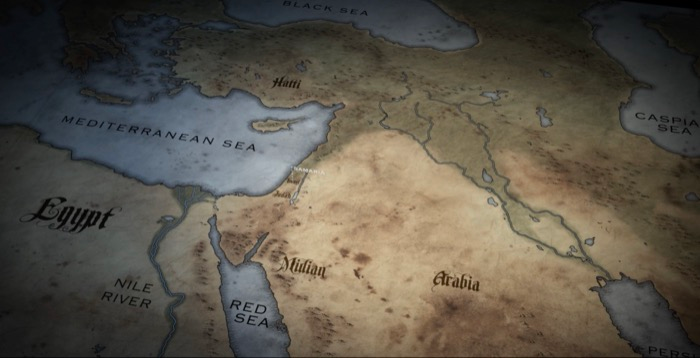
TOP PHOTO: The Mesopotamian region. (© 2024 Patterns of Evidence Foundation)


.jpg)
