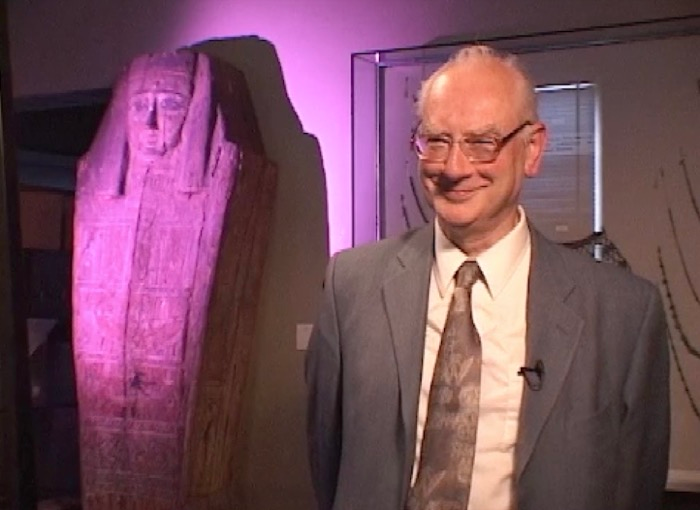
Summary: A Discussion with Kenneth A. Kitchen who was one of the leading Egyptologists of his generation. Part 1 of a 2-part series.
Therefore they did set over them taskmasters to afflict them with their burdens. And they built for Pharaoh treasure cities, Pithom and Raamses. – Exodus 1:11 (KJV)
The Exodus Investigation
Filmmaker Timothy Mahoney became increasingly interested in investigating the Biblical Exodus beginning in 1999. He embarked on his first overseas filming trip in the spring of 2002 when he joined Swedish DNA scientist Lennart Möller to record at Exodus-related locations in Egypt. The trip also featured a stop at England’s University of Liverpool to interview two professors who represented the leading edge of Christian scholarship defending the historical reliability of the Bible.
Since these British professors were both Evangelical Christians at the top of their fields, they held what would be considered the “standard view” regarding the historical setting of the Exodus. Mahoney had been impressed by arguments for alternative ideas regarding the time and place for Exodus events, and thought this might explain why physical evidence pertaining to the Exodus hadn’t been previously recognized. In fact, the evidence was lacking to the point where mainstream scholarship was almost entirely skeptical about these events happening anything like how the Bible describes them.
While hoping to gain new insights for the defence of the Biblical account, Mahoney was also intimidated by the reputation of these two giants of the academic world, especially since they held some paradigms about the Exodus that he thought should be challenged. Kenneth A. Kitchen was one of his generation’s leading Egyptologists, and Alan Millard was an orientalist specializing in ancient languages and inscriptions. Mahoney approached the discussion in an open and respectful manner, wanting to really hear and understand their thinking and the reasons why they believed what they believed. The encounter generated what can genuinely be called friendship, and was a stepping stone to an approach that would become a hallmark of the Patterns of Evidence series.
The late Kenneth Kitchen specialized in Egyptian chronology, especially in the Ramesside and Third Intermediate periods (Dynasties 19-25). The Times newspaper called him “the very architect of Egyptian chronology.” He also argued vigorously against the documentary hypothesis, which held the first books of the Bible to not be the work of Moses as the Bible claims, but the product of multiple authors centuries later, who contradicted each other in their efforts to create a mostly mythological account of Israel’s origins. Kitchen passed away in February of 2025 at the age of 93.
His book On the Reliability of the Old Testament (2003) covers a flood of evidence from archaeology, inscriptions, and ancient documents that relate to the Bible’s account of history from the line of Adam through the era of Ezra and Nehemiah after the Babylonian captivity. Although the amount of information Kitchen could recite off the top of his head was overwhelming and technical at times, his responses were often blunt and to the point – and sometimes quite humorous.
Many of Professor Kitchen’s conclusions differed from ideas Tim Mahoney favored. This included such things as Kitchen’s date for the Exodus being at the time of Pharaoh Ramesses II (instead of centuries earlier as with the “early date”) and Kitchen’s naturalistic explanations for the events of Exodus (part of what our films would call the “Egyptian” view vs. the “Hebrew” view). But Mahoney was not there to argue every point, he wanted to hear the views of this esteemed scholar. So, let’s get to the discussion.
The Date of the Exodus
TIM MAHONEY: Do you think the Biblical text should be seen as a historical document?
KEN KITCHEN: Fundamentally and basically I think so, yes. It has real things in it; names of proper places, the real names of people, things which add up to a historical narrative in some form or another.
TIM MAHONEY: Do you have any firm convictions as to when the Exodus took place? What evidence points to that time period?
KEN KITCHEN: The time period of the Exodus is a much disputed thing, as you well know, and I think, myself, on the evidence that we’ve got that it would have to be not later than 1200 and it can’t be much earlier than 1400 and by preference, in the 13th century BC.
I think about 1250, 1260 BC in the heart of the reign of Rameses. This is where Egyptian geography helps us because the study of Rameses in the Bible, Exodus 1:11, is certainly the same place as Pi-Ramesses in Egyptian texts, which is a city built by Ramesses II and his father a little bit, but not before that time. There was an older town next door but that’s not Ramesses.He was building the city of Rameses to start with. It was a new foundation that he built.
And then if you allow for the traditional 40 years or so for a generation to die and another to arise you suddenly find in the 12th century, after the Exodus period, a sudden rise in the population of the archeological levels in Canaan. And, in between the two you have a stele of the famous King Merenptah, the son of Rameses, who in 1209 mentions Israel as a people in Palestine, along with Ashkelon and Gezer and so on. So, they’ve got to be there by the year 1209, 1208, which is the true date of Year-five of Merneptah as we understand it. The Exodus could be 40 years earlier, therefore, about 1250, 1260 BC.

A statue of Ramesses II in the Grand Egyptian Museum, Giza, Egypt. (credit: John.GGVV, CC BY-SA 4.0, via Wikimedia Commons)
TIM MAHONEY: Which Egyptian dynasty would that have been?
KEN KITCHEN: This would be the 19th dynasty of ancient Egypt, the first dynasty of the Ramesses Kings. Ramesses II is the biggest man in every sense of the word. He reigned for 66 years, eight principal wives, 100 children, monuments the length of Egypt. He was a big fellow.
The Treaty/Covenant Forms in the Bible
KEN KITCHEN: Another sort of thing is the question of the covenant the Hebrews made at Sinai, and in Deuteronomy it gets repeated – that has a particular literary form. You have a historical introduction and after all the rules and regulations and commandments it has to be posited and went out to the people from time to time – the witnesses. You have to have blessings for people being obedient and curses when they’re not. It’s quite a complicated sort of document both in Exodus, Leviticus and in Deuteronomy.
This sort of covenant and treaty form is only current between about 1380 and 1180 BC. 1400-1200 BC in round figures. Not before – it’s entirely different in one way, not later – it’s entirely different in another way. The old fashioned idea of Deuteronomy being written 600 years later doesn’t fit because of what we now know, based on 90 different documents through 2000 years. There’s quite a range of evidence. So there are things like this which help us give at least an approximate date to the event of the Exodus.
Evidence for Moses?
TIM MAHONEY: Is there any evidence of Moses in Egyptology?
KEN KITCHEN: Now, would we find a man like Moses in Egyptology? Not, so far, in the records we have. And, that’s not surprising because, unfortunately for us, he was brought up in the delta, the east delta, and the number of records from the east delta, apart from broken granite is zero. The delta is made of flat mud, it produces no stone and it rots papyrus. Put a cigarette pack in the delta and it would be gone in a year or two in the water and the mud and that’s true of papyrus as well. At one time, if there was such a man, he would feature in the documents but we have no archives at all of Egypt in this period from the swamps to the delta. It’s all gone.
A distinguished professor of Egyptology, Professor Posener in Paris long ago, did a lecture in which he estimated that 98% of Egypt’s papyri had been destroyed. 3000 years of administration, history, religion, everything else has disappeared into the mud or been eaten by the ants in the desert. And if only 2% survived, it was not coming from the delta. No matter what Moses did we would not have any record. He would have to have a tomb carved of stone at Saqqara near Memphis and Cairo to survive. He’s not known to have done that. Ha, ha. So, this is what happened.
A whole lot of people exist for us only by accident. If we didn’t have certain papyri from Memphis near Saqqara, we would have nothing at all on the delta. But luckily a few got through from the east delta to Saqqara for administrative reasons and they preserve a few names of different people. They even have a word called “Apiru,” which is sometimes compared with “Hebrew,” not necessarily correctly. The Apiru are dragging stones for buildings of Pharaoh Ramesses at Memphis. So, there’s people called Apiru, which is similar to “Hebrew,” not necessarily the same word, doing the sorts of things the Hebrews had to do in Exodus 1, where they had to do slave labor, in that case bricks in the mud delta, but stone in the Memphis area. Where you get records, then, you get mentions of people. Moses? No. He’s just one individual among hundreds of others and we really can’t expect that. It’s too much to ask.
TIM MAHONEY: Was Moses a prince of Egypt?
KEN KITCHEN: Was Moses the Prince of Egypt – the famous title of the film? I think not. He was an official. He’s not the son of a king. He’s adopted by a king’s daughter, but that doesn’t make him a prince necessarily.
What I suspect is that as a Semite with the Semitic language at his command and having grown up in Egypt with the Egyptian language at his command he was well placed to serve as an official in the foreign records office of the district capital of Ramesses. This I think is what happened. There are lots of other Semites in Egypt at the same time – we could draw up an arm-length list of them – so that’s no problem. He could find lots of people to talk to in proto-Hebrew, or Late Canaanites, as well as Egyptian. I have got long lists of people. Always, of course, from sites outside of the delta because of the preservation issue.
I can ask a question. How could a mass of brickfield slaves in the delta just sweating out in the fields, possibly know how to make a covenant, an official covenant like you get at Sinai? I don’t know how to make a treaty – in Europe or America, although I’m educated. That’s not my specialty. How could they possibly know how to draw up something like we have in Exodus, Leviticus, and Deuteronomy?
If there is a fellow called Moses, and he’d been trained in the Egyptian foreign office where treaties are handled, covenants of a legal and political nature are handled, he would know the rigmarole. He would know the usage, he would know the methods. And when he went to the Sinai, if he ever did, he would know how to set out a treaty between God and his people, or a covenant. Somebody set that out according to what you could only obtain from the Egyptian foreign office. It couldn’t be just someone sweating in a brickfield or dreaming it up in Babylon 600 years later. It was all gone by then. So, if Moses didn’t exist, you’d have to invent him to fulfill the role. Otherwise there’s no explanation for the phenomena in the Biblical texts as we have them. They reflect a direct historical situation in the 13th century BC, as well as the 14th.

A proposed statue of Joseph found at Avaris in the Nile delta of Egypt, as seen in the film Patterns of Evidence: The Exodus. (© 2015 Patterns of Evidence Foundation.)
Joseph in History
TIM MAHONEY: Was there a character known as Joseph and was there a group that came in and settled and worked the delta?
KEN KITCHEN: Joseph, again, is not named by Egyptian sources because he was so unkind as to live in the delta. It’s the same problem. The period in which he lived, I suspect, was the 13th and 15th dynasties of Egyptology, that’s about 1800, 1700 down to about 1600 BC, in round figures. And, of course the 15th dynasty was the famous Hyksos who were largely Semitic immigrants themselves who took control of Egypt as pharaohs of Egypt, Semitic pharaohs. Dr Bietak’s been digging in the east delta and has found a large area where Canaanites, western Semites, had a settlement and established their district capital that was a predecessor of Pi-Ramesses but not the same place, just south of where that happened. Now, the records from there, again, happen to be zero. A handful of scarabs, which give you the names of people who may have been Hyksos princes, private people. There is no record of a Joseph, there is no record of several thousand other people either, so it’s no surprise. What you do get is all the things that happened to Joseph in Egypt are things which have good Egyptian backgrounds. He is given an Egyptian name: Zaphenath-pa-neah, a wonderful jaw-cracker.
There is a papyrus in the Brooklyn Museum in New York which comes from Thebes in the south of this period and it gives a long list of people, 70 people who belong to the household of a high Egyptian official. And, of those 70-odd people 40 of them are Semites, people of Hebrew type. I did not use the word “Hebrew.” Egyptians called them all Asiatics. They did not distinguish between whether they’re Hebrews or Phonecian or whatever. It’s like calling people Europeans – calling people Semites, a general term. So, you’re never going to get a specific term. Lots of those names are very similar to names in the Bible. There’s an “Aqob” like Yaaqov or Jacob. There’s a Menachem, there’s a Shiphrah. All sorts of good Semitic names, some of which are clearly Biblical in their form. There doesn’t happen to be a Joseph, but quite a lot of them have got Semitic names.
Evidence for the Exodus?
TIM MAHONEY: Is there evidence that there was an Exodus?
KEN KITCHEN: Egypt doesn’t record an Exodus for the simple reason that Exodus was a defeat. A) The literary records, the papyrus records don’t exist anyway and B) No pharaoh ever shows themselves or records a defeat. Because that would bring them disfavor with the gods and then with the people of Egypt. Pharaoh is always shown in a victorious pose, charging his chariot, defeating the enemy, tramping them down, sacrificing them before the gods. He is never shown losing his people in the sea, cowering back in amazement. He is never shown in defeat. You’re never going to get a military record of a successful exodus by foreigners out of Egypt to the Pharaoh’s detriment. That would never happen. Certainly not by Ramesses II, that’s completely out of character.

A relief of Ramesses II from Memphis showing him capturing enemies. (credit: Speedster, CC BY-SA 4.0, via Wikimedia Commons)
KEN KITCHEN: It’s a bit like the Assyrians. We have to track their defeats by noticing on the map where they go. “I won a victory at A, B and C.” Look on the map – it looks like a retreat. You then know that’s his way of recording defeat. In Egypt we don’t even get that. He would not permit such a thing. Pharaohs are never defeated. Ha. You’re not going to get an Egyptian reference to the Exodus on the temple walls. If there had been an administrative document, it has gone to mush in the mud of the delta.
TIM MAHONEY: Let’s talk about serpents. Because the serpent had some symbolic meaning. What was the significance of the staff turning into a serpent in Exodus?
KEN KITCHEN: Serpents in Egypt had several meanings. There’s more than one sort of serpent. There’s good serpents and there’s bad serpents. Good serpents were those that would protect you. The pharaoh on his brow would have a sacred uraeus serpent which was to protect him and spit fire at his enemies. You get the wicked serpent, the great and mighty Apopis, whom the god Seth had to fight and strike down to protect the sun god from the wicked Apopis. You had good serpents and bad ones.
Magicians, of course, were able to be snake charmers. There was a skill with cobras and serpents that has come right down to modern times. I have not tried this, and I don’t intend to, but you can give a cobra a cataleptic fit if you get it right way behind its neck or its throat, you can make it go rigid. And of course you can undo it in the same way. I wouldn’t want to try it. This is the sort of trick magicians could get up to in Egypt preceding modern times. So, magicians playing tricks with serpents is perfectly possible. What Aaron did and Moses did I wouldn’t know. Maybe they knew this. One serpent swallowing the others? Well, I have no comment to make. I don’t know enough about serpents swallowing each other. I suppose in theory they could. I don’t know how hungry they would be to swallow other snakes. I just know nothing about it. I’m not a zoologist, so I’ll leave that to others. Ha, ha.
Conclusion
Next time, Professor Kitchen gives his views on the route of the exodus out of Egypt. Until then, keep thinking!
TOP PHOTO: Kenneth A. Kitchen. (© 2002 Patterns of Evidence Foundation.)


