Summary: The conclusion of the lively Ken Kitchen interview covers the journey of the Israelites out of Egypt and the historical accuracy of the Bible.
For Pharaoh will say of the people of Israel, ‘They are wandering in the land; the wilderness has shut them in.’ – Exodus 14:3 (ESV)
Interviewing a Legend
Tim Mahoney’s 2002 encounter with the late Kenneth A. Kitchen in Liverpool, England covered a wide variety of Exodus and Bible-related questions. Kitchen was about to have his 661-page book On the Reliability of the Old Testament published, and his knowledge of historical and archaeological evidence that could be related to the Bible was dizzying.
Interestingly, although Kitchen was a professor of Egyptology and had the highest of pedigrees in his field, he never earned a formal doctorate degree. This shows that as useful as an advanced degree may be, having one is not necessary for an individual to master an area of knowledge. Likewise, while having an advanced degree may say something about the level of knowledge someone has, it does not guarantee that they always make correct conclusions with that knowledge.
Today, the subject turns to the Israelites’ Exodus journey out of Egypt. Kitchen was a strong advocate of the “Egyptian” approach, which emphasizes the Egyptian meanings of place-names in the Biblical account and their potential connections to locations near Egypt. This approach also normally holds to naturalistic interpretations for all the events in the account. The result is a small-scale Exodus in terms of its nearness to Egypt, the numbers of people involved, the depth of sea crossing, and the nature of the miracles. Let’s get to the discussion.
The Sinai Region
TIM MAHONEY: Was the Sinai under Egyptian control?
KEN KITCHEN: Well, the answer is it was, but seasonally. What happened was they sent expeditions out to certain parts of Sinai, the west side, where they could mine turquoise – a beautiful pale green-blue stone. They usually went in the winter when it was cool enough to do it. They grumbled a lot if they had to go in the summer. So, they would go down from what we now call Suez, to the middle of the coast of Sinai and then they would go up into the mountains to mine this material. It would take two or three weeks and then they would go home again.
Nobody wanted to live there I can tell you, only the local equivalent of Bedouin. So Sinai, technically, is an Egyptian territory, as it is now. But, in practice, almost as it is now, it’s hardly an occupied area, just the local tribes folk tend to live there. So, when Israel fled to Sinai they were fleeing to an area very little occupied except by odd tribes people like you read about, like the Amalekites and so on.
TIM MAHONEY: Where do you think the burning bush experience happened?
KEN KITCHEN: My short and simple answer is ‘I have not the foggiest idea.’ Ha, ha. It might have been at what we call Mount Sinai, but I have not the foggiest idea. It’s somewhere in the peninsula of Sinai or, if you think it was in Midian, it could be the other side of Aqaba. It doesn’t worry me a great deal.
The Red Sea – Yam Suph
TIM MAHONEY: The Bible talks about the Israelites crossing the Red Sea. In Hebrew, that term is “Yam Suph.” What does that mean and where is Yam Suph located?
KEN KITCHEN: Yam Suph, is commonly translated “the Red Sea” in the old version from the Greek understanding of it, Eritrea [derived from Erythra Thalassa] and all that. There is also a meaning taken in Egyptian wherein the word tjuf [sounds like choof], or suph, that means papyrus or reeds. And that’s the usual understanding, that it is the Sea of Reeds rather than the Red Sea. It also has been suggested to mean the ‘Sea of the End,’ with suph meaning something else entirely. That one doesn’t really work.
There ARE seas of reeds in the east delta, and there is a whole chain of places, lakes like Timsah and so on, which the Suez Canal more or less wrecked in a sense. And, that’s probably what it really is. It’s these seas of reeds, and as we pointed out recently, reeds can live in salt water as well as in fresh water depending on the species. And that would fit very well with the Egyptian word tjuf, which also describes reeds. And the Egyptians around Per-Ramesses mentioned tjuf, papyrus and reeds from this area. It fits naturally.
TIM MAHONEY: My understanding is that Solomon had a fleet of ships on Yam Suph. Doesn’t that require a sea and not a land-bound lake?
KEN KITCHEN: Yam Suph has an extended meaning. A, it’s the Sea of Reeds, then that Sea of Reeds runs down in antiquity until it meets the Gulf of Suez, as we call it. And, then you just extend the name. If you go on and on you find around the corner of the gulf there is another piece of sea which is also narrow and long. If you get to the top end of that gulf, there’s some reeds as well. So, there is another section that they can call Yam Suph. So Yam Suph has a narrow meaning on the east side of Egypt and it takes on an extended meaning.
We talk about Asia, meaning everything from Istanbul to Tokyo. But in Roman times it was just a tiny province inside of Turkey and everything east of Assuwa eventually came to be called Asia. So names can extend and shrink and that’s what happened there.

The Route to the Sea
TIM MAHONEY: Josephus says the crossing area was surrounded by mountains. And I just came from the Bitter Lakes and there aren’t any mountains around them. So why should the Bitter Lakes be the crossing?
KEN KITCHEN: I don’t think he ever went to Egypt did he? Ha, ha.
TIM MAHONEY: I don’t know. But why do you think the Bitter Lakes would be the crossing?
KEN KITCHEN: The Bitter Lakes play some role in this I think because they would occupy the area of Yam Suph. These lakes with reeds which you can still see today. And, that gives us the right sort of distance. A march of two days’ journey from Rameses to Succoth, and one again from Succoth to Migdol and Etham, the space and time element fits the lakes very well. If you want to put the lakes far away down to the Gulf of Suez, or even farther away, the time against march doesn’t fit. 15 miles a day is about right.
TIM MAHONEY: So it’s about time?
KEN KITCHEN: Yeah, time and distance.
And the people of Israel journeyed from Rameses to Succoth …And they moved on from Succoth and encamped at Etham, on the edge of the wilderness… Then the LORD said to Moses, “Tell the people of Israel to turn back and encamp in front of Pi-hahiroth, between Migdol and the sea, in front of Baal-zephon; you shall encamp facing it, by the sea.” – Exodus 12:37, 13:20, 14:1-2
TIM MAHONEY: So let’s talk about your ideas of time.
KEN KITCHEN: Marching in antiquity for a group of people tends to be about 10 or 15 miles per day. You got a group of people who are not mountaineers or experts. You’ve got a group of people who are not used to marching an awful lot. You’ve got wives and children and animals with them. So, they’re not going to do more than about 12 miles per day. So, that’s enough from Per-Ramesses down to Succoth and from Succoth out to the region of the Bitter Lakes and the place name like Migdol and other things that belong in that area.

TIM MAHONEY: The Biblical text says that they were able to move night and day. Have you ever thought about that?
KEN KITCHEN: No. Ha, ha.
TIM MAHONEY: You know, maybe they rested for a short time and then maybe their marches were longer than normal. I was just curious…
KEN KITCHEN: People did sometimes march by night for military purposes. People marching night and days was not unknown. The Hittite king, Šuppiluliuma, he was prepared to go by night through mountains to surprise people the next morning in a military campaign. So, people sometimes did go by night as well as by day. So, a group marching out of Egypt, if they were determined, might very well take a short rest as one might suggest and say ‘alright, up lads, come on’ and with the light of the moon they would then march on to get that much further away from the Egyptian core. So, a night march is by no means unknown. They do have them in the Near East in the late Second Millennium. I’m sure it occurs at other times, too.
Out of Egypt?
They said to Moses, “Is it because there are no graves in Egypt that you have taken us away to die in the wilderness? What have you done to us in bringing us out of Egypt? Is not this what we said to you in Egypt: ‘Leave us alone that we may serve the Egyptians’? For it would have been better for us to serve the Egyptians than to die in the wilderness.” (Ex. 14:11-12)
TIM MAHONEY: At the sea crossing, the Hebrews cried out to Moses, “Why have you brought us up out of Egypt to die in the wilderness?” Let’s talk about that passage, because if they were at the Bitter Lakes, at the traditional boundary of Egypt proper, they wouldn’t have been out of Egypt yet.
KEN KITCHEN: Well, they are out of Egypt proper. Once you’ve crossed the Bitter Lakes area you’re out of Egypt proper. Sinai is independent. It’s not a part of Egypt proper. Sinai belongs to Egypt but it’s not Egypt.
TIM MAHONEY: When they were on the shore they said “Why did you bring us out of Egypt to die?” But technically speaking they would still be in Egypt on the near shore of the Bitter Lakes, so how do you answer that?
KEN KITCHEN: Oh, well, this is rhetoric, is it not? They are away from the fields, they are away from cultivation, they are in the desert already. There is a tongue of land that comes in from the lakes between the angle of the river Nile of those days, which was further east then, and the Wadi Tumilat, which was its own waterway. That’s a tongue of desert land and that’s hardly Egypt in any sense, except nominally. They have been brought out of the cultivation, out of the area where they had lived, into the desert already before they had even crossed the lakes. I think that’s still true today in that area.

TIM MAHONEY: If they crossed at Bitter Lakes, why wouldn’t Pharaoh, with that large army, have just sent troops about ten miles around to the other side to cut them off?
KEN KITCHEN: That would be a long way around and there is a limited number of crossings. How could Pharaoh get at them otherwise? He took the shortest route. He chased directly after them. To go around to the other side he would have no idea where they would get to by the time they had done that. So, he sent his troops by the shortest way immediately – “I want them, now,” and he said, “Right, go and get them.” And he led them part of the way. And, that’s the simple answer. This is a straight route, southeast. And, he didn’t need to go right around because he had no idea they were going to be able to cross. He would think, “Right, they’re snarled up, there’s water here and water there, and they’ll be caught between waters, the desert edges, and his forces, so he did the logical thing I think.
The Dead End at the Sea
TIM MAHONEY: When the Lord told the Israelites to turn back and camp at Pi-hahiroth between Migdol and the sea, do you have any ideas where those places are or what they refer to? And then Pharaoh said they were lost in the wilderness and that the wilderness had shut them in.
KEN KITCHEN: How much do we know about where some of these other places are: Midgol, Pi-hahiroth and Pharaoh talking about the wilderness hemming them in? I think the answer is: Not a lot. If it’s wet, it’ll do. The winds blew the water we’re told, the Lord sent the east wind, they say, and the waters were blown and the sands were cleared and they went through. And, then the wind changed and whoosh, the water comes back. Exploration of the delta is still in its infancy. It’s not like the Nile valley, which is much easier to dig, you see. New work is being done. There’s Manfred Bietak at one point, Edgar Pusch at another point, and James Hoffmeier at another point, and these people need to unearth evidence for the different places occupying them and we cannot yet fully interpret the geography of this detail.
From the Sea to Mount Sinai
TIM MAHONEY: Where did the Israelites go after the sea crossing?
KEN KITCHEN: Once they go past the sea we only know that they didn’t go north to the Mediterranean – they were warned not to because there was an incredible chain of forts the Egyptians had there, and depots. And that illuminates one Biblical verse. God didn’t send them, it says, along the way of the land of the Philistines, which was the coastal route, because they might see war. If they had gone that way it would have been the chop [head chopped off motion].
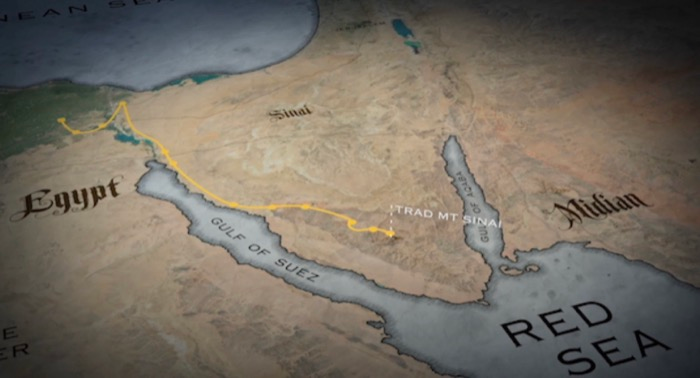
No Egyptian forces were stationed anywhere south of the Mediterranean coast, so they were sent south, well out of trouble. They didn’t go across the middle of the Sinai because it’s a barren limestone plateau, the el-Tih, even today. Therefore it seems that they turned well south. It’s ecologically sound. There’s sand beds there. You can dig down and get water. And there are wells.

KEN KITCHEN: There’s a wonderful choice of high mountains for the giving laws in south Sinai. The traditional one as we all know is Jebel Musa and Jebel Katrina. Of course Arabic: Musa for Moses, which since about the 6th century AD has held prominence. Before that we have no record at all, there is no way of knowing. It’s nice to go up at dawn to Jebel Musa and think, “Maybe Moses went up there before me,” but maybe he didn’t. Maybe he went to another one. It doesn’t matter. But that’s certainly the right sort of area. It’s as close as we can get I think.
And most people are prejudiced against it because it was held first in Byzantine and lay tradition. But, the mountain has various advantages that its rivals, like Jebel Serbal and so on, don’t have. It’s a good area for a group of people to meet, whether it’s 20 or 200 or 200,000 or whatever figure you want. And, you have a good place for a man to go up to meet God and come down again if you want. Other mountains are much less accessible, much less useful. At Jebel Serbal you’ve got three miles of stones and rocks and whatever to get to the wretched thing, although it’s a very fine mountain.
KEN KITCHEN: From there you can then go on the 11-days-journey as Deuteronomy 1:2 speaks of – you go further north to Kadesh Barnea, which is somewhere near Ein Qedeis, in that area, and cross the other Yam Suph, which is the Gulf of Aqaba and you go around Edom and Moab up through trans Jordan and across the Jordan.
I am aware, of course, of other more exciting theories than this. This is a bit too traditional for some people’s taste. But I’m not proposing it because it’s traditional, but because it fits the ecology of the region. They go through these wadis, these valleys with greenery and good run-offs. Some forms of rock retain quantities of water and they are friable. If you knock them with an implement and tap these rocks, the surface comes off and the water rushes out, like what happened to Moses. A British gentleman found that out in the 1920s – he got teased for being a second Moses having hit the rock and gotten water out of it.
So, with a limited amount of archeology, certainly some ecology, and because of the Egyptian holdings up north, we can draw a good suggested route for the Exodus from Egypt through Sinai and up through transJordan to Canaan. Other people are welcome, of course, to suggest other things and that’s their problem. Ha, ha.
Is the Bible Historically Reliable?
TIM MAHONEY: Is the historical text of the Bible an accurate document or is this just a book of myths?
KEN KITCHEN: I think the answer is it has a very firm historical basis. Biblical books – are they history? Are they myth? Are they something in between? I think the more closely you go to the Biblical books and say ‘right, what have we got that relates to it at all?’ And, you go right through all the materials from Egypt and Syria and Babylon and Arabia and the Hittites, wherever, and you bring the material together that relates, again and again and again you get a historical correlation for where they exist, the time of the kings of Israel and Judah and after that in the exile. Time and again we get exact correlations. When you go back into earlier times you’re not getting the kingdom except in difficult circumstances. Solomon and David flourished because nobody else was there to rival them. So, we get no record from a decaying Egypt, a decaying Syria and a quiet Babylon. You don’t have records about people they didn’t meet.
When you go back to the days of Joshua, Judges, and Moses and the patriarchs you’re not dealing with a nation in a sense of an empire. You’re dealing with groups of people, in the sense of a tribal community. And, they don’t leave great buildings, elaborate papyri, elaborate tablets, elaborate state records at all. What they did was on papyri, if any, which have perished in the mud or ostraca [pot sherds with writing on them] which have to be sorted out to see it at all if you’re lucky. So, we’re not going to get the same sort of record in early times.
KEN KITCHEN: It needs a lot of work to study these things. Many languages and lots of archaeology. It’s hard work, slow work. But out of this morass of material many interesting things come up and many details. Joseph was sold for 20 shekels. So what? It just so happens to be the correct price for a slave in about 1700 BC. Isn’t that strange – in about the time when he was alive? In Moses’ time you get people going for 30 shekels in Exodus, you get a possible redemption price of 50 shekels in Leviticus. Surprise, surprise, in the late 2nd millennium people are selling for 30-50 shekels. Way down in the 8th century a man has to redeem his nobles from the city for 60 shekels or 50 shekels. Surprise, surprise 50, 60 and upwards is the right price for slaves in the days of the Assyrian kings.
After that, galloping inflation, so by the time of the imaginary writer P [P for the Priestly source in the documentary hypothesis] around 400 BC they’re not saying people are 20 shekels or 40 sheckels or 60 sheckels. It’s rocketed through the roof. It’s a hundred sheckels or 120 sheckels. Anyone writing in that period would use that sort of figure, not the very genuine figures we’ve got, and the order of things in the Scriptures. That sort of timing thing comes up time and time again, when the whole mosaic fits together you get a mosaic [or a pattern] and not chaos.
Conclusion
Many of the topics covered in this interview were explored in our Red Sea Miracle and Journey to Mount Sinai film series. Asking scholars questions helps to understand their theories and uncover new information. As much can be learned from the quality of some answers, as from the weakness of others. Sometimes you don’t even recognize the strength or weakness of a view until you speak with someone else with a different perspective that points out the significance of particular points. We all hold to certain paradigms that tend to become more cemented in place over time as we gain knowledge and increasingly focus on points that support our adopted view and ignore or downplay points that speak against it. It is useful to hold our ideas about certain scientific systems loosely as we consider alternative possibilities that may tip the scales in another direction as more information is gained. This helps us to keep thinking.
TOP PHOTO: The lands of the Exodus, showing the standard view today. Ken Kitchen favors a sea crossing a bit farther south at the Bitter Lakes, the largest lakes east of the Nile delta. (© 2020 Thinking Man Films)


.jpg)