Summary: Does DNA evidence prove Darwinian evolution? Dr. Rob Carter concludes the series by showing why the answer is an emphatic, “No!”
Thy word is true from the beginning: and every one of thy righteous judgments endureth for ever. – Psalm 119:160 (KJV)
The Waiting Time Problem – Creating New Systems
This week concludes the discussion about genetic evidence matching the Bible between Tim Mahoney and geneticist Dr. Robert Carter from Creation Ministries International. You can catch part 1 of their exchange here. Now, let’s listen in on this important and intriguing episode.
TIM MAHONEY: Let’s talk about another topic, which is the Waiting Time Problem. What is it and how does it relate to everything we’ve been discussing?
ROB CARTER: John Sanford and Bill Basener wrote a paper on the Waiting Time Problem. So Bill’s a mathematician, a geneticist. This is something that comes from evolutionary literature. So we didn’t make this up. It’s simply that if you need something completely new to arise in a population, you’ll have to wait forever.
So if you have a gene, and if the gene mutates right there, the thinking is, “Oh, now we have the ability to do something else.” Well, the probability of that kind of mutation happening is very, very, very low, but it’s even worse than that. The problem is that it’s not just that you have to wait for that mutation to happen somewhere in the population. It probably has to happen three or 400 times, because most mutations are lost accidentally. Just because I have a child who has that mutation. Again, the thinking is, “Okay, now we can evolve to something else.” Well, that child might die before he’s an adult. The probability of that letter getting passed on to their next child is fifty fifty.
So even if that child has a mutation, even if that child has children, it doesn’t mean that the grandchildren will have that mutation. So it’s the Waiting Time Problem. There’s three billion letters in our genome. If you have to have a single letter change, this T has to change to an A. Well, you’re going to wait a long time. If you need two changes, an A and a T, an A here and a T there, you have to wait a really long time, not just for it to appear once, but to appear and then to stick.
ROB CARTER: And the calculations tell us that if you’ve got to wait for four or five or six letters, you need more time than the history of the universe. If you’re waiting for a specific function to arise, it’s never going to arise. That’s the problem. Now, I know what they say in return, because I’ve made a video on this, and a well-known YouTube personality, anti-Christian and evolutionist, did a retort video on it. So the information’s out there.
They’ll say, “Oh, but evolution’s random. Evolution isn’t waiting for a specific thing to arise. Lots of things are rising. And so if this happens to arise or that arises, whatever, whichever one arises, that’s what evolution can work with.”
Okay, that’s a nice thought, but if all those things are equally improbable, nothing’s going to arise. You might get a few things to arise in human history, even in your millions-of-years scenario, but not nearly enough to have evolution happen. We need a lot of genes to separate us from chimpanzees, not just one lucky one. Lots of them. We have entire gene families in the human genome that chimpanzees and gorillas don’t even have. It’s like 600 genes, the full thing, the whole gene is there. It’s got introns and exons, and controlling features, and it makes us protein, and it does other things.

ROB CARTER: So it’s not just that we have the gene, the gene is integrated into our biology. So it didn’t just arise and now the body doesn’t know what to do with it. No, it arose and it’s already part of our systems. And in fact, if you take it out we die. So all that has to arise. When you start adding the probability of all of those things, there’s not enough time in the history of the universe, even in a 13-billion-year-old universe, for all that to happen. So random or not, it doesn’t matter.
My other thing is that, okay, let’s just say that genes can arise at random, but most of them are lost. Then our genomes should be full of genes that are arising all the time because you have to lose 99% of them. And our genome’s not full of incipient genes. It’s full of complete genes, some broken genes, but not incipient genes, just one letter away from becoming this new feature. So that’s the Waiting Time Problem.
TIM MAHONEY: You’re saying that for that evolutionary process, say from an ape to a human, that there’s not enough time for all those modifications to have happened, and there’s a whole bunch of missing components, right?
Do Species Have an Expiration Date?
ROB CARTER: Yeah. And especially when you add to that genetic entropy. Genes break faster than they form. Genes erode away, mutations destroy things, and natural selection has to remove all those bad mutations in order to clear the field so that a beneficial mutation, if they can even happen, can finally arise and now a positive evolution can happen. No, natural selection has to constantly get rid of these mutations that are accumulating, but it can’t.
And one of the big problems is that we’ve got two copies of our genes. Now, God engineered that on purpose. Being a good engineer, he said, “You know what? I need a backup copy.” So if a mutation happens, the person still has a good gene that still works, but that means that the good gene masks the bad gene, and these mutations build up over time, not being selected, not being removed, until so many of them build up and all of a sudden a child starts inheriting two bad copies.
And so the process of sexual reproduction masks the problem with genetic entropy until it’s too late. And that’s why populations of species can’t last for millions of years. The mutations will build up and we’ll go extinct.
TIM MAHONEY: I never heard that before. What you’re suggesting then is that the batch of genes we got from the beginning from Adam and Eve, is continuing to mutate through every generation. Then it went through Noah, and because of his old age when he fathered children there was a huge amount of mutations that happened around the time of the flood. And if you go on in time, those mutations are going to happen to a point where we’re not going to be able to actually recreate?
ROB CARTER: There will come a time when the human race can no longer reproduce because it’ll be impossible to find a mate with whom you can have a child because mutations do build up over time. They build up faster than they are removed, the essence of genetic entropy. We see that in species that have very small population numbers like the cheetah. There’s about 10,000 cheetahs in the wild in between India and Africa, and they’re broken up into little isolated pockets. And so each little pocket is a lot less than 10,000 individuals, and we’re seeing birth defects increase, litter size decreasing, reproductive incompatibilities happening.

Cheetahs are having a hard time reproducing. They’re going to go extinct. There’s nothing we can do about it. Now, we don’t know when it’ll happen, but all of a sudden, maybe a new parasite comes up or the climate changes or something happens, a virus wipes them out. That happens over a slower period for species with larger numbers. So humans are going to persist for a long time, maybe even millions of years potentially, but we’re going to be building up mutations and our robustness, our fitness, our health, will be going down every generation.
ROB CARTER: One particular mutation that’s common in Europe, maybe 10% of the people or something, there’s a big place in a chromosome where the genes are reversed. It’s called an inversion, and that produces infertility in a lot of couples. So add a lot of things like that over time, and as they build up and build up, all of a sudden you have lots of infertility. Because I mean, it’s been thousands of years. The fact that the human species has survived, or any species survived for thousands of years, is a testimony to the genius of God and his unbelievable creative brilliance.
If he wasn’t so smart to build us robustly, we would already be extinct. That’s what the science is telling us. This is the result of sin. This is the effects of sin building up over time, and it is hard to watch. But we have modern medicine, and we can now cure things, like some cancer, genetic cancers. All of a sudden a person could live 30 or 40 more years after something would’ve killed him in 1950. So medicine has advanced and we’re reversing a lot of the effects of the curse, but that’s only temporary.
Trained as an Evolutionist
TIM MAHONEY: You were a skeptic when this all began in your life.
ROB CARTER: I think I became a believer when I was 19. I’d even gone to church all my life. I was a paper-thin Christian. I had no desire to know more about God. I didn’t know anything about the Bible. I really think God woke me up when I was 19. But even then, I was an evolutionist.
TIM MAHONEY: You were an evolutionist?
ROB CARTER: I was never introduced to this creation stuff growing up. No way. I never met anyone who actually really believed the Bible, as far as I know, who actually said, “this is what the Bible says.” When I first started running into people like that. I thought they were nuts. So yeah, “Okay, the Bible says that, but you believe it? What?” So yeah, it’s been a long, long road.
TIM MAHONEY: So what would you say to someone who’s hearing this right now? They went to high school and they were given a lot of information about evolution, just like you were, and just like I was. And he’s not believing anything about the Bible. What would you say to him?
ROB CARTER: I would say to him that very intelligent and reasonable people have a very different opinion about the things he’s learning. I like to generally warn the 18, 19, 20 year olds, I say, “Congratulations. You’ve become an adult. You have an adult brain, an adult body. You now have the capacity to know anything that an adult knows. But by the time you’re done with college, you’ll have the intellectual capacity to parrot everything your professor said. You will not yet have the decades of experience that that person has, to know why they said this or know why they said it in a certain way. They’ve already seen people like you.“

I mean, I was a teacher for four years and honestly, you kind of know, “Oh yeah, it’s that kid.” Even though it’s not the same kid, you know it’s that kid, and this is how they’re thinking. It’s how they’re behaving, it’s how they look, and this is what they’re into. And you get a feel for the type of kid, and you know what makes him tick, and you know how to take them apart. And the professors practice. They practice. “Oh, here comes the young evangelical kid who thinks Noah’s flood is true, and Adam and Eve are true.”
And they announce that evolution’s a fact. That got me. Man, when my professor said that, he actually stopped in the middle of class. He just said, “Let’s just accept it. Evolution’s a fact.” And then he went on with his lecture. In fact, I had that guy three times. Every single semester he did that at one lecture sometime in the middle of the semester. And what did I do? I remember saying to someone,”Oh, face it, evolution’s a fact.” Because what else did I know? I only knew what I was learning. I did not know there’s an entire separate intellectual track that is in parallel to evolution and completely antithetical to evolution. I had no idea.
TIM MAHONEY: Well, there’s just so many mathematical and other reasons that this isn’t making sense at all. A friend of mine, Frank Turek, has a great book, “I Don’t Have Enough Faith to Be an Atheist.” And honestly, I want to just thank you for the work that you’re doing because I’m going to be tapping into it, I believe, when you look at genetics, that’s just a whole nother window into God’s creation.
ROB CARTER: I don’t have enough faith to be an atheist? I got a new line that I’ve been using after documenting all these things that are incredibly improbable. I say, “No, it’s the atheist that believes in miracles.” I have a reasonable creator. I have a cause, and there’s a reason why this exists. Our God took matter and arranged it such that you can have living things. They have to believe in random chance.
And the probability of life ever arising, and the probability of complex life arising, and the probability of the information getting spelled out in DNA in the earliest life, is essentially zero. They have just blind chance. And the probability of these things coming together so that we can have this conversation even are so vanishingly small that I’m not the one appealing the miracles here, it’s them.
Weaknesses of Evolution
TIM MAHONEY: When you think about the idea that there’s a male and a female, let’s just say something was created randomly. First of all, all the body parts and all the functions – the digestive system, the eye, the ear, and then to create a mate, the idea of male and female animals.
ROB CARTER: The origin of sexual reproduction is on our list that we have as an article on our website, 15 Questions for Evolutionists. This was done a long time ago. In fact, it was so popular that the evolutionary community made their own articles, 15 answers to the creationists. And we have answers to their supposed rebuttals, but one of those 15 questions was, please explain the origin of sexual reproduction because it makes no sense. Why on earth would an organism decide to only share half of its DNA? And how on earth did this complex way of taking chromosomes and linking them up and crossing them over? I mean, and if that system doesn’t work, the organism dies. So how do you go from a bacteria, that’s simply clonally reproducing itself, to something that’s scrambling its DNA? I mean, what? Hundreds of proteins are involved in that process. Any number of mutations there kills the organism.


TIM MAHONEY: Do you know who Gerald Schroeder is, astrophysicist? I met him in Jerusalem and he came to our Exodus showing. He loved it and he focuses on the Torah and he’s a big fan of Patterns of Evidence. But he was saying that there aren’t enough particles in the universe to do even a simple Shakespeare sonnet randomly.
ROB CARTER: There was a new article that just came out in evolutionary literature. They concluded that, ‘No, a billion monkeys could never type Shakespeare’s plays.’ Even an infinite number of monkeys at random, it’s never going to happen. But that’s not even the problem. The problem is not, “What’s the probability of a monkey randomly striking keys that he’s going to put up something intelligible?” The problem is, “How do you find it?”
Let’s say we’re looking for one of Shakespeare’s plays, perfect, with no spelling errors. You’re just looking at random pages printed out from typewriters. If, “Somewhere in the universe, that thing has arisen.” Yep. Your universe is full of useless pieces of paper with random marks on it. How do you find the one copy of this somewhere in this endless sea of paper? Not only can it not happen, even if it did happen by some miracle, you can’t locate it.
TIM MAHONEY: And then you’d have to have another one just like that to actually mate with. Like we said, Gerald Schroeder, astrophysicist, I met him in Jerusalem. His conclusion was if you measure all the particles in the universe, there’s not enough particles in the universe to randomly accomplish that. And the eye, the retina, and all this is so much more complex than that concept. And so that’s the reason why it’s so interesting to have people so adamant about evolution.
ROB CARTER: I mean, Darwin said, “Let’s start with a light sensitive spot.” And then he talks about the origin of the eye and how it can fold and make an image. And just putting aside the fact that a lot of the geometric shapes the eye would morph into will produce a worse image than the earlier ones, so you’re not going to evolve from one to the other. But besides that, Darwin started with a miracle. He said, “Let’s start with a light sensitive spot.” Excuse me? The chemistry of the detection of light is insane. Not only that, the wiring between the light sensitive spot and the brain, and the brain being able to interpret the fact that it’s seeing something, it’s insane. I mean, in our eyeballs, every time we detect one photon, I mean, billions of photons are coming through our eyes at any instant.
One photon is detected by a photoreceptor and it’s destroyed. It’s broken. That photoreceptor, that chemical has to be exported from your eye cell to another cell that fixes it and it gets reimported into the light-detecting cell. Those photons are strong enough to destroy biological molecules. How did this arise? How did biology say, “Hey, I’m going to …” It’s akin to a butterfly catching a bowling ball. That’s what it’s like to be able to pull light out of this air and image it in the back of our eyes and then send it to our minds so that our minds can now say, “Hey, I see a bowling ball flying through the heavens and oh, there’s a butterfly.” And we see this video of it.
Conclusion
TIM MAHONEY: Well, thank you, Dr. Carter, for being a friend. And thank you for the work you guys are doing at Creation Ministries International, and for helping us understand a little bit more.
ROB CARTER: You’re welcome. It’s been great.
TIM MAHONEY: We’re going to be coming back to talk again. Until then, keep thinking!
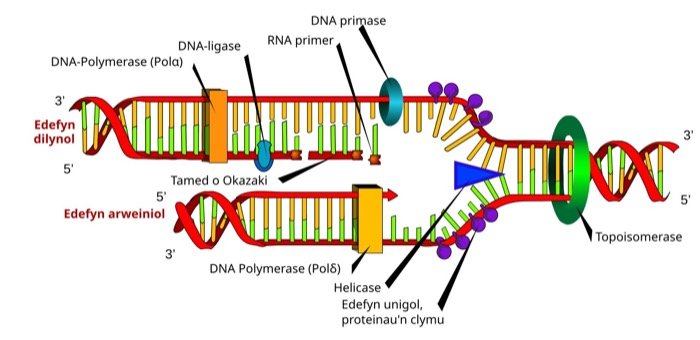
TOP PHOTO: DNA replication or DNA synthesis is the process of copying a double-stranded DNA molecule. (LadyofHats, Public domain, via Wikimedia Commons)


