Summary: Hundreds of ancient flood stories from the four corners of the world testify to the truth of the Bible’s account of a great flood.
…when once the longsuffering of God waited in the days of Noah, while the ark was a preparing, wherein few, that is, eight souls were saved by water. – 1 Peter 3:20 (KJV)
Noah’s Flood in History
The Bible’s account of the great flood in Noah’s day has been the source of fascination, controversy, and questioning. Did it really happen? How did it happen? Where did it happen? And is there any record outside the Bible of it happening?
This week’s Thinker Update features excerpts from a recent podcast discussion between Tim Mahoney and researcher Nick Liguori. Nick has found amazing evidence for the Bible’s flood narrative from hundreds of cultures around the world. He has included this information in two books titled Echoes of Ararat. The first volume covers evidence of Noah’s flood in flood legends found in North and South America, while Volume Two (still in the works) will cover East Asia and the Pacific Islands. He shares some of this testimony in the following 2-part Thinker series.
The flood account in Genesis chapters 6-9 has God flooding the world because all mankind had corrupted their ways and had done evil in the sight of God. Noah alone found favor in the eyes of the Lord, and God told him to build a giant ark – a ship capable of saving Noah, his wife, his three sons and their wives (eight souls in all), and animals of every kind on the face of the earth. All else perished in the flood. After coming to rest on Mount Ararat, the earth was repopulated from those on the ark. Now, onto the discussion.
Ancient Sources for a Great Flood
TIM MAHONEY (T.M.): Some people have said that it’s a fairytale, that it didn’t happen. But what you found is very compelling, Nick. And we’re going to get into how in the world you found all this information.
NICK LIGUORI (N.L.): Well, Tim, one thing that you’ve said over the years in your documentaries and elsewhere is that we have a historical faith, and I’m keenly aware of that. I came to Christ on a college campus that was very hostile to Christianity, there at Colorado State University, and I had to be prepared to defend my faith. And so often these intellectual battles have to do with the book of Genesis, right? Because Genesis is foundational to worldview and the rest of the Bible. And one thing that’s huge in Genesis is the flood of Noah, that this world has been destroyed by a flood sent by God. Scripture devotes four chapters to it. And there are many lines of evidence for this flood, but one of them is flood legends.
And this idea that there are actually hundreds of tribes and nations all over the world with a memory and an oral tradition of such a flood that sounds just like Genesis; matching it in both general outline and specific details like the forewarning, the divine judgment, the preparation of a great canoe, they call it, or sometimes the raft. That ark being lifted up by the floodwaters, all other life perishing, it landing on a high mountain after a while, the flood eventually going down. Also birds, that there were one or two birds, and one bird returned with something in its beak as a sign that the flood was ending, and the subsequent repopulation of the world. Sometimes the Tower of Babel after that, even a rainbow.
I was studying many other things, but one day this subject struck me in a new way. This is powerful evidence and people need to know about this. And so I wanted to learn more about this. What is the state of the evidence?
But as I began researching, I found that these hundreds of flood stories, I couldn’t find them. I might find a Christian book with a few tribes here or there or secondhand information, but it was piecemeal. It was often poorly documented. And that was disappointing. It was disappointing because I felt that as Christians, we were doing a disservice to the world by not documenting this powerful evidence. There ought to be a book that we can share with unbelievers to let them know that this flood is real, that God’s word is true and we can trust it right from the very first page in Genesis. And in fact, some of the best books on the subject were written by unbelievers who didn’t believe a word of the flood. And so I thought that was disappointing as well.
We have some good stuff from Christian authors, but it’s mainly from the 1800s and it’s difficult to access these days. And even that’s kind of piecemeal. So I kept reading and I drilled down first on the Native Americans. I love the Native Americans, fascinated by them. And so I just started reading, what did the Cherokee and the Iroquois tribes believe about the flood? And I would find that tribe after tribe had an ancient tradition of this flood matching Genesis. The Arapahoe, the Cheyenne, the Apache, the Ottawa, these tribes of Canada.
And then I went down into Mexico and they knew about the flood as well. And I would just ask myself, what is the Genesis flood doing in the histories of these nations? It’s not supposed to be there unless the Genesis flood is true. And I would find that in South America as well. And before long, I realized that I had to write a book.
T.M.: Everybody needs to own this book because this is such a great testimony. Even though there’s different variations, there’s a consistency to them. The research that you went into, I mean, it’s so well done. How did you start to tackle this?
N.L.: Well, first, I wanted to find good primary sources written by authors who were in a position to know what were the early beliefs and traditions of these tribes and these nations. And that could be a report from an anthropologist in the 1890s, or it could be an explorer in the early 1800s or maybe a government official that wrote something in the 1800s or a missionary or even a native author or a historian writing in the 1700s and early 1800s about the Americas. The earlier, the better. And in fact, many of our sources go back even to the 1500s, and some of the evidences themselves predate Christ, very ancient. We have not only oral traditions, we have some that were written. From a practical standpoint, I will say I’ve certainly been helped by things like the digitalization of old books and also interlibrary loans.
I would say for Volume Two, one thing that was challenging was the language issue. Now, Volume One, you have some Spanish, but it’s mostly English, a little French. Volume Two, you have to go into other language works to track down the original information; Russian, Chinese, even Japanese, Vietnamese, other languages, Dutch. I’ve been very much helped, especially in Volume Two, by a co-author, Valdis Gauss, who is a linguist. He’s actually an expert in Taiwan and the Taiwanese tribes and their traditions, probably the leading expert in the world on Taiwan’s traditions because again, we have to go back to the original best sources.
I would also say there was a level of quality assurance and screening that we had to do when we talk about the risk of Christian influence on these traditions, because I want original traditions. I’m not interested in influenced traditions (from Christian contact). I want what they believed in the ancient past. And so there are ways that we can get at that. It’s pretty easy to tell. They’ll often refer to Noah or to Mary or Jesus or the Holy Spirit, and that’s one thing. We certainly don’t want to see that for it to be an ancient tradition. Second, we want to see native material, native beliefs, even their religion that’s very much part of these traditions. That’s a good indication of aboriginal authentic information. Third, if we find a flood story, it’s got its own twist on it compared to Genesis. And then we find that same variation, that same twist in other tribes within a language family. So then we have multiple confirmations – that is a good indication.

T.M.: How long have we known about the existence of flood traditions?
N.L.: Well, we’ve known about this for a long time, and this isn’t a new argument or a new premise I’ve come up with. This is an ancient argument that’s well established. I’m just documenting it more thoroughly and bringing it up to date, but this is ancient. It goes back more than 2,000 years ago. If I can read a quote from Josephus almost 2,000 years ago, he says, “Now all the writers of barbarian histories make mention of this flood and of this ark among whom is Berossus the Chaldean,” and he goes on to list several of them. So he’s saying to the Romans, “Look, this flood, it’s our Jewish history, but it’s also your history. This is ancient.”
So if you had read Josephus’ Antiquities of the Jews, you knew about this, you knew about flood stories all over the world. If you had read various Greek classics, you had heard of Deucalion and the Greek flood story, or if you had read Indian Mahabharata, you had heard of their flood story, or if you had read the Icelandic creation story or the Welsh creation story, or maybe you had encountered Berossus through reading Eusebius in the early Christian writings, or if you had read the early Spanish accounts of the colonization of Mexico and Columbia from the 1500s or of Columbus and those with him landing in Cuba, we have testimony of the knowledge of the flood from Cuba before the year 1500, or if you had read maybe French missionary accounts from the 1700s in Canada, or if you had read early reports of the Native Americans, you knew that this knowledge of the flood was pervasive.
Challenges to the Biblical Flood
N.L.: So these flood traditions have been known for a long time. And in fact, for most of history, people just acknowledged the flood. There was a flood long ago. Now, maybe they didn’t believe in the God of the Bible, but they acknowledged the flood at least. So what changed? Well, three things I would point to in the late 1700s and the early 1800s, the rise of uniformitarian geology, especially with Charles Lyle and his principles of geology. Of course, that undermined the importance of the flood as an explanatory event and replaced it with millions of years, slow and gradual processes. The second would be, of course, Darwin. Darwinian evolution does not mix well with the flood. And the third would be the discovery in 1872 of a Babylonian tablet with a flood narrative. That’s when the argument arose that, “Well, we think the Genesis flood was borrowed from an earlier (Babylonian) source.”
We have refuted that at length in this book. Genesis did not borrow from a Babylonian source. The Genesis flood account is the true original history. And when we look at these flood legends all around the world, they point back to Genesis as the true one and not the Babylonian version as the original record of that event.
T.M.: Because it’s different, right? The Babylonian account is different than the Genesis account.
N.L.: It differs in several ways. For example, the part about the birds in Genesis, Noah sends a raven and then a dove. And on the second trip, the dove returns with an olive leaf in its beak. It’s a very different account of the birds in the Babylonian epic of Gilgamesh. And can you guess which one native flood stories agree with? They always agree with Genesis and not the Babylonian version or why the flood was sent. Very different reasons – because of mankind’s wickedness in Genesis. In the Babylonian version, it is because mankind was too noisy and the gods couldn’t sleep. We could look at the shape of the floating vessel. In every single instance whether the native version is from North America, South America, China, Southeast Asia, the Pacific, Europe, Africa, they always agree with Genesis and not the Babylonian version.
T.M.: What is the shape difference there? Is it much of a longer shape?
N.L.: So in Genesis, God tells Noah to build an ark of 300 cubits, by 50, by 30 high. And it’s very similar to the dimensions of a modern cruise ship. In the epic of Gilgamesh, it is a cube, which is absurd from a stability in the water standpoint. And so in the tribal versions, it’s always a long shape that’s a canoe or something much longer than it is tall or wide.
T.M.: Well, if you look at secular scientists and historians, there have been certain people that wanted to throw the Bible off in some ways, right? They wanted to throw off the narratives of the Bible because they didn’t want to see the world through that lens. As you mentioned with Darwin and these other ideas that came forward, what did you learn, Nick, about the flood narrative when secular people came along, how did they interpret it or did they just dismiss it?
N.L.: Well, after these events in the 1800s, they tried to dismiss it. It was considered a myth. Materialism [the belief that physical material was all that existed] was the new view in vogue. And so they said if there’s an account in Genesis of the flood, well, it was borrowed from a myth from some other culture in the Near East, maybe there was a local flood, and there are several arguments, maybe the Black Sea flood is the source of flood stories. Some have even said that it was just a local flood and tribes around the world, they just remember a local flood. And these are the false narratives that Paul tells us in two Corinthians 10, we are destroying strongholds and refuting falsehood and bringing every thought captive to the knowledge of Jesus. We have answered these arguments at length. We can discuss a few of them if you like. The only view that will account for the data is that the Genesis flood is true.
T.M.: There’s so much you could talk about. Now, what you don’t know is that I know that in the future I’m going to make a film about the flood. I’ve had that in my heart. I felt a sense that God very clearly made that clear to me, and I’ve been waiting. So what’s joyful for me is I see the work that you’ve done as part of that testimony. There’s more that’s coming, but I’m looking forward to delving into it. That’s why for me, this is impactful. And how many flood stories, and you probably haven’t found them all, but how many have you found in certain areas?
N.L.: We found over 300 from North and South America, and that’s in Volume One. We found another 300 from East Asia and the Pacific. I couldn’t tell you how amazed I was at how many we found in Vietnam among the minority tribes of China, in New Guinea. I was told so many things going in, “China doesn’t know of the flood. New Guinea doesn’t know the flood. Siberia doesn’t know the flood.” All these narratives are wrong, and we’ve refuted that at length and documented this. There’s even echoes of it in Japan. Again, this is exactly what we’d expect to find if the Genesis flood is true. And it’s the last thing that anyone would expect if an atheistic worldview is true.
A History Common to All
T.M.: This also goes into what happened after the flood with the different languages. The Tower of Babel. This understanding had to have happened after the flood and before people’s languages were shifted. There’s practically no way that you could iron into a culture and to a tribe, a new origin story, because these 600 origin stories were ironed into these people’s consciousness, right? And they are spread around the world. 600 different cultural stories that you’ve uncovered could be a lot more, but 600 is a pretty good sample.
Let’s talk about the Chinese. Some people would say, “Oh, this Chinese flood story is really a local flood, and therefore the Noah flood was unknown in China.” What do you have to say about that?
N.L.: Yeah, and that’s what I was told. As far as the flood story in China. It comes in two of China’s classics, the Shu King or Book of Documents, Book of History, and the Shi King or Book of Odes, Book of Poetry. The consensus position is that it’s describing a local flood of the Yellow River, but there’s debate about that. Let’s put that to the side for the moment. Those two sources are not our only source from China regarding their knowledge of the flood. We can look at another classic called the Huainanzi, which involves two characters, Nüwa and Fuxi, and you’d be hard pressed to say that’s a local flood. It talks about the sky falling. The waters were surging. It says the whole of China was devastated. Well, when you talk about devastating the whole of China, that’s not a Yellow River flood.That’s a much larger region.
And it even says that the pillars that supported the sky had to be rebuilt. The sky fell, the vault of the sky fell. So that’s not local.That’s not even just global.That’s celestial. It’s beyond global at this point. And it talks about the fact that Nüwa, this female goddess, had to take five different colored stones and smelt them together and raise it up to patch up the sky. Now, picture five different colored stones and it being lifted into the sky.
T.M.: Does that sound like a rainbow?
N.L.: Exactly. This is a memory of Noah’s rainbow, and we find the memory of Noah’s rainbow scattered throughout the world as well. That’s not our only evidence of the knowledge of the flood in China. China’s ancient written language is pictographic.
T.M.: Yeah. I remember hearing about that. Let’s let people know about the oldest characters in China.

N.L.: They’re called Oracle Bone Script. Their oldest written script. It testifies to a knowledge of the events, not only of the flood, but also the Garden of Eden and the Fall. The character that means deny is composed of symbols that depict a snake between two trees. So deny means a snake between two trees. And we’re reminded, I think, of the tree of life and the tree of the knowledge of good and evil. And as far as the Garden of Eden, in fact, China has what’s called the bronze tree statue of Sanxingdui. It’s this 3,500-year-old artifact, and it shows a woman’s hand reaching toward this tree for something in the tree, and there is a serpent with front legs living on the tree. And the serpent has this knife on its back, and the tree has knives for fruit, and yet the woman is reaching for this tree.

That sounds just like the tree of the knowledge of good and evil. And that tree of knowledge of good and evil shows up in Chinese mythology. I would recommend a few books that analyze these Oracle Bone characters a lot more. The Discovery of Genesis in China, God’s Promise to the Chinese, Faith of Our Fathers. There are other books being written.
But as far as the flood, the Chinese character for boat is made up of three symbols, which are a vessel, eight, and people. Have you ever heard of a vessel with eight people? Sounds like Noah’s ark, right? That’s their symbol for the word boat. Why would you write the word boat as a vessel with eight people? I think what happened was they left Babel and they dispersed and they went on to travel eastward to China and they recorded in their language these events, Noah’s ark in the very composition of their characters.
If I can say one more thing about the Shu King and the Shi King, coming back to that, it’s not so simple to say it’s a local flood. There is strong language in there that says that the floodwaters covered mountains and threatened the heavens themselves. That sounds like more than a local flood. Now they may have sort of mixed a knowledge of the global flood and a local flood, that there’s something more than just a local flood.
And actually what’s been really fun in this research is finding that that same flood story occurs among many minority peoples of China and other parts of East Asia. We can identify as the same story because just like in the Shu King and Shi King, they refer to something blocking the drainage of the flood. These tribal versions, likewise, something was blocking it, whether it was a giant snake or a crab, swim down there and kill it so that the water can drain. It is the same story, yet it’s always a global flood in these parallel versions from other parts of East Asia. So we have clearly a global flood, and then we have the Chinese version, which is sort of ambivalent. I’m going to put my money on it being a global account based on the comparative analysis.
T.M.: We are living in a culture that wants to amuse ourselves. And the word muse means to think, but you put “ah” in front of it and it means not to think, right, Nick. And so that’s where we have to start thinking to become a thinker and not a non-thinker and just to be entertained. We’re living in, I think, a dangerous time when entertainment is such a high priority that we’re actually in a drug culture of entertainment and people are addicted to high levels of entertainment like they’ve never been entertained before, and they are not thinking. And the reason why I’m so excited about what you’ve done is that I’m trying to give some insight into the fact that the Bible says that as it was in the days of Noah, so shall it be when the Son of Man returns. This whole issue of what happened during the flood, the Bible says in a way will repeat itself.
And in the days of Noah, as we look at it, there’s enormous violence in the world. People were doing a lot of things that God was displeased with so much that he decided he would destroy the earth. The only people who were saved were in the ark – Noah and his family.
Conclusion
We hope you enjoyed this first part of the discussion with Nick Liguori on echoes of Ararat. If you’re interested in getting a copy of Nick’s first book, please see the link below. Stay tuned for the next installment when more evidence and its implications are addressed. Until then, Keep Thinking!
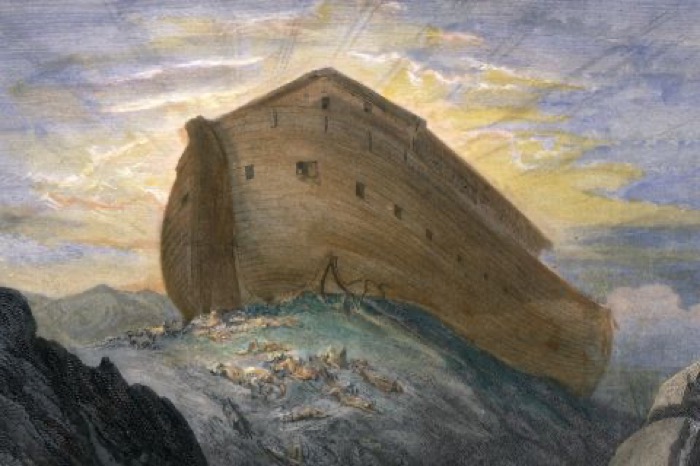
TOP PHOTO: Noah’s Ark. (Martinek220, CC BY-SA 3.0, via Wikimedia Commons)


.jpg)
