Summary: Part 2 covers the dramatic birth of the Temple Mount Sifting Project and the chance to purchase gift pieces of that soil.
And he burnt the house of the LORD, and the king’s house, and all the houses of Jerusalem, and every great man’s house burnt he with fire. – 2 Kings 25:9 (KJV)
The Temple Mount Sifting Project
Last week we explored the significance of the Temple in Biblical history and theology. However, political tensions have long put potential excavations there off limits and the lack of evidence has fed skepticism about the Temple’s existence in ancient history.
In today’s Part 2 we will look at the events that allowed artifacts from Jerusalem’s Temple Mount to finally come to light after 1999. The Temple Mount Sifting Project that ensued has uncovered hundreds of thousands of items and fragments from 9,000 tons of soil illegally removed from the Temple Mount, many of which are related to the kingdom of Judah and the Jewish Temple.
This discussion features excerpts from a more extensive series of Patterns of Evidence podcasts with author and archaeologist Dr. Randall Price. Additionally, Dr. Price continues to share a unique opportunity to purchase a piece of the Temple Mount while helping to support the archaeological work there. Let’s break into the conversation.
An Illegal Dumping of Temple Mount Soil
TIM MAHONEY: So Dr. Randall, why don’t you just share with us a little bit about the more-recent story of the Temple Mount.
RANDALL PRICE: It’s a blend of both archeology and politics. Because as we mentioned in a previous episode, the Temple Mount, which is a 35 acre platform that has been there for 3000 years and would contain some of the greatest archeological finds we could imagine, is off limits. No one has really been able to excavate there. In the 19th century, some British and German and French archeologists were able to get in and uncover some structural things and tunnels and various things. But real excavation couldn’t take place even then because for the last 1300 years it’s been under Islamic jurisdiction, first largely under the Ottoman Empire, and then in recent times under a Jordanian administration, and now still in a Jordanian administration from afar. But a Palestinian authority has usurped some of that control.
But you can’t excavate, because first off, when you talk about the Muslim perspective – it’s not the academic Muslim perspective, but the political and maybe common man Islamic perspective – no temple ever existed. There was nothing there, absolutely nothing. In that view, from the very beginning, Ibrahim, who was a prophet, a pre-prophet of Islam, built a mosque there. When he offered his son Ishmael, not Isaac, it was in Mecca, not in Jerusalem. And no one who was faithful to Allah would ever allow some rival structure to be built on a place that Allah had consecrated to himself. So they say no temple ever existed.
And then in 1967, Jerusalem came back into the control of the Israelis. So it became a political issue. The whole thing is that the Islamic authorities, because of political reasons, denied the existence of a temple. So again, no excavations related to a temple because there’s no temple to excavate. All the things that are there, from their perspective, are either pre-Islamic or Roman Christian or something else.

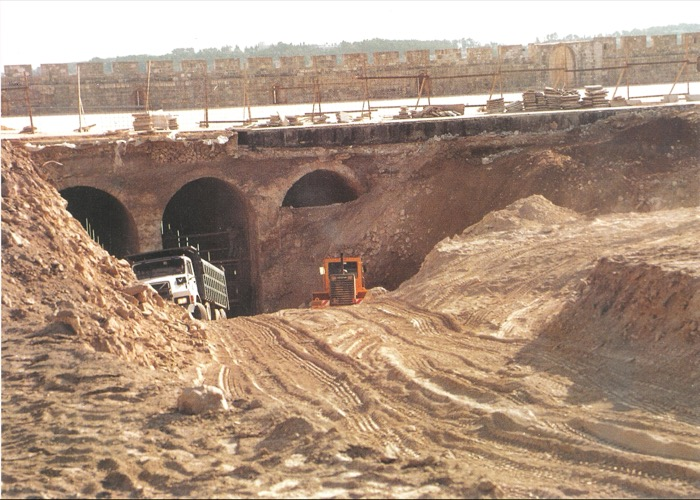
RANDALL PRICE: There has been much controversy over the site. So it was really unusual that all of a sudden around 1999 they decided they would just take matters in their own hands. And aside from the status quo that existed since 1967, which allowed for no changes to take place, they decided to build a new mosque – adding to Al-Aqsa Mosque and then the Dome of the Rock, which is simply a shrine. And to the Southeastern part of the Temple Mount platform, they brought bulldozers and over three days and nights, they just dug up and crated off some 400 truckloads of soil, archeologically rich soil, full of all kinds of things.
TIM MAHONEY: So right there where the temples are supposed to have been, the first and second temples, it was 400 dump trucks full of material. Where did the material go?

RANDALL PRICE: Well, first off, the area itself is the area of what in the Crusader period was called Solomon Stables. But it was clearly storage areas for the priests and areas to the east. But then as you come up, there was a massive walkway where all the people who ever entered the Temple on the south came through this double gate and then they went up a staircase to ascend to the Temple Mount. And the area behind led to what we call the Beautiful Gate. And Jesus and the disciples and everybody went that way into the temple, this whole area of ascent.
This is the same area where they created the new mosque, a 10,000-seat mosque called Al-Marwani Mosque. There are many other problems with that, but the first thing was that the soil was taken out and the soils first dumped by cover of night in one of the suburbs of Jerusalem.
But then they were found out. There were people watching this. They put it together and said the soil is coming from the Temple Mount in these trucks. And they started to expose it. So they started bringing the trucks in and just dumping it much closer to the Temple Mount, a place in the Kidron Valley. And there were several sites that they just dumped these massive amounts of debris.

TIM MAHONEY: The debris had stuff in it though.
RANDALL PRICE: Oh yeah. And some of this is still on the Temple Mount. If you go today and are able to get into the Temple Mount and walk around, you’ll see these massive amounts of stones, and piles of dirt, and all kinds of things. And those can’t be touched yet, but they’re still there. They haven’t done anything with it.
But the ones that were outside of this area in the Kidron Valley, some archeology students, particularly one, he said, “We know where it came from and it’s sitting here. Could it have artifacts, things of importance?” And so he went in and did what we call an archeology survey. You just kind of look at what’s on the surface. And he saw all kinds of pot shards and things like this. And he and some other fellow students gathered these up and took them to Gabi [Gabriel] Barkay, who was a very renowned archeologist.
And he looked at these in a single night and he could just go through every single piece and say, “We have things here from the Iron Age I, Iron Age II, the time of David Solomon.” And then further all the way through up even to the Islamic period, all these pieces that were there. He said, “This is a treasure. Where did it come from?” Well, they explained where it came from.
So they began trying to get some kind of permit. Israeli authorities and the Antiquities Authority, neither one wanted to acknowledge the source of this or what was going on. They were just trying to cover it up because it would provoke the Muslims. And at this point in time that was a very sensitive issue with the Israeli government – Islamic provocation. It had consequences for the peace process they were still trying to bring about with the Oslo Accords. It had all kinds of ramifications immediately in Jerusalem, because riots would happen and people would die. So they were trying to protect this.

RANDALL PRICE: The students went out and got more things and tried to make this public, because it was so important. If the authorities wouldn’t do it, they’d try to provoke the authorities to do something. And they went and arrested the students and put them in jail,
TIM MAHONEY: Really?
RANDALL PRICE: Yeah, Zachi Dvira in particular. Fortunately, Gabi got him out and because of the public pressure they allowed them to go ahead and start taking samples. And eventually this became an operation. They knew they couldn’t do things in the Kidron Valley there. So they removed all that soil that was available to them, and they transported to what’s called Emek Tzurim, Flint Valley, which is actually a part of the Mount of Olives, but it overlooked the Temple Mount.
Artifacts from Temple Mount Soil

RANDALL PRICE: And so for the last 20 years, they’ve been sifting through this systematically. And I hope we can talk about some of the marvelous discoveries that have been made because the very people who brought that soil out through a violation of the law – accidentally, let’s say, gave the greatest evidence we have for the existence of the Temple there and the history of the Jewish people at that site, because they exposed this material and made it available.
TIM MAHONEY: So normal archeology would be that you have a location and in that location you dig and you record everything you find.
RANDALL PRICE: Yes
TIM MAHONEY: In this particular case, bulldozers and dump trucks came and hauled out all of this material and they just moved it, not in any order, but you know that it’s from the Temple Mount.
RANDALL PRICE: That’s the benefit. I mean, first off, in archeology you want things “in situ,” that is in the archeological context, because you document this, as you said, going down layer by layer. Each layer is a different period or strata of time. And so when you find artifacts in a layer, they all come from that time. So you don’t want to move them around or shuffle them around. You want to go about it in a very systematic way, we call it the “grids,” so we can control the data. Well, you can’t do this in this case because they took it all out and dumped it. But we know where they took it from.
We find artifacts in the black market, in the antiquities market, and those things are out of context, and they’re valuable because we know they relate to certain time periods, but we don’t know where they came from.
So this is kind of in between. It’s not as good as archeology on the site, but it’s far better than just these miscellaneous items that came from the black market. So, they know this particular bunch of soil came from the southeastern corner of the Temple Mount. And since that can be documented, every artifact that’s found within it comes from that place, which is the Temple Mount. So that’s why we call it Temple Mount Soil or Temple Mount Sifting. It’s all from that particular place.
TIM MAHONEY: So the stats for the last 20 years, because it’s been over 20 years since the sifting has come about, and we’re going to be talking more in the next episode, we’re going to be talking about the coins that have been found, because there’s been criticism by scholars that have said, “Well, the Biblical narrative isn’t true” or, “It didn’t really happen that way.” Then there’s a political angle and all that. So, a lot of the sifting answered those questions, didn’t it?
RANDALL PRICE: Yes. Well, the Muslim authorities said there was no Temple that ever existed there. The critics said, “Well, there was a Temple, but it didn’t exist from the 10th century BC. It came rather in the eighth century BC,” much later, let’s say around the time of King Hezekiah. And then they would say that the Bible itself that records this came even much later in the sixth century BC and was post-exilic. This is not uniformly among all the critics, but this became a school of thought. And so in that view the Bible itself was the invention of a much later period, either using an oral tradition or just creating an origin history for Israel itself. And what these excavations have shown is that, no, there were Jewish people with these kinds of artifacts in this time period, all the way through the story.

TIM MAHONEY: I actually went to the Temple Mount Sifting Project about 15 years ago and met with Gabriel Barkay. And he called the illegal removal of this material “barbaric.”
RANDALL PRICE: Yeah. Professor Barkai was correct. This was a barbaric act from an archeological perspective, because if we just could have gotten to it in the context and gone down layer-by-layer, it would be much easier to control this data. As it is, we have all these random pieces we have to somehow systematically organize. And there’s so much of it. It’s just taken an army of individuals to get there.
On the other hand, this was a benefit because we never expected to have the opportunity to even touch this material. Israel, had they asserted themselves, had the right to excavate – this is the capital of the nation, this is the most holy place in all of Judaism – I mean, it should have been excavated. But again, the politicians control that and the international community affects that, so it hadn’t been done. But now the Muslims did it for us, and provided at least a glimpse of the kind of riches that are there.
So, after Professor Barkay got involved and was able to bring, let’s say, the clout of his reputation to this, they decided to go through the material systematically. And this was going to take forever because there were so many tons of it that had to be gone through. So they set up a building, it was more of like a Quonset hut to begin with, and set up these tables with the sifters on them and with hoses. And the whole idea was to wet sift. They tried to initially dry sift and couldn’t find anything. And when they took the same material and wet sifted it, all kinds of things appeared. And we’re talking about things like fragments of glass, fragments of pottery, metal filings or objects, beads, arrowheads, all kinds of things that would either be randomly discarded or as the result of war.
TIM MAHONEY: So the Temple Mount Sifting Project really was an unusual thing because it shouldn’t have happened in a way. In other words, it should never have been dug into. But once they dug into it, then the idea came, well, let’s sift through here and they started to find the history of the Bible showing up. Can you give a specific example of what’s been found?

RANDALL PRICE: A number of seals were found, Lamelekh seals [LMLK in Hebrew translates to “belonging to the king”], which were from Hezekiah’s period. These are usually related to big store jars for taxation. And the seal will have a symbol of either a beetle or some kind of bird-like thing, which is related more to the pagan people he’s going to give this taxation to. But of course, what Hezekiah did was he stopped paying the taxes to Assyria.

TIM MAHONEY: What if there’s somebody who’s just randomly listening to this podcast wondering, “Well, why should I care about the fact that they found this little impression?”
RANDALL PRICE: Well, the basic answer is that if the people who wrote the Bible, we believe under the inspiration and authority of God himself, were so careful to make these historical notes and record things in such detail, and we can substantiate that from history – that they’re accurate in what they’re saying and trustworthy – then why shouldn’t we believe everything else they say? These people lived, they were real people. And that’s the thing about the Bible. The message of the Bible is real. If the history’s real, the faith needs to be real. We need to have a real faith in the things the Bible says.

RANDALL PRICE: But they needed some kind of an army to sift through all the material to find these things. Initially, they recruited kids and local archeologists and students at the universities, and then they expanded it to the tourists so that it became really quite an industry. So, around the clock these things were being done. That’s how you get 300,000 people, as it were, all putting their hands on this and handling it. All these finds are made, then you have to have professionals go through and look at each one, and they have to do write-ups on each one. And most of this has not been published. They publish on the website or once a year they invite the public in Jerusalem to come see some of the finds, but this is moving toward a final publication of these almost a million artifacts and what they are.
That’s a huge job – a huge, huge activity. But that’s what they are doing and why we think it’s so helpful to support that. And that’s what we want to get into because it really points to the fact that if this place one day is finally excavated, we’ll be able to answer so many questions that have been unanswered since the beginning of archeological work.
Own Mementos of Temple Mount Soil
TIM MAHONEY: And we’ve got something called Temple Mountain Soil. And people have an opportunity to actually get some of this soil for themselves.
RANDALL PRICE: This soil came from the Temple Mount Sifting Project without the artifacts. But it’s the leftover soil that even has the ashes from the destruction of the Temple. It can be worn, can be exhibited and displayed simply to express the recognition of what God did at a place like that.

RANDALL PRICE: And even to the extent we talk about this cross here with the soil on it, the Lord Jesus called this his Father’s house. He said this was a place that was going to be a place of prayer for all the nations of the earth. And the last week of his life, he preached there and taught there. So this kind of thing for Christians is also quite important and this is why these products have been made available and also of course to help support that Temple Mount Sifting project so that more and more work can be done in the future.
TIM MAHONEY: Yes. Well, thank you for bringing this to our attention. And if you’re interested in helping out the Temple Mount Soil Project and the sifting that’s going on there… Because it’s been really difficult for them, right? I have a number here. At one point, there were 256,000 sifters that had worked there. And then recently, hardly anyone’s been there to help.
RANDALL PRICE: The work is so extensive. There’s so much to be done that from the beginning they set up a tent with all of these sifters and it’s a wet sifting. They invented the wet sifting process. So dry sifting, you miss a lot. Wet sifting, you don’t miss anything. You can find it all. And they invited people who come on tours, “Hey, how about giving us an hour of your time? You get to sift and maybe make discoveries like archeologists did.” “Wow.” And they gave a certificate saying you’re a small-time archeologist, but you’re part of this. And people loved it.
So around the clock, they had these thousands and thousands of people coming and doing this work. Also local Israelis, of course, were doing this. But with the war, this has pretty much ground to a halt, as has a lot of the giving, the donations that were given to help this be done. Because money is diverted elsewhere, people are concerned about other things. So we’re trying to help as much as possible, keep this very active excavation going because now they sift things not just from the Temple Mount, but from all over the excavations in Israel. They’re the one place people take all of these things to be sifted so that discoveries can be made.
TIM MAHONEY: Yeah. So once again, if you’re interested in supporting this endeavor or purchasing a gift for a loved one, a portion of the proceeds from these Temple Mount Soil keepsakes will go toward that.

Own an actual piece of the soil rescued from the Temple Mount, set in heirloom jewelry and keepsakes, each with a Certificate of Authenticity. Free U.S. shipping over $100 at https://templemountsoil.com/bible
Conclusion
Look for additional episodes in the future as we cover more amazing artifacts discovered by the Temple Mount Sifting Project. Many of these finds relate to Biblical history. Until then, consider visiting the Temple Mount Soil website and keep thinking!
NOTE: Not every view expressed by those interviewed for our films and podcasts necessarily reflects the views of Patterns of Evidence. We include perspectives from various sides of debates on Biblical matters so that readers can become familiar with the different arguments involved. – Keep Thinking!
TOP PHOTO: Soil on the Temple Mount being illegally removed in 1999. (credit: Temple Mount Sifting Project)


