Summary: A recently discovered complex of mikva’ot or Jewish ritual purity baths at the approach to the Temple Mount in Jerusalem connects to various Biblical accounts.
When they go into the tabernacle of the congregation, they shall wash with water, that they die not; or when they come near to the altar to minister, to burn offering made by fire unto the LORD: – Exodus 30:20 (KJV)
A Discovery of Biblical Significance
At a time when some voices are declaring a Jewish temple never existed on Jerusalem’s Temple Mount, a rare and significant archaeological discovery there shows more evidence not only that it did, but also how it actually functioned in the final decades of its existence.
At the conclusion of a five-year excavation, a statement released by Hebrew University last month outlines the discovery of a 2,000-year-old Jewish ritual bath complex at the foot of the Temple Mount’s southern wall. The finds add to the evidence for numerous such immersion pools in the vicinity which may even connect to the New Testament’s account of the birth of the church.
Washing in the Bible and Jewish History
The Jewish term for a pool or bath used for purification is “mikveh” (plural mikva’ot). The meaning of the word comes from the Bible, where it means “hope” or “gathering together.” It is used to describe the gathering of water that makes one pure.
Nevertheless a fountain or pit [cistern], wherein there is plenty [mikveh] of water, shall be clean: but that which toucheth their carcase shall be unclean. – Leviticus 11:36
Ritual purification in the Bible goes back to the Mosaic law and included the commands to use water, blood, or ashes to cleanse a person who was “unclean” so that they could enter the camp or God’s presence. At that time, the bulk of the commands for purification involved the priests entering the tabernacle for service.
Archaeologists in Israel have found many mikva’ot in Israel from late in the Second Temple period (100 BC – AD 70). The development of stepped ritual purification baths in this era came with many rules and regulations for their use by Jewish sages. Leviticus 15:16 commands a person who has become impure to “wash all his flesh in water,” so the Talmud requires the minimum size of the pool to be large enough to accommodate the entire body, or one cubit by one cubit by three cubits. However, the focus was on spiritual cleansing, not just physical.

Deuteronomy 16:16 required Jewish males to travel to the place God chose to observe the major feast days three times a year. In first century Jerusalem, this would have meant huge crowds. The challenge was that all these visitors were required to immerse (for ritual purity) before entering the Temple. Many rules were developed to maintain this purity, such as entering the Temple Mount on a righthand staircase, circling it, and then exiting on the left.
One of the research questions the excavation team had was how the logistics of ritual bathing worked at the Temple in the face of large crowds. The discovery of this mikveh complex, dubbed Beit haMikvaot (“House of Mikvehs”), helps to answer that question.

The Archaeological Findings
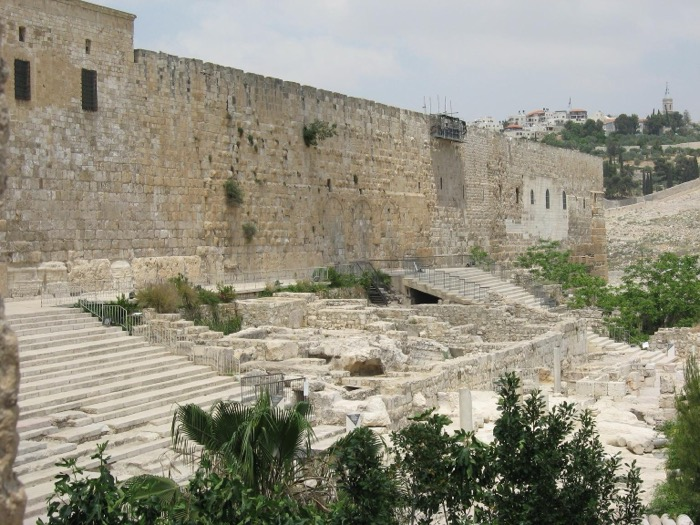
The complex was below the southern wall of the Temple Mount in the Ophel (the area between the Temple Mount and the City of David to the south). It features a central monumental structure with multiple rooms and plastered baths dating to about AD 10, putting it during the life of Jesus. Immediately surrounding this luxurious building were 18 additional mikvehs that had been uncovered in past excavations. When added to the numerous mikvehs from elsewhere in the vicinity, it is clear that this area was designed to accommodate the large crowds visiting the Temple.
The excavations on the eastern Ophel, which concluded this summer, were co-directed by professors Uzi Leiber and Orit Peleg-Barkat, and were conducted by the Institute of Archaeology at the Hebrew University of Jerusalem in cooperation with the Armstrong Institute of Biblical Archaeology, with funding from the Israel Science Foundation (ISF), the Armstrong Institute, and the Hertog Center for the Archaeological Study of Jerusalem.

In the joint statement by the directors, the find is described as extraordinary – not only in scope and concentration of pools, but also in preservation, with one vaulted bath preserved to its full floor-to-ceiling height of 4.2 meters. The central pool was about 10 x 12 meters (32 by 38 feet) with steps on each of its four sides. Dozens of people could have immersed themselves in it at the same time. The excavators also believe it may have been used to purify Temple vessels. A beautiful portico with fine ashlar (cut) stones and three additional rooms, each with a mikveh and impressive vaulted ceilings (though only one remains intact) were adjacent to the main pool.
The site lay beside the entrance road leading to the triple gated entrance to the Temple at the Huldah gate. This gate was walled off centuries ago, but in the first century it would have been one of the main access points to the Temple Mount, lying at the end of the Pilgrimage Road up through the streets of Jerusalem.
The whole area was covered by ash and debris from the Roman destruction in AD 70, including dozens of coins dating to the time of the Jewish revolt. Later Byzantine layers of the city needed to be removed to reach the older Second Temple levels.
Professors Leibner and Peleg-Barkat summed up the main structure in the press release:
- A monumental ashlar structure devoted entirely to ritual purification, situated at the foot of the Temple Mount and near one of its gates, is a truly unparalleled phenomenon. The complex goes to the heart of our research into the archaeology of Second Temple Period pilgrimage: how the area immediately south of the Temple Mount was designed to accommodate the many pilgrims who came to Jerusalem to visit the temple, and what activities and rituals took place near its gates.
They concluded that the optimal location of the central complex, and its opulent nature, likely means that it catered to the upper classes of society, including temple workers.
Living Water
A special aspect in the central complex is that each of the baths were linked together by a subterranean drainage complex that kept the water running and had inner arches tall enough to walk through. Mikva’ot with drain holes have been found before, but they are rare. The remarkable design of this facility with water cycling through it, keeping it clean, points to its function of serving large numbers of people.
This links to the recent discovery of a water channel that is believed to have been built sometime in the first century BC. The 13-mile-long aqueduct took water from springs in the area around Bethlehem to the south end of the Temple Mount, including the ritual purification pools. From there the water flowed into the city of Jerusalem, while an exit tunnel in the mikva’ot complex drained into the Kidron Valley to the east. Amazingly, this aqueduct traversed terrain filled with mountains and valleys at a consistent miniscule grade, and remained in use until just over a century ago.
The importance of this flowing water source is seen in the Biblical purification practices. The water that worshipers were to immerse themselves in before entering a holy place was supposed to be naturally collected “living water.”
Jewish writings in the Mishnah rank different grades of purifying water. Water for a mikveh was not supposed to be stagnant, carried, or mechanically delivered, like from a pump. The water could be collected from rainwater if it was free-flowing into a cistern, or from rivers, springs etc. However, “living water” from a flowing source like a spring was at the very top of the list. This fits the water in the aqueduct flowing to the Temple and feeding into the Ophel complex.

The Connection to the Acts 2 Birth of the Church
Acts chapter 2 records the birth of the church in Jerusalem on the day of Pentecost. On the Jewish calendar, this was known as Shavuot or the Feast of Weeks. It came 50 days after Passover and was traditionally thought to be the day that the law of the covenant was given to Israel at Mount Sinai.
After the apostles received the Holy Spirit they preached to the people of Israel. The people were amazed because each heard the apostles speaking simultaneously in their own native language.
Now when this was noised abroad, the multitude came together, and were confounded, because that every man heard them speak in his own language. And they were all amazed and marvelled, saying one to another, Behold, are not all these which speak Galilaeans? And how hear we every man in our own tongue, wherein we were born? Parthians, and Medes, and Elamites, and the dwellers in Mesopotamia, and in Judaea, and Cappadocia, in Pontus, and Asia, Phrygia, and Pamphylia, in Egypt, and in the parts of Libya about Cyrene, and strangers of Rome, Jews and proselytes, Cretes and Arabians, we do hear them speak in our tongues the wonderful works of God. – Acts 2:6-11
The text (verse 41) then says that about 3,000 people received the word and were baptized that day. Where did this preaching and baptizing take place? Where could the apostles possibly have had the space and opportunity to preach to thousands of people, and where could 3,000 be baptised in one day? The last verses of chapter 2 point to the answer.
And they, continuing daily with one accord in the temple, and breaking bread from house to house, did eat their meat with gladness and singleness of heart, Praising God, and having favour with all the people. And the Lord added to the church daily such as should be saved. – Acts 2:46-47
According to Deuteronomy 16:16, Shavuot was one of the three feast days when Jewish males were required to visit the Temple. The other two were Passover and the Feast of Booths (Sukkot). Jews from all over the known world would have streamed into Jerusalem to visit the Temple and fill its spaces. The first century Jewish historian Josephus recorded that 2.7 million visitors came to Jerusalem for Passover in his day.
This would provide the ideal opportunity for the apostles to address thousands of Israelites with their newly empowered message.
The new archaeological discovery adds to our understanding by revealing that hundreds of ritual baths existed near the entrance to the temple so that pilgrims could ritually cleanse themselves before ascending the steps. This would also give ample opportunity for 3,000 to be baptised in one day.
Conclusion
Once again, physical evidence helps us paint an accurate picture of the accounts found in the Bible. The evidence for this complex of Jewish ritual immersion pools shows not only that the Temple existed, so did the infrastructure that allowed for its operation according to Biblical commandments. The evidence also confirms that there was ample space and opportunity to preach about a new covenant (on the anniversary of the old) to thousands of Israelites from across the world – and baptize them on the same day. The Biblical and archaeological reports combine to give a richer understanding that on that day, they were immersed in living water in more than one sense. Keep Thinking!
cite CBN video
TOP PHOTO: The south wall of the Temple Mount enclosure, with stairs on the right leading to the triple Hulda gates. The recent finds occurred in the area where the Ophel meets the Temple Mount just to the right of the stairs in this image, within 100 meters of the wall. (credit: Oren Rozen, CC BY-SA 3.0, via Wikimedia Commons)


