Summary: A new series on Temple Mount evidence with Dr. Randall Price, and you can own a piece of the soil rescued from the Temple Mount, set in heirloom jewelry and keepsakes.
And let them make me a sanctuary; that I may dwell among them. – Exodus 25:8 (KJV)
A New Series on the Temple Mount
Jerusalem’s Temple Mount has witnessed a remarkable swath of history from its early position above a Canaanite fortress, to the building of temples by kings Solomon and Herod that were both destroyed, to the building of mosques and being at the epicenter of political tensions in the Middle East. Israel’s Temple was at center stage of events in both the Old and New Testaments. However, today, some voices are questioning the early reality of Solomon’s Temple, while others claim no Jewish Temple ever existed on the Temple Mount.
Into this story comes the illegal removal of 400 truckloads of soil from the Temple Mount in 1999 that was saturated with archaeological material. The soil was originally thrown into a dump, but over the last 25 years itl has been sifted by a quarter million volunteers and has yielded more than 650,000 artifacts from all periods of history.
Today, we begin an exciting new series on the Temple Mount – its significance, the story of the sifting project to salvage the artifacts, and some of the amazing things that have been found. As a guide for this exploration, archaeologist, author, and former head of the Judaic Studies Department at Liberty University, Dr. Randall Price joins filmmaker Timothy Mahoney. They begin with the question of the importance of the Temple Mount in the Biblical account. This discussion features excerpts from a more extensive series of Patterns of Evidence podcasts.
Additionally, Dr. Price shares a unique opportunity to purchase a piece of the Temple Mount while helping to support the archaeological work there. Now let’s get to the conversation.

The Biblical Significance of the Temple Mount
TIM MAHONEY: As we talk about the Temple Mount, one of the questions at the beginning is, well, why is there a Temple? And when we talked about this yesterday, prepping for this podcast series, you said a lot of people don’t understand the purpose and meaning of the temple. So I think it would be good to understand the theology a bit, and a historical understanding of the Temple, and why of all places it’s the focal point here in Jerusalem.
RANDALL PRICE: Well, “theology” is the right word because this was God’s design and it explains his purpose with all of mankind. I think the simplest way of understanding the temple is to say it’s where heaven and earth meet, because it was designed by God when he created the heavens and the earth and then put his creation man on earth for him to have a relationship with man. And God came down, as we read in the early chapters of Genesis, and walked and talked with man in the Garden of Eden.
Sin, disobedience, these things disrupted that relationship and God stationed some cherubim, angelic creatures who were guardians of the glory of God, at the east entrance to the garden and exiled man. So man could not get back to the presence of God. There were these guardian figures with flaming swords that prevented that way, but yet God wanted that relationship and man needed that relationship.
So we moved forward to the foot of Mount Sinai, because there God is revealing that he is going to give the nation of Israel, a chosen people, a constitution that is his will for their lives, but also for his program for all mankind. Because he is talking about using them as an example for the rest, picked one out of the many, in order to show his light to the nations. So he said in Exodus 25:8, “Let them construct for me a sanctuary that I may dwell in their midst.” And that of course is the tabernacle. In time that gave way to the permanent structure of the Temple. But the idea was for God to dwell with man or dwell on earth in some way. And the Temple was that touch point between heaven and earth.

RANDALL PRICE: We believe the Garden of Eden was situated with God’s presence in the west because the cherubim was stationed at the east of Eden to prevent that western approach.
TIM MAHONEY: Coming from the east.
RANDALL PRICE: Yes. And so when these buildings are laid out, the tabernacle has God’s presence in the west and the entrance is on the east. Same thing with the Temple as it’s constructed. So this east-west orientation is very important. But also there’s a sense in which there’s elevation, that God’s presence is higher. So throughout the ancient Near East you have the pagan concept of the “bamah,” which is a high place. Or in the Greek culture, “Temenos,” a term that’s used for a sacred enclosure. But they’re always up high because obviously God is higher than man. So to approach God, he’s going to be in a higher position. And we have throughout the ancient Near East the story of the cosmic mountain and approaching it, but all of this is sort of a corruption of the original idea that God had revealed more clearly to Israel.
TIM MAHONEY: Well, Moses says that he was shown a pattern or a plan that God revealed to him. Let’s just talk about what that pattern consisted of, because that became the tabernacle, correct? And that’s where the presence of God came down, and the things from the tabernacle were then transferred to the Temple later on, correct?
RANDALL PRICE: Yes. We go back to that same passage in Exodus chapter 25, and now there’s verse nine and there’s verse 40 that talk about Moses being taken on the mountain to see something. And God says, “Make it according to the pattern which I revealed to you on the mountain.” The word in Hebrew means something like model, blueprint, or type. But we think that he actually saw into the heavenly temple because the Psalmist and others will talk about “God is in his heavenly temple.” And there wasn’t a temple on earth when David is writing about these things, that comes only with Solomon. So the picture is that God is there.
Later when you come to the New Testament, the book of Revelation, we have a picture of the temple that is open in heaven in Revelation 11:19. It says the ark of his covenant appeared, and there it talks about altars and things. And the author of Hebrews is clear when he says – talking about the objects related to temple worship – the things on earth are copies of the things that are in heaven. Just to make it simple, God, since he’s going to come and dwell on earth, he brought a little bit of heaven to earth, a little bit of his dwelling place that’s holy, and he created that holy thing in a symbolic way on earth.
And so when we talk about these structures of the buildings as well as the implements that are part of the temple worship and sacrificial system, all that mirrors God’s program to reveal himself in a holy way.
Temple Skepticism and an Illegal Excavation
TIM MAHONEY: And one of the challenges that’s been happening the last 100 years is that people said, “Well, none of this is true.” Meaning that there is no evidence there was a temple or there was no evidence that there was an exodus. So they’re diminishing the story of the Bible.
And what’s exciting now, is that we’re going to be talking about this unusual thing that happened. And we’ll talk more about this in the next episode, but there was an attempt to actually dig a hole in the side of the Temple Mount area. And I don’t know how much dirt got removed, but a lot. And this was a very difficult place for anyone to ever touch before because politically it potentially could cause World War III if you dig into it.
But it was dug into to expand a mosque, I think. But this was soil that for about 3,000 years or so, from the first temple to the second temple, remains from that history would’ve been lying in the soil.

RANDALL PRICE: Yes. In the past, a lot of the skepticism was warranted because we didn’t have the work of archaeology that we have today. Archaeology is really only about 200 years old as a science, and it’s always compromised by wars and access to places. There were whole excavations begun in the 19th century that stopped in the 20th century because of wars and other types of things. Then on the Temple Mount, after Israel became a nation – nothing. This became a political powder keg. It became the most volatile acreage on earth.
So no excavations. Even though Jerusalem is probably the most widely excavated place anywhere, right there in the center of Jerusalem on the Temple Mount, nothing could be done. And so at one time you didn’t have the evidence and these kind of things were questionable. I mean, you had the Bible as documentary evidence, which brought us the right context. But many people not believing the Bible wanted the evidence from the ground itself. Fortunately, we’re in a very different position today, and what you mentioned was the Temple Mount Sifting Project, which has sifted that discarded material. And we’ll talk about the history of that, but now we have abundant evidence from the Temple Mount itself.
Artifacts From the Temple Mount
TIM MAHONEY: Can you share something that has been found? I know when we talked you mentioned something about the servant of the king.
RANDALL PRICE: Yeah, these are seals. They’re called bulla, singular (plural: bullae). These are clay seals that were used to seal documents usually. They would tie up a papyrus or a parchment scroll and then you would put this seal on top of it, clay, and while the clay was soft, you could then stamp the seal like this.
TIM MAHONEY: From an official?
RANDALL PRICE: Yes, they always have personal names and usually officials. That’s who would be passing the document on.

RANDALL PRICE: Now, there are some very interesting ones. There’s “Asayahu” that was found there. And he’s called a servant of Josiah. Josiah was one of the godly kings of Israel, came to the throne at age eight. He reformed, he put away idols, he cleared things up and then restored the Temple. The Temple, in fact, had been in a state of disrepair. Probably a copy of the book of Deuteronomy was found in the Temple when he was doing this work. And came out, and it was read publicly, and people began to repent because they realized they weren’t doing what God had said to do.

TIM MAHONEY: When I read that passage, I found that it was so interesting. They always had these sayings, like for Josiah it said. “He was eight years old when he became king and he reigned in Jerusalem for 31 years. He did what was right in the eyes of the Lord.”
RANDALL PRICE: He did.
TIM MAHONEY: Now previous to that, there was Manasseh, right? And it says, “He did what was evil in the eyes of the Lord.”
RANDALL PRICE: And that’s one reason the Temple was in disrepair because Manasseh had put an idol and the Ark of the Covenant disappeared at that point. We don’t know where it was.
TIM MAHONEY: So you’ve got the Asayahu, the name on the bulla we just talked about, right? Then there’s another one that was found.
RANDALL PRICE: There’s “Pashur ben Immer,” or Passhur who is the son of Immer. And this is a priestly family that is apparently an administrative family because it’s mentioned not only in Jeremiah 20, but also mentioned again in chapter 21 and then chapter 38 of the book of Jeremiah. And because there’s a time span there, it’s sort of a succession of this priestly family who have administrative control. It’s very interesting. Go ahead and read that and I’ll tell you what’s interesting.
Now Pashur the son of Immer the priest, who was also chief governor in the house of the LORD, heard that Jeremiah prophesied these things. Then Pashur smote Jeremiah the prophet, and put him in the stocks that were in the high gate of Benjamin, which was by the house of the LORD. – Jeremiah 20:1-2
TIM MAHONEY: Now here’s what Jeremiah prophesied, because he said bad things are going to happen, right? He says before this in the chapter nine, this is what the Lord Almighty, the God of Israel says, “Listen, I’m going to bring on this city and the villages around it every disaster I pronounced against him because they were stiff necked and would not listen to my words.”
So Jeremiah was saying Jerusalem and all these cities around are going to be in trouble because God’s going to bring judgment.
RANDALL PRICE: Yeah. So he says, “Submit to the yoke of the Babylonians.”
TIM MAHONEY: And they didn’t want to hear that news.
RANDALL PRICE: No, that seemed like a treasonous message because here they are as patriots. No, we need to trust God. God will save us. Jeremiah said, “I just got a word from God, he said he’s not going to save you unless you submit to these guys. There’s a practical side of this and I want you to humble yourselves and submit to his yoke.”
TIM MAHONEY: A lesson we could all learn, right?
RANDALL PRICE: Yes.

TIM MAHONEY: But they found something there, right?
RANDALL PRICE: Well, they found this bulla connected to the family of Pashur. But the seal has more to tell us because on the backside of the seal, interesting enough, it looks very rough. It kind of has a rough pattern to it. Those who’ve analyzed it say it must have been attached not to a scroll, but to a sack, some kind of like a gunny sack. They believe that that would’ve then been a sack containing gold, silver, something like this from the Royal Treasury. So because of where it was found and what it represents, they’re saying first evidence of a royal treasury in the temple and would’ve been located this part of the Ophel where this was found and then recovered in the Sifting Project. So fascinating things out of just this one seal, this whole history, the connection with people, Jeremiah’s prophecy, battling captivity, and then this idea of the Royal Treasuries.
TIM MAHONEY: So the Sifting Project amazingly has found hundreds of thousands of these different kinds of things that people really don’t know about.
RANDALL PRICE: I mean, everything the Bible says is either historically attestable or it’s historically plausible. So why not believe the entire message? These people aren’t making it up. They’re recording history, according to events that really happen.
You Can Own a Piece of History
TIM MAHONEY: Well, one of the important parts of this gathering here today is the fact that we’ve got something new called Temple Mount Soil. Tell us just a little bit about this.
RANDALL PRICE: Well, for Jews or Christians, because the Temple is at the center of Scripture and the center of God’s plan, these were designed so that a little bit of the actual soil from the Temple Mount, and we’ll talk about how that came about in the next episode, but it’s unique. It’s the only place on earth you can get this, just as the temple was the only place on earth where people could find God’s presence. So this has been packaged in a way that people can have a keepsake and have a memento. A way as it were, not only to have a legacy or a bit of the heritage of the Bible, but to express your faith that way too. So it’s in the form of pendants where you can wear this around your neck with a little bit of the Teph Mount soil.

RANDALL PRICE: People will say, “What is that?” You can explain this comes from the actual Temple in Jerusalem, historic – it has ashes mixed in it from the destructions of the temples. It’s a real piece of history archaeologically.
You also have bottles like this one here, which contain a good sample of it that you can put on display. And again, there’s nothing like this. This is a new idea. And not only is this a wonderful thing to have as a way to have a touchpoint of faith from the land of the Bible and to share that faith, but also to help support the archeological work that brought this about, the Temple Mount Sifting Project. So a portion of the proceeds will go to help support further excavation and further revelation of artifacts that support the trustworthiness and the evidence of the Bible.

Own an actual piece of the soil rescued from the Temple Mount, set in heirloom jewelry and keepsakes, each with a Certificate of Authenticity. Free U.S. shipping over $100 at www.templemountsoil.com/bible
Conclusion
Look for this remarkable account of the discovery of artifacts on the Temple to continue in our next episode. We will be talking about the history of the Temple Mount Sifting Project – how it came to be, where this soil came from, and how hundreds of thousands of artifacts eventually were uncovered. Thank you for joining us and until next time, keep thinking!
NOTE: Not every view expressed by those interviewed for our films and podcasts necessarily reflects the views of Patterns of Evidence. We include perspectives from various sides of debates on Biblical matters so that readers can become familiar with the different arguments involved. – Keep Thinking!
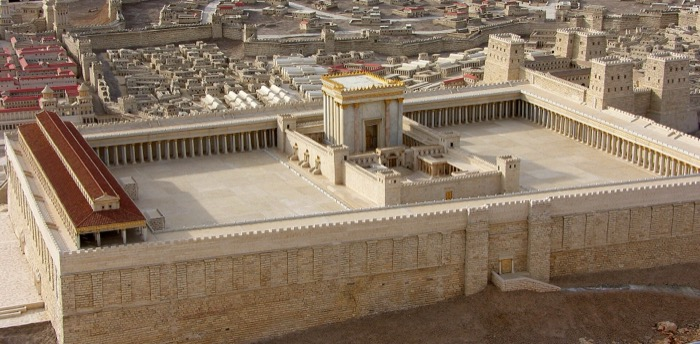
TOP PHOTO: Herod’s Temple as depicted in the Holyland Model of Jerusalem, a scale model housed at the Israel Museum in Jerusalem. (By FOTLbill – Own work, Public Domain, via wikimedia commons)


