Summary: The archaeology pertaining to the conquest of Jericho fits the Bible to an amazing degree of detail. Part 2 of a 3-part series.
Hear, O Israel: Thou art to pass over Jordan this day, to go in to possess nations greater and mightier than thyself, cities great and fenced up to heaven, – Deuteronomy 9:1 (KJV)
Exploring the Conquest of Jericho
Last time, we saw that there is widespread skepticism among archaeologists and historians over the Bible’s account of the fall of Jericho. As we will see, this skepticism is not derived from a lack of evidence for a fallen city as the Bible describes. The problem is that the archaeological evidence for Jericho’s destruction in the standard view is thought to come from a completely different time period than when the Bible has the event happening.
But how reliable are the dates? Could assumptions about the Bible’s dates for the event be off? Alternatively, could the dates assigned to the archaeology be wrong? Both need to be accurate in order to test the Bible fairly. Into the debate a recent proposal by archaeologist Bryan Windle has brought a new set of possibilities into the mix. Could there be archaeological evidence that was previously overlooked?
In Part 1 we focused on the Bible’s dates for the event, which showed that its own internal chronological information mandates an “Early” date for the Exodus and Conquest – at least about two centuries earlier (older) than the majority view among scholars. Now, in Part 2, we turn our attention to the details of the Biblical account and the archaeology that matches it. Part 3 will focus on the new data from Jericho and Bryan Windle’s new idea to match the Bible with the evidence.
Biblical Reports of Jericho
The Bible gives a lot of details regarding the siege and destruction of Jericho by the Israelites. There is also information for the area surrounding Jericho at that time. Finally, events at Jericho in the centuries following the Conquest are also mentioned. All of these accounts and descriptions can then be compared to archaeological finds that have been made at Tel es Sultan, the mound everyone agrees is Jericho. The stronger the pattern of evidence in the ground that fits the Bible, the more likely it is that we are looking at Joshua’s Conquest.

Here are eight factors from the Biblical account related to the period of Jericho and Canaan’s conquest, and four factors related to the later history of Jericho.
1) In the era of the Conquest, the Bible describes the cities of Canaan as both walled and very great (Numbers 13:28), and great with high walls reaching up to heaven (Deuteronomy 1:28, 9:1). The cities east of the Jordan that the Israelites conquered prior to entering Canaan were also said to be “fortified with high walls, gates, and bars” (Deuteronomy 3:5).
2) Two Israelites entered Jericho to spy out the city and from their account it is clear that it had a gate and wall. In exchange for her help, they promised to save Rehab and her family when they attacked Jericho. She hung a scarlet cord from the window to mark her house, which was built into the city wall (Joshua 2:5, 7, 14-21).
3) In Numbers chapter 25 while the Israelites were encamped in Moab across from Jericho, Midianites enticed the Israelites into idolatry associated with the false god Baal. This was not long before the death of Moses, and God sent a plague that killed 24,000 Israelites.
4) The Bible’s account has the siege and destruction of Jericho taking place at harvest time (Joshua 3:15) in the spring of the year. Because the summers are so hot and dry in the Jordan valley, wheat can’t be grown then. The harvest is in the spring. A spring siege of Jericho is confirmed by the Israelites celebrating Passover immediately after crossing the Jordan and before attacking Jericho (Joshua 5:10). Passover is a springtime feast, around the same time that Christians celebrate Easter.
5) The account has the siege of Jericho being very short, lasting only 7 days (Joshua 6:1-5, 15). This is very unusual for a siege of a heavily fortified city in the ancient world. Normally sieges would take months, or even years, as those inside suffered from a lack of food (and water if there was no spring within the city).
6) The walls of Jericho are said to have fallen flat (or “beneath themselves”) such that the Israelites could advance straight ahead up the mound into the city to take it (Joshua 6:5, 20). The walls were not pushed in from the battering rams of attackers etc.
7) After the walls collapsed, the Bible has the Israelites burning the city and all that was in it with fire (Joshua 6:24).
8) The Bible lists a series of other cities that were defeated during the conquest of Canaan after Jericho fell. Some of these cities are said to have been destroyed (devoted to destruction) by the Israelites. Several cities that the Israelites failed to overcome are also listed (Joshua chapters 7-13, and Judges chapter 1).
9) After Jericho was destroyed, Joshua laid a curse on anyone who would rebuild it. (Joshua 6:26).
10) Within the first century of the Judges period (after the Conquest), the second judge mentioned in the Bible, Ehud, is said to have killed Eglon, the king of Moab, after Eglon had captured the city of palms and oppressed the Israelites living in the area (Judges 3:12-30). The city of palms has been equated with Jericho because of Deuteronomy 34:3. Whether Eglon’s palace was on the mound of Jericho itself or not, or what kind of defensive walls may have been associated with it is not explicit in the text.
11) When King David sent emissaries to the Ammonites, they were treated shamefully and half their beards were shaved off. So David told them to remain at Jericho until their beards have grown before returning (2 Samuel 10:5). Using the Early Date for the Exodus/Conquest, this would have been about 400 years after the conquest of Jericho.
12) Finally, in the days of Israel’s King Ahab, Jericho was said to be built and its gate set up by one named Hiel. His sons are said to have died as a result, according to Joshua’s curse (1 Kings 16:34). So, while there may have been some occupation and building on the mound before this, apparently Hiel’s rebuild was considered the first time after the Conquest that a significant fortified city was reconstituted. This would have been about 150 years after the King David episode and 550 years after the Conquest.
Excavations at Jericho – The Case for City IV
The amazing fact is that a strong pattern of evidence fitting even the details of the Biblical account has been uncovered in the remains of Jericho’s City IV, which most believe was destroyed near the end of the Middle Bronze Age (MBA). The problem is that this is thought to be at the wrong date to fit the Bible’s timing for Joshua’s Conquest. This issue was covered in our first film, Patterns of Evidence: The Exodus. Just as the film did, let’s put the dating issue to the side for a moment and focus on the pattern of archaeological evidence in City IV.

Excavators found that Jericho at his time was protected by a brilliant defensive system. At its base, was a stone retaining wall made up of giant (cyclopean) stones more than fifteen feet high with a defensive extension wall of mud bricks rising higher still. Beyond this was a great earthen rampart – a steep slope covered with a slick surface of white plaster, where attackers would have been exposed to arrows and sling stones from above. At the top of this rampart was a second city wall, also made of mud-brick, this one more than twenty-five feet high and ten feet thick.
This certainly fits the Bible’s general descriptions for fortified cities in Canaan and for Jericho itself seen in #s 1 and 2 of the list above.
As archaeologist Kathleen Kenyon described in her reports, when City IV met its end, the mud brick walls collapsed and they fell outward, down to the base of the stone retaining wall. This provided a ramp such that the attackers could advance straight up the slope created by the tumble of bricks. In the city itself, the walls of buildings had fallen as well, and a very thick burn layer of extremely high temperatures was witnessed across the site. Kenyon wrote that it was clear that the walls fell before the fire. Because of the intensity and widespread nature of the fire evidence, Kenyon attributed it to an intentional burning from an attacking force, and not the random fires that might result from an earthquake.
This perfectly fits #s 6 and 7 of the list above, including the sequence of these events.

Within the city, a very unique discovery was made. Both Garstang and Kenyon found many storage jars full of charred grain in all the houses they excavated. The fact that these storage jars were so full suggests that the harvest had only recently been gathered in, which in turn points to a springtime destruction of the city at the time of year when the wheat harvest took place. The fact that they were so full also indicates a very short siege. Otherwise the grain in many of the jars would have been eaten down over the course of the many months of the siege.
A very short siege in springtime perfectly fits #s 4-5 in the list above.

erhaps the most remarkably specific piece of matching evidence comes from the fact that the German excavators under Ernst Sellin found that in some places houses had been built on the rampart between the two city walls. In one one section these houses had been built right up against the lower mudbrick wall. They found evidence that City IV’s wall had fallen down all around the site except in one short section on the north side of the mound where these houses were along the city wall.
This wonderfully explains the second half of #2 on the list above for how Rahab’s house could have survived the collapse of Jericho’s wall.
John Bimson’s Idea
While all these factors seemed to fit the Bible’s descriptions like a key in a lock, the challenge was that Kenyon dated the fall of Jericho’s City IV to the end of the MBA, around 1550 BC by standard dating. Not only was this many centuries prior to where the majority view (Late Date) placed the Conquest (around 1200 BC), it was 150 years prior to where the Early Date view put the Conquest. After the destruction of City IV the site was thought to have been largely abandoned until after the beginning of the Iron Age, at least 400 years later.
For skeptics of the Bible, no further investigation was needed. At the time of Joshua’s supposed Conquest, there were no high walls of Jericho to come tumbling down. In fact there was no active city at all. This showed them that the Biblical account was merely based on fragments of ancient legends and oral history that were woven together with invented elements to explain Israel’s origins. Many proposed the first books of the Bible weren’t written down until the time of the last kings of Judah (in the 600s BC) or even later during the Babylonian exile.
How did those who had a high regard for history recorded in the Bible respond? In a few different ways. At the outset it should be noted that the archaeological record is not complete. Most remains of human activity from the ancient world were destroyed or have decayed away over the centuries. People often used some of the stones from one period in building projects of the following period. Of what has survived over the millennia, only a small fraction has yet been uncovered. Even at major sites such as Jericho, if 10% of the mound were excavated, that would be considered a high degree of excavation. There are also disagreements over what dates to assign the different archaeological levels and the associated reigning monarchs. Some think the current standards are within a decade or two of the actual numbers for the Bronze and early Iron Ages, others think we may be off by centuries.

With that being said, in 1978 John Bimson from Trinity College Bristol, had his important book published, Redating the Exodus and Conquest. He took a broad approach of looking at finds in Canaan and Egypt as they might relate to the Bible’s account. He took aim at the Late Date held by the vast majority of scholars by noting that there was no evidence of large numbers of Semitic people (Western Asiatics as the Egyptians called them) in the Nile Delta during the time of Ramesses II. Neither were there major setbacks in Egypt’s wealth and power at that time, as one would expect if the Biblical Exodus with its ten plagues and the destruction of Egypt’s army had taken place. Instead, Egypt during Rameses’ reign was at the peak of its power.
- Middle Bronze Age (MBA) 2000-1550 BC – Jericho City IV
- Late Bronze Age (LBA) 1550-1200 BC – Jericho City V
- Early Date for Conquest c. 1400 BC
- Late Date for Conquest c. 1200 BC
- Iron Age (IA) 1200-585 BC – Jericho City VI
The main pillar of the Late Date’s argument for putting the Exodus at this time (the city of Ramesses’ short window of existence between c. 1300-1100 BC) could easily be called into question. The Bible has the Israelites settling in the land called “Rameses” at the time of Jacob and Joseph, hundreds of years before the Exodus (Gen. 47:11). The name “Rameses” in that instance is not connected with Pharaoh Ramesses II by anyone, so why must it be so connected in its other Biblical mention (Exodus 1:11)? The Bible has other cities that use names not instituted until much later times, such as “Dan” at the time of Abram in Genesis when it wasn’t actually named “Dan” until after the Conquest in the book of Judges.
And when Abram heard that his brother was taken captive, he armed his trained servants, born in his own house, three hundred and eighteen, and pursued them unto Dan. – Genesis 14:14
And they called the name of the city Dan, after the name of Dan their father, who was born unto Israel: howbeit the name of the city was Laish at the first. – Judges 18:29
Looking at Canaan, Bimson saw that Jericho at the Late Date for the Conquest was an empty site with no walls, and had been that way for centuries. No wonder there was so much skepticism. Proponents of the Late Date pointed to a lack of Late Bronze Age evidence for activity in areas such as Edom and Moab to claim the wilderness wandering couldn’t have happened at the Early Date. However, we shouldn’t expect large amounts of evidence for the Edomites and Moabites because semi-nomadic people often don’t leave much evidence behind. They don’t build big cities of brick and stone. Additionally, much more evidence for earlier activity in these areas has been discovered in recent decades, further supporting the viability of the Early Date.
The emergence of dozens of new settlements in the central hill country of Canaan early in the Iron Age has been pointed to by those holding a Late Date for the Exodus (The Ramesses Exodus Theory) as evidence for the influx of Israelites under Joshua beginning around 1200 BC. This is perhaps their greatest evidence for a Conquest at this time, since matching city-destruction evidence is not to be found. However, this evidence could be explained in different ways, such as Israelite refugees moving to the hills from one of the invasions by Israel’s neighbors as the Bible recounts.
The problem of lack of city destructions in this era is deflected by emphasizing that the Israelites would not have unnecessarily destroyed perfectly good cities that they could occupy. The Bible states that the Israelites would occupy cities they didn’t build, and gain vineyards they didn’t plant (Deuteronomy 6:10-12).
While this is true, the Bible also gives a specific list of cities that the Israelites did encounter and destroy. And at the Late Date the archaeology shows about half of these sites didn’t exist at all during the Late Bronze Age where the Late Date sits. John Bimson took the archaeological data to form a chart comparing the city destruction evidence. It showed a consistent match between the MBA and the Bible’s account (including at Jericho), while the Late Date had only a couple matches. The Late Date fits neither the Bible’s internal chronology, nor the available archaeological evidence.
At Jericho, a plague is evidenced shortly before the end of the MBA city where several multiple burials were discovered with no signs of injury to the bodies and lavish provisions of food in the tombs. Kenyon wrote that “some catastrophe caused high mortality on an occasion very late in the history of Middle Bronze Age Jericho.” She concluded that MBA Jericho, “suffered a plague” shortly before the greater catastrophe of the city’s destruction.”
This fits #3 on the list above where a severe plague hit the Israelite camp, just across the Jordan River from Jericho. The two spies may have carried the plague into the city with them, just weeks before the siege of the city began.
City IV’s pattern of evidence City IV is very strong. These findings caused Bimson to propose that the Middle Bronze destructions were, in fact, Joshua’s Conquest. Also, the dates for the end of the MBA were off and needed to be shifted downward (forward) by nearly 150 years. This would solve the dating problem by bringing the destruction of Jericho’s City IV into alignment with the Biblical Early Date for the Conquest (late 1400s BC).
This seems like a straightforward idea with a lot of possibilities. However the standard views for dating the Exodus and the history of the ancient world have become a paradigm so firmly set in place that few are willing to question it.
Conclusion
Next time we will conclude our series by looking at other ideas involved in bringing the data at Jericho into alignment with the Biblical account. Some took Bimson’s idea and incorporated it into an entirely New Chronology for the ancient world. Others argued that City IV ‘s destruction was misdated and should actually be considered to be at the end of Late Bronze I, the first subdivision of the Late Bronze Age at the time of the Early Date for the Conquest. Of special interest will be Bryan Windle’s interaction with the new excavation reports from Jericho. Until then, keep thinking!
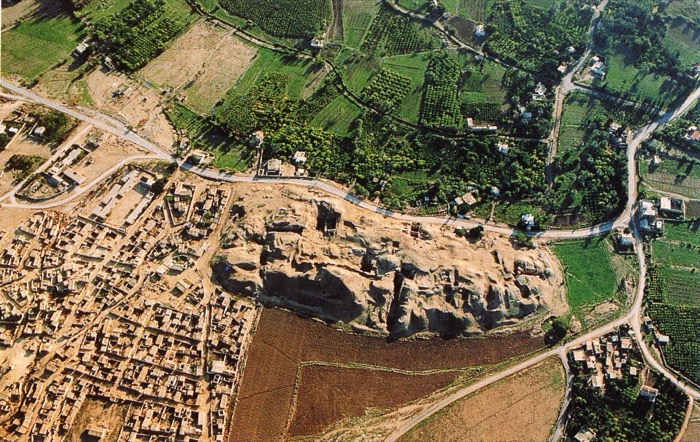
TOP PHOTO: Aerial view of the archaeological area of Jericho, specifically showing the mound of Tell es-Sultan in the center. (Fullo88 at Italian Wikipedia, Public domain, via Wikimedia Commons)


