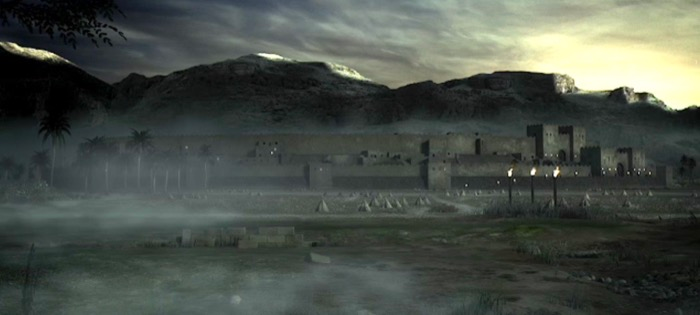
Summary: The latest excavation reports from Jericho have prompted a new theory for the timing of Jericho’s destruction, rekindling a Biblical debate.
So the people shouted when the priests blew with the trumpets: and it came to pass, when the people heard the sound of the trumpet, and the people shouted with a great shout, that the wall fell down flat, so that the people went up into the city, every man straight before him, and they took the city. – Joshua 6:20 (KJV)
The Challenge of Jericho
Of all the archaeological sites that have sparked debate over the historical credibility of the Bible, the city of Jericho stands at the center. The siege and capture of the high-walled city take up more than two chapters in the book of Joshua. Many are familiar with the account of Joshua ordering the Israelites to blow their horns and shout, and the walls of the Canaanite city came tumbling down. And we know exactly where the remains of that city exist today.
If the Bible’s account is accurate, then if any site holds matching physical evidence that could still be found today, then it should be here. Excavations at the site of Tell es-Sultan (Biblical Jericho) revealed the remains of a very large city with high walls that had fallen down and evidence that the city had been set on fire, just as the Bible describes. These finds were featured in our first film, the award-winning Patterns of Evidence: The Exodus. However, the archaeology there has also been used as “Exhibit A” in the case by skeptics to show the Bible doesn’t know what it is talking about.
The latest 19 seasons of excavations at Tell es-Sultan by an Italian and Palestinian team have most recently been headed up by Professor Lawrence Nigro from Sapienza University of Rome. His most recent reports have prompted a rethinking of the Jericho puzzle by archaeologist Bryan Windle. Could Windle’s new proposal be a breakthrough for one of the biggest questions in Biblical archaeology?
The problem at Jericho comes down to chronology (or “time”). The majority of archaeologists and historians believe that none of the city’s Bronze Age destruction levels match the time frame laid out in the Bible for when the Israelite conquest of the land of Canaan and the fall of Jericho was supposed to take place.

Perhaps the most influential book on Biblical archaeology of the last generation is The Bible Unearthed by Israel Finkelstein and Neil Asher Silberman (New York: The Free Press, 2001). They follow the majority view by dating the exodus from Egypt and the conquest of Canaan in the 13th century (1200s) BC. This is known as the “Late Date” for the Exodus or as “the Ramesses Exodus Theory.”
They write that as is the case with other Canaanite cities in the 13th century BC, Jericho had no walls to come tumbling down. “[T]he famous scene of the Israelite forces marching around the walled town with the Ark of the Covenant, causing Jericho’s mighty walls to collapse by the blowing of their war trumpets was, to put it simply, a romantic mirage.” (p. 82)
Excavations at Jericho
Skepticism about the Jericho account has not always dominated the field of archaeology. Early excavators there saw the Bible’s story reflected in what they were unearthing.
The archaeological record at Jericho reveals a long history, with layers of different cities from different periods building up the mound on which the city was built. The mound rose higher and higher as each successive city was destroyed, and the next rebuild was constructed on top of the remains of the previous one. This is common for cities in the ancient Near East, whose remains are often compared to a layer cake, where each layer is from an older period as you dig down deeper in the mound, also known as a “tell” (alternatively spelled “tel”).
The archaeological history of Canaan in the this era is divided into two main ages – the
Middle Bronze Age has standard dates of about 2000 BC to 1550 BC. This roughly corresponds with the Middle Kingdom era of Egypt (and the following Second Intermediate Period). The Late Bronze Age has been assigned dates of about 1550-1200 BC. This corresponds to the 18th and 19th dynasties of Egypt’s New Kingdom.
The layers at Jericho revealed that over the centuries the site developed into very large cities with strong fortification walls. Several city-wide destructions were noted, followed by a long period of abandonment. The oldest occupation levels at Jericho were dubbed “City I,” which is followed by Cities II, III, IV etc. The first major excavations at Jericho were conducted by a German team headed by Ernst Sellin and Carl Watzinger from 1907-1909 and 1911. Sellin eventually concluded that the final major destruction happened in City IV, near the end of the Middle Bronze Age. City IV must have been the Jericho destroyed by the Israelites.
The second major excavations were directed by John Garstang from 1930–1936. He also thought the end of City IV fit the Bible’s account of Joshua, but he dated the destruction to the Late Bronze Age c. 1400 BC. This would fit the so-called “Early Date” date for the Exodus and Conquest (see more below). This countered the view of eminent Biblical archaeologist William F. Albright, whose view shifted as new evidence came in.

A shift would come with the 1952-1958 project of Kathleen Kenyon. She confirmed that the pottery remains used to date ancient sites showed that City IV had met its catastrophic demise near the end of the Middle Bronze Age – around 1550 BC by standard dating. After a period of abandonment, the following Late Bronze City V had no massive walls (to fall down as the Joshua account requires) and only minimal remains, mostly at what was called the Middle Building, which Garstang had excavated. Kenyon’s conclusions resulted in a wave of skepticism that built over time in the field of archaeology, and was fed from other sights as well. The Middle Bronze c. 1550 BC date for the final major destruction of a fortified Jericho was far too early to fit even the “Early Date” (around 1400 BC) for the proposed Biblical conquest.
In the 1990s, Bryant Wood, one of the leaders of Associates for Biblical Research (ABR), argued that Garstang had been right all along and that Kenyon had misinterpreted the pottery, resulting in a faulty conclusion for the date of City IVs destruction. Wood believed Jericho fell in the Late Bronze Age around 1400 BC, fitting the Early Date for the Conquest. For the past 30 years, this opinion has gained little traction among archaeologists and pottery experts, but has been a popular solution for Bible-believers who favored the Early Date for the Exodus/Conquest.
The ongoing work at Jericho from Professor Nigro and the Italian/Palestinian team has relentlessly expanded knowledge of the site, sorting out the data from the previous excavations in the process. The major result concerning the debate over Joshua’s conquest is that Kenyon’s dating for the end of City IV has been confirmed (near the end of the Middle Bronze Age), typically thought to be too early to fit the Bible.
This is where Bryan Windle’s research comes in. He has taken a deep dive into Nigro’s excavation reports and Late Bronze Age pottery after noting that there was a lot more Late Bronze activity at Jericho than people generally realize. In fact, this has led him to the surprising proposal that the major destruction of City IV was not Joshua’s conquest after all. Rather City V of the Late Bronze is where the Biblical event took place, around the year 1350 BC.
So where does that leave the Biblical case for Jericho? Does Windle have a strong argument? What about the pattern of evidence profiled in the Exodus film?
As always, these questions revolve around, which city was the one Joshua destroyed and at what date did this happen?
Getting the Dates Right
In the search for potential archaeological and historical evidence related to the Exodus and Conquest events, two things need to come together – the correct Biblical dates for these major occurrences, and the correct dates for the archaeological evidence in the ground. If either is off, you will miss any potential match. To begin with, we’ll look more closely at the Biblical date.

As mentioned above, scholars have generally fallen into two main opinions about the date for the Exodus/Conquest. The minority camp takes the “Early Date” for the Exodus in the 15th century (1400s) BC. This is mainly calculated from the standard dates for King Solomon combined with 1 Kings 6:1, which states that the exodus from Egypt occurred 480 years before Solomon began work on the Temple in the fourth year of his reign. The exact dates for Solomon are disputed, but differences amount to a few decades around or after 1000 BC, putting the Exodus and Conquest into the 1400s BC.
And it came to pass in the four hundred and eightieth year after the children of Israel were come out of the land of Egypt, in the fourth year of Solomon’s reign over Israel, in the month Zif, which is the second month, that he began to build the house of the LORD. – 1 Kings 6:1
Additional evidence for there being about 480 years between the Exodus and Solomon can be found in the Bible’s chronological data. In Judges 11:26 Jephthah (one of the last judges of Israel) states that Israel had been in the Promised Land at that point for 300 years. If you add to these 300 years the 40 years of wilderness wandering after the Exodus, 60 years for the last judges including Samuel, 40 years for Saul, 40 for David, and 3 years for Solomon’s early reign, it adds up to about 480 years as recorded in 1 Kings 6:1. In a Ramesses Exodus scenario this span of time would need to be 200 years shorter. In fact all the timespans recorded in the book of Judges seem to be too much to compress down to only 200 years between Conquest and King David required by the Ramesses Exodus view (even if major overlaps are employed).
To this we can add the witness of 1 Chronicles 6:31–37, which gives the genealogy of Heman the singer. It results in 18 successive generations from Korah (a priest in the line of Levi at the time of the Exodus) to the time when David installed Heman the singer “after the ark rested” in Jerusalem (1 Chron. 6:31). This happened early in David’s reign. If we use the standard Early Exodus date, then this span would go from about 1446 BC to Year-9 of David in 1001 BC – an average of about 24.7 years per male generation over the 445-year span, which seems quite reasonable.
On the other hand, if we employ the Late Exodus date around 1250 BC the resulting 249-year span between the Exodus/Korah and Heman yields an average of only 13.8 years per male generation. People tended to marry very early in ancient times, but to have this low of an average over the course of 18 generations shows that something is wrong.
The majority of scholars favor the “Late Date” for the Exodus in the 13th century BC, mainly due to the Israelites building the store city of Raamses mentioned in Exodus 1:11. This is then tied to Pharaoh Ramesses II who is known to have built a great city named after himself, and whose reign is conventionally dated to 1279-1213 BC. To counter the seemingly clear statement in 1 Kings 6:1, most in this view believe this verse is symbolic, with 480 equating to 40 x 12, both highly symbolic numbers. Therefore they don’t think 480 should be taken literally.
Members in this group often cite a lack of confirming archaeological evidence for the Early Date. They maintain that there is no evidence for Israel existing in Canaan before the Merneptah Stele (made by the son of Ramesses II), which boasts of defeating Israel in the area of Canaan and is conventionally dated to around 1209 BC (about the time they would put the Conquest).

However, this would put the Conquest about 350 years after the onset of the Late Bronze Age, at a time where there is no evidence for a large and fortified Jericho. Proponents of this view claim that all evidence for Jericho in this period has eroded away. Since ample evidence for earlier and later periods of Jericho’s history have survived, critics such as Finkelstein don’t buy this argument.
40 Years Between Exodus and Conquest?
Why are the two events of Exodus and Conquest tied together? It is because of their proximity in time to each other – only 40 years apart. Many doubt the exactness of the “40 years” claim, even though the Bible states this span for the wilderness wanderings in numerous places. After all, a brief search for the number of times “40” is used throughout the Bible, especially for significant events, shows that it had a symbolic meaning as a number for completeness or a full amount – or the fulfillment of God’s promises, whether probationary periods, judgments, or blessings.
Because of the frequent use of the number 40, many dismiss the idea that this was the actual time spent by the Israelites in the wilderness between the Exodus and Conquest. However, a figure can have symbolic meaning and at the same time be historically accurate. The Bible claims God controls history, and it records God pronouncing that they would be in the wilderness 40 years, “a year for each day” that they had spied out the land of Canaan (Num. 14:31-35). Additionally, Moses’ account of their journeys contains more specifics that verify the accuracy and intended meaning of “40.”
And the time from our leaving Kadesh-barnea until we crossed the brook Zered was thirty-eight years, until the entire generation, that is, the men of war, had perished from the camp, as the LORD had sworn to them. – Deuteronomy 2:14
Moses’ record has the Israelites leaving Mount Sinai a little over 13 months after coming out of Egypt (Numbers 10:11). Then it was at least a couple weeks to travel to Kadesh-barnea and 40 days waiting for the spies to return with their bad news in a scouting report of giants and high-walled cities, before the people refused to enter Canaan and God pronounced the judgment of 40 years (total) in the wilderness before they could enter. The main group left Kadesh-barnea shortly afterward (Num. 14:25).
So this added to the 38 years of Deuteronomy 2:14 yields about 39 years plus two months into the 40th year between leaving Egypt and crossing the brook Zered. After this, there was Balaam’s failed attempt to curse Israel, several months of conquering the lands east of the Jordan River, Moses writing his final sermon (the book of Deuteronomy – Deut. 1:3-5), before dying on Mount Nebo, a month of mourning for Moses (Deut. 34:5-8), and the Israelites crossing into Canaan just in time to celebrate Passover (Joshua 5:10-12), exactly 40 years after leaving Egypt.
So it seems clear that if the Bible is used as the primary source to define its own timeline, the Late Date should be rejected and an early date 480 years before Solomon’s 4th year should be followed for the Exodus, with the Conquest following precisely 40 years later. Both events would then occur in the 1400s BC.
However, as we will see, some adjustments to this thinking are feasible. Bryan Windle’s outside-the-box proposal can help us reassess our views and the reasons we hold them, as we apply the Biblical data to the evidence at Jericho.
Conclusion
Could Windle’s new Jericho proposal be a breakthrough, or just one more in a throng of competing theories that don’t yet have all the answers? Join us next time for Part 2 of this important exploration. Until then, keep thinking!
TOP PHOTO: A recreation of ancient Jericho from the film, Patterns of Evidence: The Exodus. (© 2014 Thinking Man Films)


