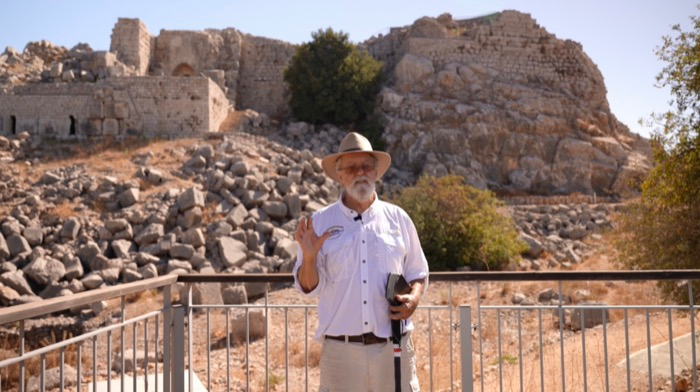
Summary: Dr. Winder continues to share profound insights about Mount Hermon and the case for it being Jesus’ transfiguration site.
And after six days Jesus took with him Peter and James, and John his brother, and led them up a high mountain by themselves. And he was transfigured before them, and his face shone like the sun, and his clothes became white as light. – Matthew 17:1-2 (ESV)
Is Mt. Hermon the Site of the Transfiguration?
Near Caesarea Philippi, at the foot of Mount Hermon, Jesus made the statement, “On this rock I will build my church” (Matt. 16:18). Six days later, Jesus’ transfiguration took place. Could these events have taken place in the same area, and what significance would that have for our understanding of them?
Biblical archaeologist Prof. Thomas Winder makes the case that theological connections from the Old and New Testaments combine with the archaeological context of 27 cultic temple sites on Mount Hermon and extra-Biblical accounts to show that the transfiguration took place at the site of Nimrod’s fortress located in the foothills of Mount Hermon.
In Part 1 of the discussion, Prof. Winder identified the remains of a stone structure at Nimrod’s Fortress as an arch built for the false god Baal. In Part 2 of this discussion, Podcast Director, Logan Kiesewetter picks up the conversation in place of Tim Mahoney to continue the exploration of this intriguing idea.
THOMAS WINDER: So to pick up from the story that’s taking place at the Gate to Hades, when Jesus says, “Upon this rock, I will build my church.” This is one of the great stories of archaeology, because this is one of the few times where theology is intertwined with the sites, with the archaeology. In fact, it’s theology that is the solution to the question, “Who do you say that I am?” Peter gets it right, then immediately gets a demotion after he rebukes Jesus for telling them that he’s got to die – to go suffer and die. And of course we know the rest of that story.
So let’s pick it up where Jesus now says, “Upon this rock, I will build my church.” And “the gates to Hades,” which they’re literally standing in front of at Pan’s altar, will not prevail against his church.
So when he says, “upon this rock,” he’s literally talking about the rock they’re standing on, which represents the sinners of the world, the pagan world. And that we all, you and I included, we’re all sinners. There’s not one of us that’s not a sinner. The church is built on sinners. Yes, sinners redeemed. Sinners that all get the Holy Spirit, that all get the keys to the kingdom of heaven. Whatever we bind on earth will be bound in heaven. Whatever we loose on earth will be loosed in heaven. That’s really important because if it’s not the church he’s talking to, he’s only talking to Peter. It’s a no-brainer. Peter can’t be the only one that has the power and authority over the dark forces of this planet. No, no, no, the Holy Spirit gives us the authority over all those dark forces.
So what happens? He immediately says, “Okay, Peter, James and John, let’s go for a walk.” Our translations just simply say they went up the hill to a high mountaintop. It doesn’t even say the summit. It just says a high mountaintop.
LOGAN KIESWETTER: Yes.

(credit: Athanasius Soter, CC BY-SA 3.0, via Wikimedia Commons)
THOMAS WINDER: So now here comes the theology. After I discovered these megalithic towers, the two towers that are still partially intact because the Islamic people just added on to this megalithic structure that used to be an arch, the top fell down in an earthquake in the middle of the 1300s and all those rocks are still there. So they were not cut up by the Islamics when they built the fortress to keep the crusaders out.
LOGAN KIESWETTER: I think that’s really important because I know when I watched your video, that was something that was very readily apparent to me is I could very distinctly see when you and your cameraman went up there, you could see the difference between the megalithic stones and the little ones that filled in the gaps.

THOMAS WINDER: Yeah, of course. They’re at Pan’s altar, at the gate to Hades. I mean, that’s a big wow to start with. What is Jesus doing there? Why does he take his disciples there for what turns out to be the Feast of Tabernacles?
Jesus takes Peter, James and John up the hill. The only hill and the only trail from the gate to Hades. Believe me, there’s a ridge on this side, there’s a ridge on that side. In between, there’s huge ravines that you can’t pass. There’s only one little ridge with the hilltop on it, literally within an hour’s walk of the gate to Hades. And it is seen everywhere. You can see it all the way to Tel Dan, today, all the way to Kiryat Shmona. Clear across the Hula Valley. I’m telling you, when Jesus puts on the light show, everybody in the region saw it. We don’t even know how long it lasted because we’re not told. It seems like it might’ve been a real quick thing, but I don’t think so.
I think it lasted most of the night because on the last day of Tabernacles, that would be the last night, by the way, Matthew and Mark say “six days later,” Luke tells you what six days later is from, Jesus gave them the keys to the kingdom. Six days later, after that, they didn’t go anywhere. It’s the Feast of Tabernacles. They go up to the top of the hill. What does Peter want to do? Build three tabernacles. That nails it.
So theologically, why does Jesus go to the top of that hill? He went up there to reverse the curse of the pagan gods. All the books that have been written about the giants and Mount Hermon in the last 10 years, the stack of books is five feet tall. Every Christian author has written about the spirits that came from Mount Hermon. They never mentioned the transfiguration. They really rarely mention, other than Jesus went there to reverse the curse.
LOGAN KIESWETTER: They don’t really go into the details like you do. If you want to get into this and share, what are some of the sources that we have that talk about the giants, the Nephilim coming from Mount Hermon, being born on Mount Hermon?
THOMAS WINDER: The number one book that was not canonized, even though it’s in the Ethiopian Bibles and quite a few other books, I mean, they didn’t erase it, it just wasn’t canonized, is the Book of Enoch. And the Book of Enoch actually names the fallen angels, the watchers, Genesis chapter six, where it literally tells you that the Nephilim came to earth before and after. That would be mentioning the flood.
And they mated with the women and the giants were born. That all happened right here on Mount Hermon. Nobody argues with that. And in fact, the Protestants will all tell you that this event we’re talking about, the transfiguration of Christ, happened on Mount Hermon. But they don’t tell you where. They guess it might’ve happened on the summit. You cannot see the summit from Caesarea Philippi. So how did all those people show up the next morning? Luke 9:37 tells you clearly that they came the next morning when they came down the mountain. That means they’re only up there for one day where Jesus meets up with Moses and Elijah.
Moses and Elijah Appearing with Jesus

LOGAN KIESWETTER: What’s the significance in your view of Moses and Elijah specifically being there at the transfiguration?
THOMAS WINDER: Well, first of all, they’re the two great overcomers. And every single person in the church is given the keys to the kingdom and the Holy Spirit to overcome the dark forces of this world. What did Moses overcome? The pagan gods of Egypt. Remember the golden calf and all that incident? And those people had to die because they built, it’s not just a calf, it’s a male calf with horns. That’s the symbol of Baal, the pagan god, the number one head dog on the pagan pantheon. So Moses being the Hebrew overcomer, he’s called.
And Elijah, what does he do on Mount Carmel? Same thing. The pagan fertility gods of Baal, the prophets of Baal, and the priest of Jeze-baal. I love to tell this story. It’s the great barbecue competition where Elijah says, okay, you guys set up your barbecue. “Put your fatted calf on it and see if your gods can call down the fire to light it. Oh, and I’ll do the same thing right over here. I’ll build my own. I’ll put a fatted calf on it. Oh, by the way, and I’ll build a moat around mine and I’ll soak it three times with tons of water just to make this even.”
And of course, the end of the story is Elijah calls down the fire. His God is powerful enough to do that. And of course, all those priests end up taken out of the living. And then, believe it or not, he walks from Mount Carmel with some superfood that an angel gives him all the way to Mount Sinai.
LOGAN KIESWETTER: Sinai. Yeah. So Moses and Elijah, the great overcomers, they overcame the pagan gods. They overcame Baal.
THOMAS WINDER: Same thing we’re supposed to do.
LOGAN KIESWETTER: And we’re supposed to do that.
THOMAS WINDER: Watch this picture. You got a pyramid, let’s say, with Jesus as the head of the church. Amen.
LOGAN KIESWETTER: Amen.
THOMAS WINDER: With Jew and Gentile overcomers as the body of Christ. Moses, we all know is a Hebrew, no doubt. But if you’ll read First Kings chapter 17 verse one, it tells us quite clearly that Elijah is a Gentile. Well, so there you have the very picture of what the church is supposed to be. Jew and Gentiles with no wall of enmity between the two, with Jesus as the head of the church. Remember how the story started with the question, who do you say that I am? What does the voice of God say? We call it the cloud of light. It’s the pillar of fire that guided the Hebrews throughout the wilderness. Wasn’t that God hovering over the Ark of the Covenant?
LOGAN KIESWETTER: That’s a connection to the Feast of Tabernacles.
THOMAS WINDER: Of course. Because on the last night of the Feast of Tabernacles, every single year annually, they put on the best light show they possibly can to commemorate the pillar of fire. So, Jesus, when he’s on the top of the mount of transfiguration, we call it the cloud of light, but he turns into the pillar of fire.

Connections to Hebrew Contexts
LOGAN KIESWETTER: This is one thing that I loved about your information. I know Tim, as Tim was on earlier, loves as well. But something that’s so important is the depth to this. All this interconnectivity, the pattern in the Exodus, and all the way back to Genesis. It’s something that I feel like a lot of believers in our time do not know. It takes knowing more about the Biblical feast days, more about knowing the Jewish calendar and understanding some of the Jewishness of the first century of the New Testament even, and understanding what that underlying backstory is, and then going all the way back to Genesis and the Nephilim and the flood and things like that.
THOMAS WINDER: And that’s the stuff I taught at the seminary school as a seminary professor. Even way back then, people didn’t understand because they’d never heard that stuff before. Colossians chapter 2 verses 16 and 17 literally tell you, don’t judge anybody according to their feast days, their full moons, and their Sabbaths. And then it tells you clearly the substance of those things belongs to Christ. They’re all about him, right? Crucified on the day of Passover as the lamb of God. He is the bread without leaven. And he is the first fruits of the resurrection three days later.
LOGAN KIESWETTER: I get excited with this kind of stuff. Aside from Biblical archeology, this is something that I’ve enjoyed studying, so it’s fun to talk with you about this. The feast days and how Jesus embodies them. If you understand the Biblical feast days and how they apply in the Gospels and where they fall in the Gospels, the depth of meaning to everything Jesus did is so much greater. It’s so much more profound.
THOMAS WINDER: Yeah. Read the Gospel of John six, seven, and eight. He’s either there at Passover or he’s there at Tabernacles. And he is the water. He breaks up the whole ceremony, says, “I am the water.” Comes in and says, “Wait a minute, I am the light.” So on the real location of the mount of transfiguration, okay, he puts on his own light show, right? I say it’s the pillar of fire because literally people from 25 miles around in all directions get to see this. You can see Nimrod’s fortress all the way across this little valley, all – everywhere. It sticks out like a sore thumb because it’s literally its own ridge that sticks up at the foot of the mountain. You can’t even see the summit. Most of the time it’s covered up in clouds or it’s just so far away you can’t see it.
So you have Jesus, Moses, and Elijah in the light show. And what does the voice of God say? The voice of God comes and answers the question. “Who do you say that I am?” What’s the answer? “This is my beloved son in whom I am well pleased. Listen to him.” These guys have to be told to listen because they don’t think spiritually. All they want to do is be in charge. They’re kind of going along for the ride. They don’t even know how to cast out demons yet.
“The LORD your God will raise up for you a prophet like me from among you, from your brothers—it is to him you shall listen—just as you desired of the LORD your God at Horeb on the day of the assembly, when you said, ‘Let me not hear again the voice of the LORD my God or see this great fire any more, lest I die.’ And the LORD said to me, ‘They are right in what they have spoken. I will raise up for them a prophet like you from among their brothers. And I will put my words in his mouth, and he shall speak to them all that I command him. And whoever will not listen to my words that he shall speak in my name, I myself will require it of him. – Deuteronomy 18:15-19
THOMAS WINDER: Until this event when they finally see who Jesus really is. He’s not just some great prophet like Elijah or Jeremiah. He’s not just some great rabbi. He’s not some enlightened guru. He is the Messiah, the son of the living God. God speaks in the light show at Baal’s throne after Jesus comes from Pan’s altar. He goes right up the hill to Baal’s altar. I mean, it’s a no-brainer. It had to be on that hilltop. But where and why? Well, now we know. Basically it’s checkmate. He’s telling the devil, he’s telling everybody who exactly he is. And by golly, there’s a new sheriff in town. He’s putting all those spirits on notice that now there’s an army cut out of the rock, right? Sinners cut out of the rock of sin. Now they’re the army against the very captain of sin.
The Mission of the Church
THOMAS WINDER: Even Abraham came from the pagan world that Isaiah 51 tells us clearly had to be cut out of the rock and hewn out of the pit to be Abraham and go to the Promised Land. I mean, we all had to be cut out of the rock of debauchery, the rock of sin before we could be cleaned up, given the Holy Spirit and the keys to the kingdom of heaven to fulfill our mission. And our mission is to come against the principles and powers of the dark forces of this world.
LOGAN KIESWETTER: Yes.
THOMAS WINDER: Now here I go, I’m going to preach a little bit if you don’t mind. The church is not a country club. It’s not some feel good place where all you get is sermons about positive thinking. No, no, you’re supposed to preach conviction so that people get convicted to do what? To repent of their sins and become part of the army against the captain of sin.
And all that happens right here on Mount Hermon, right at Pan’s altar and then Baal’s altar. And when they come down the hill the next morning to a huge crowd of people, because everybody saw the light show, so they show up to find out what the heck was that all about. Amen. And Jesus picks 70 people and sends them out to cast out demons. Now, wait a minute, wait a minute. You can’t do that without the Holy Spirit and the keys to the kingdom. Our whole purpose as the church is to cast out demons and heal the sick. We are the army that Jesus put together to fight the captain of sin. There’s a good sermon for you.
LOGAN KIESWETTER: But, what you’re saying is true. It’s very true. And I think that’s one of the things that’s incredibly inspiring about your research into the transfiguration and Mount Hermon being the location of that is, again, I know I keep using this phrase, but the depth of meaning and then understanding what the church was actually given the ability to do, called to do. And as you and Tim were talking earlier, it just kind of goes over everyone’s head. The transfiguration is like, oh, that’s obviously important. We don’t really understand the true meaning of it and how truly important it actually is.
THOMAS WINDER: Believe me, it was the theology, once I had learned it, that opened my eyes to see the archeology. Right?
LOGAN KIESWETTER: Yes.
THOMAS WINDER: Because for 30 years, I looked at that fortress at least hundreds of times and I didn’t see it. All I saw were rocks, until I knew the theology behind it. And there had to be something there before they built that fortress. And there’s all these megalithic stones and all the cut stones below it that fell off that are literally carved in curvatures to create an arch. I mean, once you see those stones, there is no question. There’s absolutely no question that those two towers used to have a big arch on it. They built an arch. I can show you arches all over the Middle East that have the exact same cut stones. Once you put all these pieces together, it completes the puzzle.
Conclusion
LOGAN KIESWETTER: Your transfiguration video, and then also some other videos you’ve done where you’ve actually gone and spoken to different groups and churches talking about that dovetailing, that interconnectivity of the archeology and the theology. Because we can have the two separate, but when they come together, when you have the archeology bolstering the theology and vice versa, the theology bolstering the archeology, that’s where Biblical archeology really shines. And the archeology can give a new perspective on the Biblical text. It can go both ways.
THOMAS WINDER: When you hear this and you understand the theology behind it, well, duh, he is the Son of God. He is the Messiah. He is God in the flesh. By the way, that’s the very first doctrine of Christianity.
Keep thinking!
NOTE: Not every view expressed by guests on Thinker podcasts necessarily reflects the views of Patterns of Evidence. We include perspectives from various sides of debates on Biblical matters so that readers can become familiar with the different arguments involved. – Keep Thinking!
TOP PHOTO: Dr. Thomas Winder on Mount Hermon below Nimrod Fortress. (© Thomas Winder)


.JPG)


