Summary: Part 2 of a 3-part series examines the timing of the dramatic events in Jacob’s family to reveal more surprising details and deeper insights.
And Jacob loved Rachel; and said, I will serve thee seven years for Rachel thy younger daughter.” – Genesis 29:18 (KJV)
Jacob and Chronology
Last time, it was seen that chronology (timing) is a very important yet overlooked aspect in understanding the narratives of the Biblical account. A close look at the chronology of Jacob’s life revealed he was actually not a young man when he fled to Haran, as popularly believed, but 77 years old. There he met and married his cousins Rachel and Leah. Other surprising realities in those generations showed that long lifespans allowed them to do things at twice the age as is typical today. Yet these old ages show evidence of being genuine and not the invention of a writer many centuries after the events.
In fact, recent news stories have covered studies showing that long ages today are mostly affected by genetics, and those with slower “internal clocks” are often clustered within families. In their 1966 book, Anomalies and Curiosities of Medicine, George Gould and Walter Pyle (p. 366-383) present examples of people living exceptionally long lives, who are often grouped in specific regions. A Roman census from AD 76 listed one area in Italy that had many people over the age of 100, and several over 130.
The chronological details revealed in the Bible lead to even more surprising realities. The Bible says the Israelites multiplied to a huge population during the time in Egypt, but other places show only four generations for that period. Additionally, the numbers don’t seem to add up for the period when Jacob’s children were born in Haran. Readers are often confused or even experience doubts about the Bible when faced with difficulties like these. Once again, a proper understanding of the timing can provide some satisfying solutions.
Since there was so much good material related to this topic, I decided to turn the series into three parts rather than cutting things out to fit it into two segments. So let’s get started.
Older or Younger?
One apparent dissonance during the era of Jacob and his family is the collision between extremely old and very young ages compared to what is normal today. The Bible presents the early generations of mankind living to very great ages. Even at the time of Jacob, they were still living to about twice as long as people in modern times. At the same time, we know that in the ancient world – and in the Bible – things like marriage, child-bearing, and obtaining positions of employment and authority occurred at much earlier ages than is typical today.
In fact, the ancient and traditional Jewish coming-of-age ceremonies marking the transition from childhood to adulthood carry over the realities of that time. The bar mitzvah is celebrated for Jewish boys at age 13, the bat mitzvah for girls at age 12, which roughly aligns with the onset of puberty. This initiates certain responsibilities and rights, including the ability to lead community prayer, take vows, possess personal property, and enter into contracts, including marriage. This raises an obvious question, ‘So which is it – were these kinds of things happening in the Bible when people were very young or very old?’
First, it should be noted that just because certain realities don’t fit today’s norms doesn’t mean they aren’t true. Secondly, it appears to be the case that both of these circumstances were happening at the same time in the Biblical account. Situations normal to people in their 20s and 30s today could be happening at both much younger, and much older ages at the time of Jacob – and these two realities are not contradictory. Let’s take a closer look at how this might play out with the situation of timing and multiplication of the Israelites in Egypt.
Questions have been raised about the accuracy of the Bible when it speaks about the great multiplication of Jacob’s family (the Israelites) during their time in Egypt, not only because of the feasibility of moving such large numbers across the wilderness, but also the seeming impossibility of multiplying so greatly in just four generations. God promised Abram in Genesis 15:16 that they would come out of Egypt in the fourth generation. Exodus 6:16-20 appears to give the fulfilment of this prophecy by listing four generations from Jacob’s son Levi down to Moses and Aaron, the leaders during the exodus from Egypt.
At the same time Genesis chapter 46 lists 70 members of Jacob’s family going into Egypt, and then Exodus 12:37 says 600,000 Israelite men left Egypt. The book of Numbers confirms over 600,000 Israelite men (not including women and children) at the time of the exodus. So how could they go from 70 to 600,000 in just four generations?
Some have proposed “missing generations” in places like Exodus 6 to resolve the difficulty. However, God had promised four generations. Additionally, the genealogy of Levi to Moses is repeated several times in the Bible, always in the same way, and the number of mothers, aunts and uncles, and other interconnected family relations listed for their line during this period makes the insertion of missing generations difficult. However, other family trees in the Bible list many more generations for this same period (especially the line from Ephraim to Joshua in 1 Chron. 7:23-27).
Even without very old ages, it can be seen that if parents are having 6 or more children, the difference in time from the oldest to the youngest can be quite significant. Within one generation there can be overlapping generations, where the oldest child of a set of siblings is older than their youngest aunt or uncle. Within a few cycles of this situation there can be one line of descent that is 2-3 or more generations ahead of another line.
When adding to this reality the fact that some patriarchs in the Bible did not have children until old age, it can be seen that there could easily be a situation where one line of descent had 4 generations (Levi to Moses in Exodus 6), while others had at least twice that many generations (the vast majority of Israelites). Moses is not recorded as having children until shortly before returning to Egypt to confront Pharaoh, perhaps when he was 70. Another family line could have produced four generations in that time.
A family line proceeding in a normal fashion for the ancient world would be marrying young and having lots of children at a young age. Although typically, many children died at a young age from warfare, starvation, and various diseases in the ancient world, God had promised that Abraham’s descendants would multiply exceedingly (becoming as numerous as the stars of heaven). It is interesting to note that despite Benjamin likely being in his mid to late 20s when they moved to Egypt (from chronological clues), he already had ten sons by that time (Gen. 46:8, 21), perhaps by more than one wife.
In this way it can be seen that a few Israelite families could have had men marrying late or couples struggling with infertility where God broke in with special provision to provide children, as he had done with Terah, Abraham, Isaac and Jacob. This apparently was the case with Levi’s line down to Moses. But at the same time, if most Israelites were operating in the typical fashion, then both exceedingly great multiplication and four generations (in a few families) could have taken place simultaneously. This helps to understand what was happening in the narrative and in history at the time.
Great Multiplication Argues for a Short Stay in Egypt
Interestingly, one ramification of the information above is its impact on one of the thornier debates about Biblical chronology – the length of the Israelites stay in Egypt.
Now the sojourning of the children of Israel, who dwelt in Egypt, was four hundred and thirty years. – Exodus 12:40 (KJV)
While the majority of recent commentators favor the interpretation that this means 430 years in Egypt, Christian and Jewish theologians for more than 2,000 years (until the late 19th century) almost unanimously considered this 430-year period to be the sojourning of Abraham’s family in Canaan through their exodus from Egypt, not just the time in Egypt. This fuller sojourn is what Jacob may have been referring to when he met Pharaoh.
And Jacob said to Pharaoh, “The days of the years of my sojourning are 130 years. Few and evil have been the days of the years of my life, and they have not attained to the days of the years of the life of my fathers in the days of their sojourning.” – Genesis 47:9 (ESV)
The ages listed for the four generations from Levi to Moses in Exodus chapter 6 show that even if they all fathered their children in the last year of their life, there was not enough time for 430 years in Egypt (and probably much less than 300). There are many other arguments on both sides of the debate, but one underappreciated factor in play is the exceedingly great multiplication the Bible describes for the Israelites. If the vast majority of Israelite families were marrying young and having many children, then taking a closer look inside the numbers can give us a better understanding of what may have been going on.

How many sons did a typical Israelite family have in this era? Genesis chapter 46 lists the members of Jacob’s family that went down to Egypt. It lists 70 members, including Joseph and his two sons who were already living in Egypt. It states that the list does not include Jacob’s sons’ wives. A closer look at the list also reveals that its total only includes male members, except for two (Dinah and Serah), otherwise no daughters. Perhaps the two most prominent women were included to bring the total up to 70. It includes Jacob’s 12 sons, 50 grandsons and 4 great grandsons. This means Jacob’s 12 sons had an average of more than 4 sons per family and they were far from finished having children at that point. To this information could be added: Abraham having 8 sons (despite starting at age 85), Isaac 2 sons, and Jacob 12 sons. This is a fairly large data set, and not mere speculation.
Most arguments for a short stay in Egypt propose either 210 or 215 years there, since they take the 430 years as being from Abraham to the exodus, and we know the ages of Abram, Isaac, and Jacob along the way. So the debate is between 430 years in Egypt vs. 210/215 years. Taking the shorter number, it can be seen that 9 generations could fit into 210 years if the center point of each generation was 23 1/3 years apart (as many sons born before the center point of the generation as afterward). A conservative approach of an average of 3 sons per father, along with a simple calculation for the population with each successive generation yields the following numbers.
- 0) 50 males (upon entry into Egypt)
- 1) 150 (yr. 23.33)
- 2) 450 (yr. 46.66)
- 3) 1,350 (yr. 70)
- 4) 4,050 (yr. 93.33)
- 5) 12,150 (yr. 116.66)
- 6) 36,450 (yr. 140)
- 7) 109,350 (yr. 163.33)
- 8) 328,050 (yr. 186.66)
- 9) 977,150 (yr. 210)
It can be seen that 210 years is enough time to reach 600,000 adult men if they were averaging 3 sons per family. Even though Generation 9 would only be at its midpoint in Year 210, many from the previous generations would still be living at that time. If they actually were averaging over 4 sons per family, it would allow a longer average time for each generation within the 210-year span.
However, if we continue that rate of increase for the number of years required for a long sojourn in Egypt, it yields a population of adult males in excess of 20 billion (with a “b”) by the 430th year – obviously, completely out of line with any Biblical or historical figures.
- 10) 2,931,450 (yr. 233.33)
- 11) 8,794,350 (yr. 256.66)
- 12) 26,383,050 (yr. 280)
- 13) 79,149,150 (yr. 303.33)
- 14) 237,447,450 (yr. 326.66)
- 15) 712,342,350 (yr. 350)
- 16) 2,137,027,050 (yr. 373.33)
- 17) 6,411,081,150 (yr. 396.66)
- 18) 19,233,243,450 (yr. 420)
Alternately, to reach 600,000 adult males by the 430th year, with this generational spacing, each family would need to average around 1.6 males per family. This does not match the data for family size presented in Genesis, or the exceedingly great multiplication claimed by the text.
The Bible does not claim that the Israelite population continued its dramatic increase after the exodus from Egypt. In fact, due to warfare, plagues, and other judgments by God, the census figures for Israel at the beginning of the book of Numbers were about the same as those at the end of the book, 40 years later. Much more could be said on both sides of the argument. But the exceedingly great multiplication the Bible declares for the time in Egypt, combined with data from the text, and social norms in the ancient world, provide a strong argument for the shorter stay in Egypt.
Did Jacob Wait 7 Years to Marry Rachel?
When looking back at the 20 years Jacob spent in Haran (as laid out in Part 1), a problem arises for the standard view that has Jacob waiting 7 years before marrying Leah and Rachel. Even though that interpretation seems like a natural reading of the narrative, it causes a number of chronological conundrums downstream. Significantly, if that was the case, it doesn’t leave enough time for Leah and her maid Zilppah to birth their eight sons and daughter by the time Rachel’s son, Joseph, is born at the end of the first 14 years in Haran. Here again, chronology can point us to the best understanding of the account.

The verses below are the basis for the popular view that Jacob worked a full 7 years before marrying Leah and Rachel.
And Jacob served seven years for Rachel; and they seemed unto him but a few days, for the love he had to her. – Gen. 29:20 (KJV)
And Jacob said unto Laban, Give me my wife, for my days are fulfilled, that I may go in unto her. – Gen. 29:21 (KJV)
And it came to pass, that in the morning, behold, it was Leah: and he said to Laban, What is this thou hast done unto me? did not I serve with thee for Rachel?… – Gen. 29:25 (KJV)
In verse 21 Jacob is asking for the marriage to take place because he has fulfilled the agreed upon period before they would be married. But is this really after the full 7 years, or after some lesser benchmark? Many Bible versions start verse 21 with “Then,” which contributes to the general perception that this is happening after the 7-year work period of the agreement, but “And” is a normal translation for this term. There are several strong indicators in the text suggesting that the marriages happened early in the first 7-year period and not after its completion.
The first clue is found in verse 20 where the 7 years seemed like no time at all to Jacob. However, this is the opposite of what one would expect in such a situation. When you are in love and looking forward to the wedding day to come, time seems to move too slowly, not quickly. The more you anticipate something, the slower time seems to pass – it seems like the day will never get here. But if Jacob was actually married to Rachel during the 7-year period he worked for her, then he would feel like he could bear anything as he lived in happiness with her.
As covered in our recent series on the documentary hypothesis, ancient Hebrew writing didn’t operate like our own. It often would introduce an overview statement or account and then follow that by going back in time to zero in on some details of that account.
Another clue comes in verse 21 where Jacob says his “days” not “years” are fulfilled, implying a certain number of days from the making of the contract until he could actually take his wife (Rachel – he thought). The 7 years of service was the total bride-price and not the customary waiting period for a wedding. Verses 28-30 show that the second 7-year-work-period for Rachel did not need to be completed for the actual wedding to Rachel to take place. Was the same thing true for the first wedding as well?
The strongest reason for thinking that the marriages happened very early during the time in Haran is that the chronology for the births that followed can’t be made to work if they need to be jammed into the short 7-year period between the end of Year-7 and the end of Year-14 (with Joseph’s birth).
A summary of the childbearing in Haran:
Gen. 29:31-35: Leah is fruitful and bears Reuben, Simeon, Levi and Judah. The birth of these four must have been over at least a 4-year period and then she left off bearing.
Gen. 30:9-13: Leah sees that she has left off bearing so she gives Jacob her maid Zilpah who bears Gad and Asher. This period must have been more than 3 years in total – at least a year for Leah to realize she had left off bearing, and a minimum of 2 years for the 2 children. Rachel’s maid, Bilhah, also birthed Dan and Naphtali sometime around this period, but their timing does not impact the chronological issue.
Gen. 30:14-21: Leah begins to bear again and bears Issachar, Zebulun and Dinah. A minimum of a 3-year period. It is possible that this period began before Zilpah’s second son was born. This yields a total timeline for Leah’s bearing (and barrenness) of around 10 years at a minimum and likely several years longer.
Gen. 30:22-24 Rachel bears Joseph. It seems that Joseph was born about the same time (or after) Leah’s youngest (Dinah) and this completed the childbearing in Haran.
The conundrum comes with the birth of Joseph, which, as we saw in Part 1 is fixed at the 14-year mark of the 20 years in Haran (Gen. 30:25-36, 31:44). It seems from the birthing account that Joseph is the last and youngest son born in Haran (Benjamin was born in Canaan). This reality is supported by the fact that Joseph is called the son of Jacob’s old age (Gen. 37:3-4) and the strong jealousy of Joseph’s brothers that comes when Jacob gives him the robe of many colors signifying favor, and Joseph’s dreams that had his brothers bowing down to him (Gen. 37:5-11).
But if it was 7 years before Jacob married Leah and Rachel, it means the pregnancies and births of all nine of Leah and Zilpah’s children, along with a year or more waiting for Leah to realize that she has ceased bearing, all need to be squeezed into the 7 years between the ends of Year-7 and Year-14, when Joseph is born.
The standard view results in an average time between births of less than 9 months when it should be at least a year, and probably somewhat more. A comparison of the two views below appears to verify that Jacob and Leah must have been married long before the end of Jacob’s first 7-year work period. The standard view of Jacob working 7 years before the first marriage makes things too compressed to be feasible, but if Jacob married in the first year, all the events fit comfortably.


As mentioned in Part 1, ancient views of marriage were quite different than today. Importantly, bearing children to build a family for inheritance purposes was a central concern, which is one reason why lineages receive such a focus in the text. In some ways, the timing involved in Jacob’s marriage-contract with Laban for his daughters may have operated like other types of significant long-term contracts today, such as acquiring a house. Typically, buyers have to come up with a downpayment, and when that requirement is fulfilled and they sign the contract, the house is theirs. However, even though they celebrate getting the house and moving in, there is still a 30-year mortgage that needs to be paid off to satisfy the contract. All the while they are living in the house and enjoying it. So it may have been with Jacob and Rachel.
Conclusion
In examining the chronological details for Jacob’s family we have bumped into other important aspects of the Genesis and Exodus accounts. There seems to be a good reason to think Jacob did not wait 7 years before marrying Leah and Rachel. Next time we will conclude with more strong evidence for this conclusion. In the process, passages that have presented difficulties to readers will be cleared up, with deeper insights gained into the narrative. Until then, keep thinking!
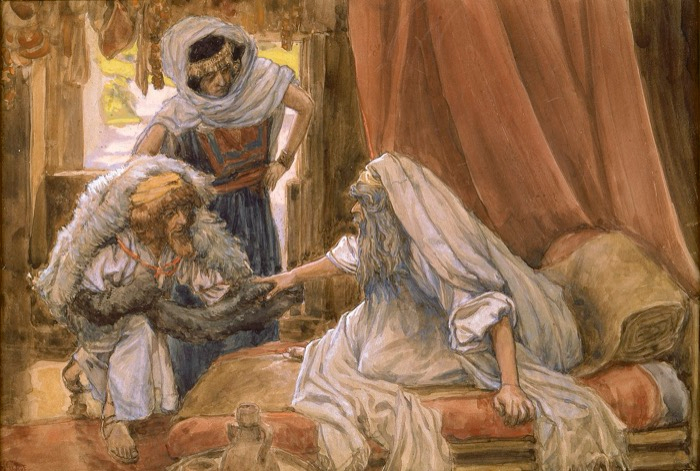
TOP PHOTO: Jacob deceives Isaac before fleeing to Haran where he marries Leah and Rachel. (James Tissot, Public domain, via Wikimedia Commons)


