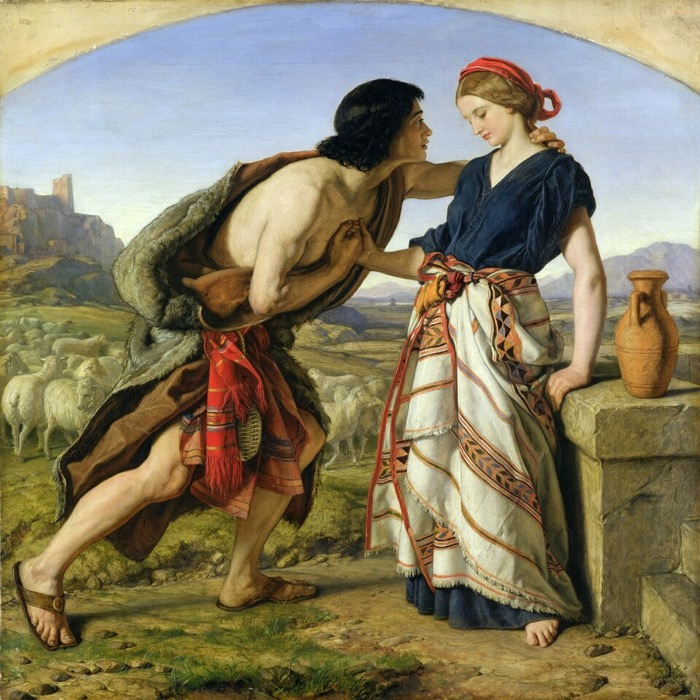
Summary: A close look at the events of Jacob’s life reveals details that may change how we view the account and answer challenges by skeptics. Part 1 of a 3-part series.
Now as soon as Jacob saw Rachel the daughter of Laban his mother’s brother, and the sheep of Laban his mother’s brother, Jacob came near and rolled the stone from the well’s mouth and watered the flock of Laban his mother’s brother. – Genesis 29:10 (ESV)
The Story of Jacob and his Children
Among Bible readers a familiar account in the book of Genesis is that of Jacob. Jacob, the grandson of Abraham, steals his brother Esau’s blessing through trickery, and then flees Esau’s wrath by traveling hundreds of miles to relatives where he marries the sisters Rachel and Leah. In that process he is tricked himself by his uncle Laban and ends up working 14 years to marry Rachel, and eventually runs from Laban back home to Canaan, reconciling with Esau along the way.
It has all the makings of a Hollywood romance drama, but a closer look at the narrative reveals details that would shock many. What is your impression of Jacob’s age when he fled from Esau to meet Rachel? It’s often assumed that Jacob was in his 20s or 30s when he arrived in the settlement of Haran. This makes sense because he would go on to marry the sisters and have 12 sons and a daughter with them and their servants. He also worked long hard days for many years in order to care for Laban’s flocks. Would it surprise you to learn that Jacob was 77 years old when he met Rachel at the well?
In fact there are several details in the account of Jacob in Haran, and later in Canaan, that have troubled some, and even caused doubts about the accuracy of the history presented. A closer look at these issues will highlight the importance of an often underappreciated aspect of the Bible and history – the aspect of “time” or chronology.
The Importance of Chronology
There are many things people believe about Biblical history that upon closer examination of the text turn out to be simply not true. Sometimes the true realities can surprise us greatly, or jar our sensibilities. But readers of the Bible would do well to dig deeply into the narrative accounts to learn what the Bible is actually claiming. Knowing the historical context of the ancient world at the time can also help.
It has been said that chronology is the backbone of history, and knowing the correct sequence of events and the timespans between those events can greatly affect how we read the narrative. The Bible spends a surprising amount of space giving specific times, numbers, and locations. Apparently time and place are very important, which should encourage us to treat them as significant as well. This also lends itself to interpreting the events as more than mere stories. As we will see, timing matters.
However, readers of the Bible can often run into details that don’t seem to add up. When dates or numbers seem odd, it can create confusion or even doubts about the realism of the account. If the specifics don’t seem realistic, it contributes to the sense that the history found in the Bible, especially in its earliest books, may not have been meant as a completely accurate account of events, but more like morality tales meant to teach lessons.
This detachment of the Bible from true history, no matter how subtle, can then erode confidence in the entire message of the Bible. After all, the older books of the Bible present their narratives just as much in a straight-forward manner as the later books do. And if Jesus treated the earliest books as historical, what does it say about his authority if those accounts are shown to be less than accurate?
Of particular interest are several examples of apparent timing discrepancies and oddities that come in the Bible’s account of Jacob and his children. This was during their time in Haran and Canaan, before moving to Egypt where they multiplied into a great nation by the time of the exodus. A cursory reading of these narratives can produce some seemingly far-fetched scenarios, such as very old women being so beautiful that they were brought into the harems of Pharaoh and Abimelech. A bit more scrutiny appears to reveal preteen boys slaughtering an entire village and fathering children. Are there satisfactory answers to these challenges?

Some Chronological Details
Jacob is almost universally depicted as a young man when he puts on Esau’s clothing and the skins of young goats on his arms to trick his father into giving him the elder son’s blessing. The same thing is seen when he meets Rachel after he flees north. The paintings above are two examples. But are these merely images out of our own imagination that don’t actually fit with the facts presented in the text?
To determine Jacob’s age we can do some simple calculations to compare Jacob’s age with that of his son Joseph, and starting with these known time stamps, look backwards to determine the dates of earlier events. There are three general periods that define Jacob’s later life:
A) His time in Haran after fleeing from Esau, where he marries Rachel and Leah and most of his children are born
B) His time in Canaan after returning from Haran and before entering Egypt
C) His time in Egypt after the great famine, where the family moves to reunite with Jacob’s favorite son Joseph who has been made Pharaoh’s 2nd in command
So how do we arrive at 77 for the age of Jacob when he met Rachel? We start with the fact that Jacob was 130 years old when he entered Egypt and met Pharaoh.
And Jacob said to Pharaoh, “The days of the years of my sojourning are 130 years. Few and evil have been the days of the years of my life, and they have not attained to the days of the years of the life of my fathers in the days of their sojourning.” – Gen. 47:9
We can also determine that the age of Joseph at this same point was 39. This is because Joseph is said to be 30 years old when he entered Pharaoh’s service (Gen. 41:46) after he interpreted Pharaoh’s dream. The sequence of plenty and famine started immediately after Joseph’s rise to power at age 30.
There will come seven years of great plenty throughout all the land of Egypt, but after them there will arise seven years of famine, and all the plenty will be forgotten in the land of Egypt… And the doubling of Pharaoh’s dream means that the thing is fixed by God, and God will shortly bring it about. – Genesis 41:29-30, 32
When Joseph brought his father Jacob and his family from Canaan to Egypt, it was after the seven years of plenty, and two years into the great famine.
For the famine has been in the land these two years, and there are yet five years in which there will be neither plowing nor harvest. (Gen. 45:6)
So 7 years of plenty + 2 years of famine after Joseph was age 30 = Joseph’s age of 39 when Jacob came to Egypt at age 130. This means a 91-year difference in their ages. In other words, Jacob was 91 years old when Joseph was born to him in Haran.
The Bible also records Jacob’s following statement to Laban about his 20-year stay in Haran, where he worked 14 years for the privilege of marrying Rachel and Leah, and then six more years for the speckled, spotted, and black sheep and goats of Laban’s flock.
These twenty years I have been in your house. I served you fourteen years for your two daughters, and six years for your flock, and you have changed my wages ten times. (Gen. 31:41)

Twelve children (11 sons and a daughter, Dinah) were born to Jacob during the first 14 years of service in Haran, with Joseph being the final son born. At that point Jacob negotiated for the speckled and spotted of Laban’s flock (which led to his final 6-year period of working for Laban). From the calculations above, this 14-year mark in Haran is when Jacob was 91 years old.
As soon as Rachel had borne Joseph, Jacob said to Laban, “Send me away, that I may go to my own home and country. Give me my wives and my children for whom I have served you, that I may go, for you know the service that I have given you.” But Laban said to him, “If I have found favor in your sight, I have learned by divination that the LORD has blessed me because of you. Name your wages, and I will give it.” (Gen. 30:25-28)
All of this leads to the fact that 14 years before Joseph was born – when Jacob arrived in Haran, met Rachel, and began working for Laban – he must have been 77 years old (91 – 14 = 77). This mandates that the 20 years in Haran were from Jacob’s age of 77 to 97, and therefore his time in Canaan afterward, before going to Egypt, was from age 97 to 130 (Gen. 47:9), or about 33 years.
Old Ages in Genesis
In ancient times, a preponderance of evidence shows that it was normal for men and women to marry in their teens, for women often in their early teens. The idea of a 77-year-old Jacob marrying Rachel who was almost certainly in her teens or twenties seems disturbing to our modern sensibilities. However, our thinking is often biased by what is considered to be “normal” in our own time, but was not necessarily typical in the past. We should be careful about jumping to conclusions without carefully thinking through all the factors involved.
For instance, there were very different views about certain aspects of marriage and other social customs in ancient times; some of those ideas may have been immoral and others not necessarily so, just as modern thinking may contain a mixture. Producing the next generation to perpetuate the family line and its inheritance was a central aspect of marriage that received much more emphasis than today. The age of a spouse was apparently not a primary consideration.
It should be noted that a much older Boaz commended Ruth because she had “not gone after young men, whether poor or rich” (Ruth 3:10), and she married him as a kinsman redeemer.
Also, Abraham married Ketura who bore him six sons (Gen. 23:1-2, 25:1-7). This was apparently after Sarah died (accounts in the Bible don’t always follow each other in chronological order) and certainly after Isaac was born. This would mean Abraham was more than 100, and perhaps more than 137 when he married the young Ketura.
To judge by today’s norms, the events recorded for these old ages seem unrealistic. Afterall, when Abram (Abraham) and Sarai (Sarah) lived at Shechem, then Bethel, and then in southern Canaan, a famine forced them to go down to Egypt to find food. Abram was concerned for his own safety because of Sarai’s great beauty. At that point we read this:
When Abram entered Egypt, the Egyptians saw that the woman was very beautiful. And when the princes of Pharaoh saw her, they praised her to Pharaoh. And the woman was taken into Pharaoh’s house. – Genesis 12:14-15
Sarai was 10 years younger than Abram, who was 75 when he entered Canaan (Gen. 12:4, 10-20), so she was about between 65 and 70 years old at this point. The situation becomes more difficult when a similar scenario plays out with the king of Gerar in chapter 20, when Sarah is apparently 89 years old (Gen. 18:10, 20:1). While beauty can be retained into later life to some degree, it might seem strange that Sarai could be so stunningly beautiful in her late 60s and even her late 80s.
Others were also vigorous in old age. Abraham was well over 100 when he married Ketura, Jacob was in his 80s and 90s when he was shepherding Laban’s flock, and 97 when he wrestled with God until dawn and received the name “Israel” (Gen. 32:22-32).
However these problems fade when considering that, according to the narrative, the members of this family at the time were living about twice as long as life expectancy is today. If this was the case, Sarah in her late 80s may have had the appearance of a woman in her mid 40s today. She only gave up hope of conceiving a child with Abraham (giving him her maid Hagar in her place) when she was about 75 (Gen. 16:16). Abraham at 100 might have had the vigor of a typical man in his late 40s today (since he lived to age 175), the same with Jacob in his 90s. In fact several generations later, when Moses died at age 120, the account says, “His eye was undimmed, and his vigor unabated” (Deut. 34:7).
What about Abraham at 100 being said to be “as good as dead” in the New Testament (Rom. 4:19, Heb. 11:12) and Abraham himself questioning whether he would have a son at age 100 (Gen. 17:17)? There is no warrant to conclude that this means he was unable to father children (since we know he lived another 75 years after this point and married Keturah during that time). Perhaps the phrase “as good as dead” was just a figure of speech meaning “really old,” especially for someone who was fathering their first son in the line of promise – and had been waiting most of his life for that to happen.
Perhaps lifespans in the line of Abraham were unusual and unexpected compared to the surrounding people, to show that God’s hand was on them in a special way. We just don’t know the answers to all the possible questions pertaining to the great ages recorded in the early history of Israel, but the numbers in all these accounts fit together in a smooth and coherent way.
But skepticism and scoffing about excessive lifespans goes back earlier, because the old ages in Jacob’s era were just a continuation of a process that had been going on since the flood of Noah. Before the flood the lifespans recorded in the Bible were around 900 years or more. This has led some to propose that each of these names might represent a whole family line of descent, with many missing generations, and only listing the firstborn patriarch of the line as a figurehead.

However, when plotting out the ages, it can be seen that after the flood they declined rapidly in a most peculiar way. According to geneticists such as Dr. Robert Carter, the descending ages match biological decay curves known from the science of mutation accumulation. We have interviewed Dr. Carter for past Thinkers Updates and podcasts and our Red Sea Miracle films.
Damaging mutations add up with each new generation, eroding genetic information in a consistent way that has been observed in many examples. In an article on the topic Dr. Carter writes, “In the end, the Bible provides a beautiful decay curve. This would be completely unexpected if the data are not real.”
Carter continues,”Appeals to a misreading of biblical numbering schemes or to faulty translation from a sexagesimal counting system (i.e., base-60, like that found in multiple cuneiform writing systems) to a decimal system (base-10, like the system we use today) do not work. First, the opposite is more likely. Second, the rest of the biblical data fit too perfectly with the lifespans given to us in Genesis 5 and 11.
“Are the ages of the biblical patriarchs outside the modern experience? Yes, they are. Should we doubt that the numbers are real? No, we should not. At least, biology does not preclude people living for centuries (see Living for 900 years), math tells us there is a real trend in the data, and logic tells us that nobody made up those numbers out of whole cloth.”
The Bible is not the only source that points to great ages for earlier generations of mankind. For instance, the Babylonian Chronicles have extremely long lifespans for the earliest generations. Although their history may have become corrupted, they seem to have had some distant memory of this reality.
Conclusion
We can see that examining the chronology of the life of Jacob has brought us into contact with issues that require thinking and ultimately help to understand the accounts more fully. Along the way we have addressed topics that may have troubled readers, but for which there are some answers. But this isn’t the end of questions related to Jacob’s life. Next time, we will continue this exploration with some particularly thorny problems that have equally enlightening solutions. Until then, keep thinking!
TOP PHOTO: The meeting of Jacob and Rachel. (William Dyce, Public domain, via Wikimedia Commons)


