Summary: If the evidence against the documentary hypothesis is so strong, why is it still taught as the standard Bible-origins theory? The final part of a 3-part series.
For if you believed Moses, you would believe me; for he wrote of me. – John 5:46 (ESV)
High Stakes for the Documentary Hypothesis
This is the final part of a 3-part series investigating the theory, known as the documentary hypothesis, that challenges the Bible’s claim that Moses wrote its first books. Will some of the remaining claims of the theory hold up to closer scrutiny? A big question that remains is, ‘if this theory is so flimsy, why is it still being taught as the standard paradigm in Biblical studies?’
The stakes involved with this theory are very high. Timothy Mahoney has interviewed many scholars who have commented on the documentary hypothesis. One of them is Dr. Randall Price, an author, archaeologist, and Co-Director of the Qumran Cave Excavation Project.
TIM MAHONEY: What I’m learning by talking to scholars like yourself is that when Moses was inspired to write, he informs us about the origin of the world and the universe, he tells us why there’s evil in the world. He builds a case that man has fallen and needs redemption, and that there is a God who’s willing to redeem people, and that there’s a plan, that there was a Messiah that would come.
RANDALL PRICE: All this goes back to the first five books. If you undermine those, the substructure, the foundation of all the rest of the Bible is gone. Morally, theologically, historically, everything.
TIM MAHONEY: But if it’s true, then it tells people they’d better pay attention.
RANDALL PRICE: Yeah. And of course everybody else who wrote the Bible, or whom the Bible was written about, believed this. There was no doubt there was a Moses. There was no doubt that there were these promises that he wrote.
Different Names for God
The documentary hypothesis matured in the late 1800s, largely with a group of German critical scholars led by Julius Wellhausen. It explained the origins of the Torah (the Bible’s first five books) not as the writing of Moses, as the Bible indicates, but as the product of several different sources many centuries after the time of Moses. These sources supposedly had contradictory views on many things, and they were stitched together by one or more editors or redactors, after the Babylonian captivity (perhaps in the 400s BC). Because the classic version of the theory proposed four sources, it is also known as the “JEDP theory,” after the first letter of the sources: the Yahwist (J), Elohist (E), Priestly source (P), and Deuteronomist (D).

In Part 2 of this series, we looked at repetitions and parallel accounts in the Torah. These were claimed as evidence for different sources by critics, but finds of ancient archives, such as the Ugaritic tablets, from this period show that repetitions were very typical for Semitic writing at the time.
In Part 1 of this series we showed that the name “YHWH” was likely known from ancient times, long before Moses, dispelling the claim that the Bible sources were contradicting one another, with one saying YHWH was unknown before the exodus and another saying this name was known from ancient times. However, another pillar of the documentary hypothesis is that the use of different names of God is a key to splitting up the material into distinct sources. The supposed Yahwist Source used the name “YHWH” for God, while the Elohist Source used the name “Elohim” for God. But is that really a strong argument?
Mahoney also interviewed Brian Rickett, Professor of Bible and Apologetics at Brookes Bible College, and Principal Researcher at MIKRA Research Laboratory. Some of this material (and what comes below) ended up in a bonus feature on the documentary hypothesis found in the Collector’s Edition box set for The Moses Controversy film.
BRIAN RICKETT: The documentary hypothesis theory was developed in the 1800s. It really hasn’t changed a whole lot, but it was based upon a naïve understanding of the way that the names for God were used. For example, Genesis chapter one uses the name for God, “Elohim.” And then Genesis 2 uses the divine personal name of God, “Yahweh.”
TIM MAHONEY: Did they have a problem with two different names being used?
BRIAN RICKETT: Well, Yahweh (Hashem) is connected to the law. And so it was thought that over the evolutionary development of an Israel-like religion that a redactor went back in and added that and modified it.
TIM MAHONEY: Okay, so basically these editors, or they’re called redactors, changed things.
BRIAN RICKETT: Right.
RANDALL PRICE: Based originally on the idea that the name of God early on took one form and then evolved over time to another. So they go from early to late. On that basis as they dissect these portions of the text, they assign them to different time periods and to different sources.

TIM MAHONEY: Are you saying that God has more than one name?
BRIAN RICKETT: God has more than one name, more than one title. Just like I have more than one name, more than one title. For example if I email you it’s got my name, my degrees, it says that I’m a director of something. It says that I’m a professor of something. It says I’m an administrator of something, and it has some other titles there for me too.
TIM MAHONEY: It’s simple when you think about how you clarified that I’m a father, I’m a husband, I’m a grandfather, I’m a filmmaker, I’m a business owner, I’m an entrepreneur. Could you say that God was revealing himself or his character to people?
BRIAN RICKETT: Absolutely you could say that. Then there are the discoveries since the JEDP theory was first posited that relate to documents with the names of other ancient Near Eastern gods. You can find a document with the name “Horus” referencing him in more than one way, more than one name. The same thing is true with Zeus. The same thing is true with Ra. In the ancient Near East you had many particular gods referred to by more than one name in particular documents.
It could be said that the more important a person is, the more names and titles they are apt to have. So it would be very appropriate for God, as the most important being in existence, to have many names and titles. The Torah also has places that use both Elohim and YHWH name forms together in the same passage. Instead of seeing this as evidence undermining their theory, critical scholars claim these places have been updated later by an editor to add these names, which seems like special pleading.
Proposed Contradictions in the Bible
While repetitions have been shown to be typical of ancient Semitic literature (and not evidence for multiple sources), contradictions and inconsistencies between repeated accounts in the Bible have been claimed as a main evidence for the idea of separate sources. However, how valid is this claim?
One example often given is the creation account. The order of events in Genesis chapter 1 are said to contradict the events of chapter 2, so that it is impossible to reconcile the accounts. The order in Chapter 1 is given as 1) Plants (Day 3), 2) Animals (Days 5 and 6), 3) Man and Woman (Day 6). However, critical scholars claim the order is different in Chapter 2: 1) Man, 2) Plants, 3) Animals, 4) Woman.
A closer look at the details, however, dissolves this apparent contradiction. The words for vegetation and animals in chapter 1 are different from the words used in chapter 2. This is why most versions say “bush of the field” and “beast of the field” or similar wordings in chapter 2. These were domesticated varieties put into the garden for the man to till and keep, not the wild plant and animal kingdoms of chapter 1. Chapter 1 would then be a panorama of the creation week, while chapter 2 zooms in for a more detailed account of events on Day 6 of creation week.
Duane A. Garrett is the Chair of the Department of Old Testament at Southern Baptist Theological Seminary.
DUANE GARRETT: You can find alleged contradictions and you can say these contradictions are evidence of multiple authorship. But I think in most cases, the alleged contradictions are not only pretty easily resolved, but often they are keys to more fully understanding the text.
Another scholar interviewed by Mahoney was Peter Gentry, Professor of Old Testament Interpretation at Southern Baptist Theological Seminary.
PETER GENTRY: So our society, in the Western world, is based on Greece and Rome. And Aristotle taught us to think in a straight line. So you start at A, and you go to B. And you move in a straight line by means of logical syllogism. So every scientist in the Western world writes like that. And Hebrew literature is totally different. It’s based on repetition. So I start up a conversation, and I go around the topic. And then I shut that conversation down and I start another conversation over here, and at first it looks like I’m on a different path altogether.
PETER GENTRY: But then you realize, he’s talking about the same thing from a different angle, a different perspective, a different point of view. When I have those two conversations out on the table, they’re like the left and right speakers of a stereo system. So when you’re listening to the left and right speakers. Is it the same music, or is it different?
TIM MAHONEY: Yeah. I get it.
PETER GENTRY: Yeah, so it’s actually both the same and different. They’re not interested in moving in a straight line. They’re gonna give you a three dimensional idea, and you can look at that idea from all different angles. That’s why there’s Genesis chapter one and Genesis 2. It’s not because there’s different sources. This is totally the way Hebrew literature works, and the Germans just didn’t get it.
The Unity of the Text
TIM MAHONEY: Can you see a single mind working in the Pentateuch or the Torah? Is there a continuation of thought?
DUANE GARRETT: Well, the Pentateuch as such is a coherent text from beginning to end, beginning with creating and going through sin and the call of Abraham and the struggles he faced, the patriarchs, the descent into Egypt, the exodus. It is a thoroughly coherent document that tells the story of the election of Israel as God’s agent for salvation. And so the Pentateuch as a whole makes sense. It’s not a problematic text in that regard. It’s not as though there were parts of the Pentateuch that just didn’t fit. The whole thing in my view fits together very well. It’s a very coherent narrative.
TIM MAHONEY: So do you think there is any evidence that there were multiple authors? Or has anyone ever found a manuscript of J, E, D, or P?
RANDALL PRICE: There’s absolutely no evidence of that whatsoever.

RANDALL PRICE: If you go to the Dead Sea Scrolls, the Dead Sea Scrolls don’t have any documents like this. These ideas don’t exist. They don’t show up. The Dead Sea Scrolls see it as a unified book. These are the oldest copies of the Bible we have.
DUANE GARRETT: You can always postulate multiple authors. But in terms of actually seeing it in the text, no, I don’t see it. It is entirely inferential. There’s nothing in Jewish tradition, no explicit evidence in the text.
TIM MAHONEY: And why didn’t one source just erase all the other names for God?
DUANE GARRETT: Well, that’s a reasonable surmise. If you think the other source is wrong, why didn’t the person who stitched them together assuming he had some opinion one way or the other, why didn’t he delete the matter that he thought was wrong? It’s problematic.
TIM MAHONEY: Have there been any other documents in the history of the world that were put together like that?
DUANE GARRETT: No, to my knowledge there is no historical analogy for the documentary hypothesis. It’s a very outlandish kind of theory in that respect. It’s pretty much only in Old Testament studies that you have this really peculiar theory for the origin of a text.

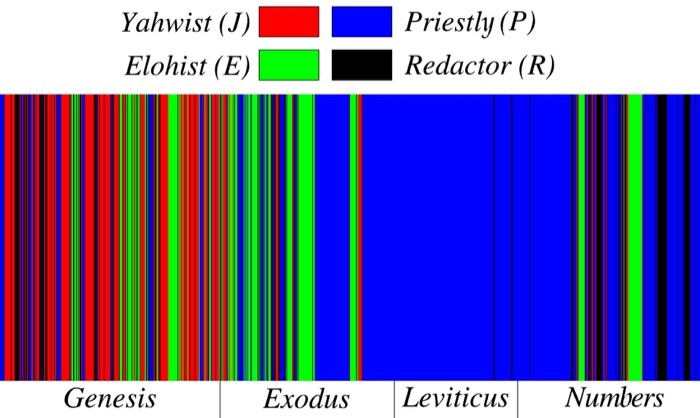
While the chart at the top of the article is a more typical depiction of the classic documentary hypothesis, other scholars have taken things much farther and created many more divisions.
PETER GENTRY: There was a man by the name of Paul Haupt, and he created what he called the Polychrome Bible. Because he wanted the average person on the street to be able to understand the documentary hypothesis. So he made an edition of the Torah that was color-coded. He used green for one source, yellow, pink, and blue. And it really shows how ridiculous the theory is because he has like half a verse in blue and half a verse in pink, and the “and” that joins them is in yellow.
PETER GENTRY: So I think he succeeded in showing how questionable this hypothesis is. And no two scholars in the last 250 years identify the J source or the E source or the D source or the P source in the same way. This theory should’ve become passé many years ago.
Why Has the Documentary Hypothesis Remained So Dominant?
DUANE GARRETT: The documentary hypothesis – in its classic form – is pretty much dead among many, many Old Testament scholars. Many critical scholars today, again, people who have absolutely no faith in Mosaic authorship, will look at the arguments for the document hypothesis and say it’s a farce. It looked really good when it came out if you were a scholar in 1910 looking at all this stuff. But when you go back and more carefully analyze it, it’s a house of cards.
DUANE GARRETT: Now, that doesn’t mean that they’ve embraced a conservative view of the Old Testament, and have gone back to Moses or something like that. But especially in Europe, it would be hard to find any Old Testament scholar who holds to the classic documentary hypothesis. Again, this is not to say they’re going in a conservative direction, but they’re going in every direction. You can read 10 different scholars and get 10 different opinions about the origin of the Pentateuch.
DUANE GARRETT: But, in fact, today although it is still taught as the Orthodox critical dogma like in a freshman Old Testament class in university, among working scholars there are not many who really hold to it anymore. So it’s kind of peculiar in that sense.

PETER GENTRY: When I went to a school they taught the documentary hypothesis every day for 17 years. I read a book by an Italian Jew called Umberto Cassuto. He lived in the 1920s and 30s and 40s, and he was a very interesting man because instead of accepting all the Jewish traditional ideas, he tried to use the archeology, the history, and the languages to explain the text of The Bible. And he wrote a very good book criticizing the documentary hypothesis.
PETER GENTRY: So one day I was at the University of Toronto and my professor was teaching the documentary hypothesis and all I did was very politely say, “Well have you ever looked at the book by Umberto Cassuto?” And the answer I was given was, “Well, you know we don’t read books like that around here.” So that was when I clued in and realized that for them it’s a face stance. It’s not as if this is perfect science.
TIM MAHONEY: Right, in other words there’s a sense that they didn’t want to hear other information.
PETER GENTRY: That’s right.
TIM MAHONEY: Why is it still being taught?
DUANE GARRETT: Because you’ve got to have something to put in a freshman textbook to tell students, “Okay, this is what scholars think about the origin of the Old Testament.” And so, frequently, those books will just go with the traditional documentary hypothesis because it’s been the, to use this word, “critical orthodoxy” for over 100 years now.
TIM MAHONEY: So basically freshmen students that are going to study the Bible at a university are going to get information that’s really out of date.
DUANE GARRETT: They are getting obsolete information, that is correct.
Conclusion
PETER GENTRY: I’m not saying I have all the answers, I have a lot of questions. But, what I’ve tried to show is if you look at the Book of Deuteronomy in terms of the kinds of things it talks about, they fit the culture of the 14th Century BC. The literary structure fits that time. The language is not from the fifth century or fourth century. It’s from a much earlier period of time. Therefore, what the text is claiming is supported by this archeology, history, linguistics, literary structures; all of these things are actually dovetailing with the claims of the text.
TIM MAHONEY: It fits the fact that Moses could’ve been the author.
PETER GENTRY: That’s right.
Keep thinking!
TOP PHOTO: The distribution of the sources of the first four books of the Bible, according to the documentary hypothesis of R. E. Friedman 1997. (Vadym Zhuravlovderivative work: Newman Luke, Public domain, via Wikimedia Commons)


