Summary: More legends from around the world that testify to the reality of a great flood, as well as other accounts in the early chapters of Genesis.
And the ark rested in the seventh month, on the seventeenth day of the month, upon the mountains of Ararat. – Genesis 8:4 (KJV)
A Common Memory of Early Genesis
This week we conclude our 2-part series on flood legends from around the world with Nick Liguori, author of the Echoes of Ararat. Part 1 featured evidence of the surprisingly widespread and large number of flood legends from around the world – and the fact that they contain elements that align, not with flood legends from Mesopotamia, but rather with the account of Noah’s flood recorded in the Bible. In part 2, Nick continues to lay out evidence that the Biblical flood and other foundational accounts in the early chapters of Genesis find echoes of remembrance around the world.
This article features excerpts from our podcast series with Nick Liguori. If you’re interested in getting a copy of Nick’s book, please see the link at the bottom (and stay tuned for news on the release of his second book, Echoes of Ararat: Volume Two). We hope you enjoy this important discussion.
TIM MAHONEY (T.M.): There’s this Black Sea flood, which a lot of people have said is the inspiration for the flood story that’s found in the Bible.
NICK LIGUORI (N.L.): My question is, “Is a local flood sufficient to account for global flood stories all over the world?” Suppose that the Black Sea flood had left a strong impression on some people living in Turkey, right? Would they then develop this flood story in global terms about the preparation of an ark, the taking aboard of pairs of animals, even birds, the lifting of this ark by the waters and landing on a high mountain? None of that happened in the Black Sea flood.
But let’s say they invented that. Would they then successfully take that to the rest of the world and convince tribes and nations, overcome language barriers and convince tribes from Siberia to Canada to South America to abandon their traditions and adopt a new tradition about this flood and to have a deep conviction that this flood took place? I don’t think that’s going to work. That explanation seems plausible, but it cannot account for the data.
T.M.: Because what separates all these tribes is language. If you look at the fact that they all spoke different languages and that speaking of different languages happened shortly after the flood, at the Tower of Babel. If we look at the Bible, this flood narrative had to be impressed upon them before their languages changed because otherwise you’re going to have to find a way to take a story and make it their own story with hundreds and hundreds, over 600 so far, different languages. There’s no way you’re going to get an origin story with that kind of consistency, right?
N.L.: That’s right. What’s interesting is the last thing that these different tribes have in common with Scripture in their oral traditions, is the Tower of Babel. So we’re talking about the creation, the Garden of Eden, the flood, and the Tower of Babel. That’s Genesis one through 11. The Tower of Babel is the last thing that they remember.
So we find a whole lot of Tower of Babel traditions, a whole lot of Garden Eden traditions, even mixed accounts. And again, that’s to be expected if Biblical history is true. But notice we don’t find traditions from these tribes of the chapters after Genesis 11, because that’s when humanity spread out from Babel, the different people groups around the world we find listed in Genesis 10, the table of nations, they spread out. And that’s exactly what we’d expect to find if the Tower of Babel and Genesis is true. So we don’t find traditions of Abraham, Isaac, traditions of the Exodus. The last thing that we all have in common in this shared history of humanity is the Tower of Babel.
Not Missionary Influence, but Ancient Tradition
T.M.: Where have you found references to the Tower of Babel and the dividing of language in these origin stories?
N.L.: I’ve been amazed, particularly in Volume 2 [of the book], with the number of Tower of Babel traditions that we find in Southeast Asia. We find them even near India, Myanmar, Vietnam. For example, the island of Borneo, it’s one of the largest islands in the world. They have this tribe called the OW-HANG. They have a mixed account of the flood and the Tower of Babel. And if you took those two events in Scripture and kind of mixed them together, that’s what it sounds like. And the anthropologist who recorded this, Bernard Sellato, this is very well said; he says, “Some might think that this story with its local version of the Deluge and the Tower of Babel reflects the influence of missionaries. They would be wrong. This same story has been collected independently in various regions of Borneo with the same original details.”
So that’s amazing. He’s saying, “You’re going to hear this story that sounds like the Tower of Babel and the flood, and you’re going to be tempted to say that’s missionary influence, but you would be wrong because we find it over and over again among different people groups.” And I hope that this book is going to shift the Overton window, not only in the flood, that we can no longer deny that these are ancient, authentic traditions that tribes and nations all over the world know about.

If I could give you one example of the Garden of Eden. Easter Island is the most remote, anciently inhabited island in the world. Around the year 1910, a young man sits down and interviews this old man, a native of the island who had been born before the arrival of Europeans, missionaries, and so forth. He had been born around 1840 and he recorded the traditions from this old man. And he went on to narrate a creation story in which he says “Make Make,” they call the creator “Make Make,” he said, “Make Make impregnated some clay and from it, man was born. Make Make saw his creation and was pleased. Later, Make Make saw that things were not quite right. The man was alone. Make Make made the man sleep in his own house. And when he’d fallen asleep, Make Make impregnated the ribs on his left side, and woman was born.”
Now again, you might think that that’s got to be from influence, but guess what? We find these rib stories of Eve’s creation, and Garden of Eden stories, all over. I’ve found nine separate ones spread across thousands of miles in the Pacific, rib stories of the creation of women from the Polynesians. And we find these all over the world. Again, if the flood is true history and they know about it, then what’s to prevent them from also knowing about the Garden of Eden?
T.M.: Captain Cook went exploring and was mapping out areas. I just read a biography of his. And people had never come to those islands before. This is like the first time two civilizations were meeting each other. I think that there is this dismissal that these traditions came from missionaries, right? And these cultures had an oral culture that went from generation to generation. So the children would be told by the parents and the grandparents where they came from. Let’s just once again talk about the fact that these stories were coming from an original earlier source from that tribe, not from the missionaries, right?
N.L.: That’s right. And that’s one of the most common arguments is missionary influence upon these tribes. But that argument is not based on the data. That argument is a desire for these things not to exist, not to be authentic. And this book is going to bear that out and refute that argument once and for all. How can it be missionary influence if the traditions and the flooded histories and artifacts predate missionaries? They go back, I quoted Josephus earlier, they go back to the BC era. We have ancient texts from China, from India, from Mexico. We have ancient rock carvings and paintings. We have about six or so people groups in Mexico that have these ancient paintings depicting the flood and a bird returning to this floating log.
Number one, the information that the data is too early. The argument of missionary influence implies that there’s some period of time between when the missionaries got there and when tradition was recorded. And so in that period, there was influence. That’s simply not the case. Many of these traditions were recorded immediately upon contact. Columbus sailed the ocean blue in 1492. Well, we have a source from 1493 with a flood account from them. They’re recorded very early. There’s not enough time for influence to have occurred.

Now, sometimes there’s more time before it was recorded, but that is also to assume that these tribes were easily influenced to abandon their tradition. I find it insulting toward these tribes, but also let’s remember these were sacred traditions to them. We find, for example, the Mandan tribe in North Dakota, an annual ceremony commemorating the flood in New York, the Iroquois and other tribes from a large region would gather on Mount Marcy once a year, this holiday, to commemorate the flood and offer sacrifices to the great spirit in thanksgiving for allowing their ancestors to survive.
The Native Americans had holidays to remember the flood. I wish we had a flood holiday. So how do you influence something that’s so deeply ingrained? This was not some shallow belief that could be influenced. The roots of this flood knowledge are deep. They had ancient chants. The Miao people of China had songs commemorating the flood that they would sing at marriages.
The Mandan tribe, for example, they held the dove in highest esteem. They said, “You cannot harm this bird.” They even trained their dogs never to harm a dove. Why? Because they believe the dove was what returned to their ancestor NUMUK MUNKENA with a willow leaf and a willow branch in its beak. They had taboos reflecting a memory of the flood.
Again, rock carvings in Venezuela. The Haulapai tribe, Spirit Mountain, a place with rock carvings. One depicts the mountain, an old man and a bird returning to the man with something in its beak. Another rock carving depicts a boat actually leaving the mountain with eight survivors in it.
I believe you’re in Minnesota. In Minnesota, there’s this site called Pipestone Quarry, which was holy to the Native Americans. They believe that that site, I think in the southwestern part of the state, was where their ancestors, the Native Americans, made their final stand against the flood and then were buried.

And they say that this beautiful red stone that’s found there is the remains of their bodies. They would excavate it and use that to make their sacred pipes. This was a holy site. And again, a memory of the flood associated with this site, and it was a holy site. It was neutral ground. Natives from thousands of miles away would travel here. They would say they believe that this is where the flood ended.
Again, we’ll find native beliefs in it that don’t match Genesis, which is a good sign, by the way, of authentic material. They’ll still say that the flood was because something was blocking the drain and they had to use a Ram’s horn to clear the drain. And that’s good native material. But example after example, this is deep rooted stuff that cannot be accounted for by missionary influence.
If it’s missionary influence, where are the traditions of other famous events of the Bible like the Virgin Birth, the resurrection of Jesus, David and Goliath stories, the Exodus stories? Why is it only the flood and early Genesis stories? So it’s an ad hoc argument and it’s just not going to withstand the force of the data.
Passing Down Echoes of the Story
T.M.: How do you think the tribes preserved the traditions so well orally for thousands of years?
N.L.: This was sacred to them. In many cases, you had a priestly family or you had tribal elders in their family. They would be in charge of passing this down faithfully from generation to generation. My memory’s not so good, but the human memory, it’s an amazing power if we cultivate it. I’m really amazed how well they’ve passed it down over thousands of years. Not perfectly, but pretty well.
In many cases, they had devices designed to help them remember. They had special chants. They had things that were set to rhyme to help them remember it, and they would recite these at annual festivals. A whole family would together narrate the event. So this was something that was deeply important to them. I also think that God was at work in this, that it says in Acts 14, that God has not left himself without witness in any nation on earth. So maybe God was helping them preserve this as a witness to himself.
T.M.: I think it’s possible that there’s some sort of miraculous preservation even for this time so that other people who have become secularized would go, “Wait a minute, what’s going on here? Why are we here?” This question of our existence, we’re on this planet and things are going on to show us not forget who God is and to not forget where we came from.
T.M.: I mean, after working in all the patterns that I’ve seen, and once again, Nick, this is a fantastic pattern of evidence. First of all, there’s the creation story, the fall of man, and judgment of the flood, then you’re seeing these symbols that you could go, “wait a minute, these are echoes.” I think the echo is fantastic. It’s an echo of what had happened earlier that’s being memorialized in their origin story. I mean, this should be for everybody who believes and has looked at this.
And if you’ve heard all this growing up in Sunday school or whatever, and you decided that there’s no evidence for God or who knows, we evolved or whatever. I’m telling you, you have to be careful because there’s a testimony that’s coming right now. It’s coming from around the world. And Nick, I think you’ve done just a fantastic service. And once again, the same thing happened to me. I wasn’t planning on making these films about the Bible, but it became important because I had to make a decision by God’s grace. But the evidence was there. The thing that’s astounding, when you look at this book, Nick, you did a fantastic job of pulling out all this information.
The Message of the Flood
T.M.: God says, “Now the earth was corrupt in God’s sight and was full of violence. God saw how corrupt the earth had become for all the people on your earth had corrupted their ways. So God said to Noah, ‘I’m going to put an end to all people, for the earth is filled with violence because of them.’” Do those narratives talk at all about that in some cases?
N.L.: They do. They mention violence. They mention mankind’s evil ways of particular sin. The flood was sent in judgment. Generally the reason for the flood is divine judgment.
And I think this is so impactful to realize if you’re someone who doesn’t believe in a God that judges, well, what if you could be shown that the flood is true? If you become convinced that the flood happened, that’s going to totally transform your perspective on the fact that we have a personal God that expects things of us. And actually, the ark was a form of God’s mercy and Noah wasn’t a sinless man and the ark was a foreshadow of Christ.
T.M.: I think that your work is really important because it could be a very good message for these cultures that have never really understood who God is. Our faith is not a white man’s faith or red men’s faith or a Chinese faith. It’s universal, it’s a humankind faith, the story of God in the Bible, all cultures, all people. And the thing that you’re showing us with this investigation is that it goes all the way back to the beginning.

N.L.: It does. And if this book can serve as a bridge to the gospel to a tribe, to a person in China, in another country, in Laos, Thailand, wherever, that wow, I have a history. Before my people embraced Buddhism, they believed in this Supreme God and my ancestors believed that there was a flood, and that matches Genesis. And if that can open someone’s ears to the gospel, and you mentioned creation and how we’ve been corrupted. And then someone asked me, “Why are you writing a book about the flood? What’s so important about it? Why is it a big deal?” And I like to say, as much as all this time I’ve spent years and years researching the flood, what I’m really even more contending for is Adam. And I’m contending for the Garden of Eden, and I’m contending for Romans five and six about the law of sin and death at the foundation of the gospel.
If we’re just going to say the flood doesn’t matter or it was a local flood, then we don’t have a way to defend the biblical truth of the law of sin and death. The Bible says that sin happened and then death, but the secular world says death happened and then sin. The secular narrative contradicts the Bible at the heart of this law of sin and death. I’m contending for the law of sin and death. Paul, when he’s making the case that Jesus is the savior of the world in Romans five, he predicates his argument on Adam.
T.M.: I couldn’t be more excited about this book. When I first got it, the first volume, I was amazed. I actually think parents could sit down and read the stories of this to their children, whatever age, just sit down and show them and read this because it’s important for our children and our grandchildren. I’ve got eight grandchildren now, just to basically tell them about our faith and why our faith is historical.
N.L.: If I can encourage someone in this book, that this is true history and the character of God too. We have a God who acts. We have a God who does big things. We have a God who’s personal and he’s direct and he acts in space and time. We can trust God’s word from the very first page. People will deny it, but the evidence is coming in and confirming. And Paul says in Romans, “Let God be true though every man be a liar.”
Conclusion
Flood legends from around the world strongly support the Bible’s account of the deluge in Noah’s time. This is one more powerful pattern of evidence in history, archeology, and science that affirms the historical credibility of the Bible and shows that God acts in history.
We hope you have enjoyed this important episode. Our goal is to help you think critically about matters pertaining to Biblical faith and the challenges against it. If our films or other forms of media have had a positive impact on you or your family, please consider donating by going to patternsofevidencefoundation.org. Your donations are what keep our ministry running and help us continue to produce God-affirming media for a world seeking a firm foundation. Thank you. And as always, keep thinking.
CLICK HERE to purchase the book Echoes of Ararat (Vol.1)
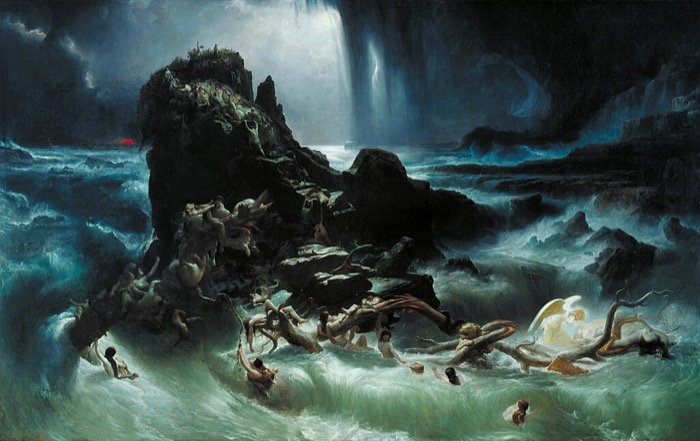
TOP PHOTO: The Deluge. (Francis Danby, 1793-1861, Public domain, via Wikimedia Commons)


