Summary: An ancient Egyptian’s DNA shows a mix of African and Mesopotamian heritage, hinting at a fantastic story about the origin of Egypt’s pharaohs.
These are the clans of the sons of Noah, according to their genealogies, in their nations, and from these the nations spread abroad on the earth after the flood. – Genesis 10:32
The Mesopotamian DNA of an Egyptian Man
Recent DNA analysis from the remains of a man who lived in ancient Egypt has provided new insights into the rise of Egyptian civilization in the pre-Dynastic period. It also connects to the Biblical account of the spread of nations after the tower of Babel and an under-reported proposal regarding the rise of Egypt. This remarkable proposal has been downplayed by most academics today, but was widely accepted by ancient historians and early Egyptologists of the modern era.
The remains came from a man buried in a sealed clay pot found in a hillside at the village Nuwayrat located near Beni Hasan and about 165 miles south of Cairo. The study was conducted by a team led by Dr. Adeline Morez Jacobs, visiting research fellow at England’s Liverpool John Moores University, and published in the journal Nature.
“The body was interred in a ceramic pot within a rock-cut tomb, potentially contributing to the DNA preservation,” wrote the authors of the article. The pot was excavated early in the 20th century and donated to World Museum Liverpool, where it has been stored ever since.
Pot burial is associated with higher classes during this period. It was fortunate that the burial took place before mummification was common, because the chemicals used in that process makes it more likely that the DNA is degraded (although advanced techniques have now successfully extracted DNA from some mummies).
DNA samples were from one of his teeth. Carbon 14 tests of the bone material gave results of between 2855–2570 BC, making it the oldest Egyptian DNA sample ever extracted. This would have been about a couple centuries after Egyptian unification, and just before the beginning of the Old Kingdom period, which began with Egypt’s 3rd Dynasty.

b, Pottery vessel in which the Nuwayrat individual was discovered.
c, Cervical vertebrae belonging to the Nuwayrat individual with evidence of extreme osteoarthritis (arrows).
d, Summary of genomic and radiocarbon data.
e, Egyptian civilization timeline and radiocarbon date of the Nuwayrat and Third Intermediate Period individuals. Photo in b reproduced courtesy of the Garstang Museum of Archaeology, University of Liverpool.
(open access – CC 4.0)
Researchers sequenced the entire genome of the Nuwayrat individual. The DNA results showed that while 80% of his DNA was consistent with North African groups, 20% traced to the Mesopotamian region a thousand miles to the northeast. This area was home to the civilization of Sumer at the time (in modern-day southern Iraq).

His skeleton was also studied and found to be from a man who likely died in his 50s or early 60s who may have been a potter. This was shown by a number of factors including patterns of osteoarthritis and stress indicators in his bones.
Features in the back of his skull and upper spine show he spent long hours looking down and leaning forward. Muscle attachments show the effects of hard work holding his arms out in front of himself, and moving them back and forth for extended periods. His pelvis bones were expanded, indicative of prolonged sitting on a hard surface for decades, and he had advanced arthritis in his right foot, consistent with what would be expected from endlessly kicking a potter’s wheel.
Normally, potters were not part of the upper classes, so it is a bit of a mystery as to why the Nuwayrat man was honored with a pot burial in a rock-cut tomb.
The Spread of Nations and Sumer
The mixed DNA of the Nuwayrat man brings to mind the Bible’s account of the Tower of Babel in Genesis 11. The Babel incident follows the list of Noah’s descendants after the great flood known as the table of nations recorded in Genesis chapter 10. The confusion of languages at Babel is given as the mechanism for the spread of the nations.
Therefore its name was called Babel, because there the LORD confused the language of all the earth. And from there the LORD dispersed them over the face of all the earth. – Genesis 11:9

The Tower of Babel was built in Mesopotamia – the land “between rivers,” referring to the Tigris and Euphrates river. This area hosted the world’s first known civilization called Sumer, which most historians generally date to the 4th and 3rd millenniums BC. Sumer developed the earliest forms of writing and agriculture, as well as ziggurats, the stepped pyramidal structures that predated Egyptian pyramids and may have been inspired by the Tower of Babel.

The world’s first great civilization arising in this area makes sense, since Noah’s ark was said to come to rest on the mountains of Ararat, just to the north of the Mesopotamian river valleys. Presumably, the nations listed in Genesis 10 and 11 radiated outward from the region of Sumer. The question to consider for this period of history is what ways might that dispersion have taken place?
It is easy to imagine the gradual spreading of people from a geographic center in all directions to populate the earth. But what if that process was not always so gradual?
The Meteoric Rise of Egypt
How might the Mesopotamian near-ancestors of the Nuwayrat man (who may have been Sumerian) have come to Egypt, and what caused the rise of Egyptian civilization? The predominant view among scholars today is that ideas filtered from Sumer and the Fertile Crescent (the arc-shaped area of land including Mesopotamia and the eastern coast of the Mediterranean Sea) to Egypt gradually over the centuries through trade.
The findings of the DNA test were promoted as the first direct evidence of contact between Mesopotamia and Egypt, but scholars maintained the rather subdued tone that the social and technological advancements of ancient Sumer may have influenced similar developments in Egypt. The authors of the study wrote, “our results indicate that contacts between Egypt and the eastern Fertile Crescent were not limited to objects and imagery … but also encompassed human migration.”
However, beginning more than a century ago with the father of Egyptian archaeology, Sir Flinders Petrie, early Egyptologists saw clear evidence for something much more than merely influence. They saw the swift advance of technologies in Egypt like a writing system, metalworking, the potters wheel, and monumental architecture coinciding with the sudden appearance of kingship rituals, art, and culture emulating what was going on in Sumerian civilization.

The Step Pyramid in Saqqara was Egypt’s first pyramid. Standing at 205 feet tall, it was built during the reign of Pharaoh Djoser, who was either the first or second king of the 3rd Dynasty at the onset of the Old Kingdom. The stepped architecture is clearly an offshoot of the stepped ziggurats of Sumer.
In Sumer there was evidence of these things developing over many centuries, but in Egypt there was no evidence for them until they appeared beginning with Egypt’s first dynasty and within a comparatively short period they can be seen in advanced form.
This was more than just gradual development of technologies through cultural contacts, it was the rapid rise of Egypt from loosely associated farming communities to become the mightiest civilisation on Earth – a quick process that began with the onset of the pharaohs and the dynastic period.
This led Petrie and others to conclude that an invasion had taken place by elite forces with a Sumerian background, which would fit DNA findings from the Nuwayrat man. And it’s not just early Egyptologists who had this idea. Ancient historians also gave accounts that fit an invasion scenario.
This history is covered in Egyptologist David Rohl’s book Legend: The Genesis of Civilization (1998 Arrow Books). But David’s story about this part of ancient history does not stop there, and the archeological evidence was not confined to the Nile Valley. Rock art from Egypt’s Eastern Desert depicted scenes that may directly relate to the identity and surprising method of conquest for this new group of people.
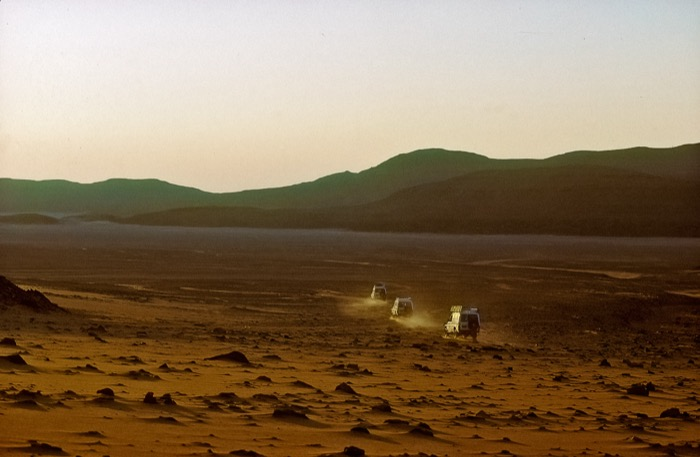
Some of the primary examples of this rock art had been initially discovered in the early 20th century, but then passed out of knowledge over the ensuing decades. So in the late 1990s David Rohl set off with a caravan of four-wheel-drive vehicles into the dunes and canyons of the Eastern Desert to search for these enigmatic depictions and answers to one of history’s great mysteries. What he found was truly amazing.
Conclusion
Stay tuned for next week’s conclusion of evidence related to the spread of nations and the rise of Egypt that will keep us all thinking.
TOP PHOTO: The caravan of the Eastern Desert Survey heads out into the desert (© David Rohl)


