Summary: A new study of Israel’s ancient enemy, Assyria, seeks to discover more about the common people living outside its opulent royal palaces.
Now in the fourteenth year of king Hezekiah did Sennacherib king of Assyria come up against all the fenced cities of Judah, and took them. – 2 Kings 18:13 (KJV)
The Scriptural Significance of Assyria
Assyria was the archenemy of Israel for 300 years during its Divided Kingdom period. The Assyrians were ruthless to all who opposed them during their wide-ranging conquests to form a great empire. The prophet Jonah was sent to warn the great Assyrian city, Nineveh, of God’s impending judgment because of their wickedness. Jonah then lamented over God’s mercy shown to the city after they repented.
Assyria would end up destroying the northern kingdom of Israel around 722 BC, and soon after nearly destroyed the southern kingdom of Judah when King Hezekiah was ruling. Only a miracle of God saved Judah at the time, allowing it to survive more than a century longer before succumbing to Assyria’s successor, the Babylonian Empire. Various forms of the word “Assyria” appear 145 times in the Bible. Like Egypt, Assyria greatly influenced Israel.
But what do we know about the Assyrian people? Since the 1840s the bulk of what we knew about Assyria came from excavations of the amazing palaces, temples, and monumental reliefs of its kings. Now, a new project seeks to reveal the residential neighbourhoods of the ancient city of Nimrud to gain insights into how the common people outside the royal precinct may once have lived.
Assyrian Kings in the Bible
The Bible names six consecutive Assyrian Kings (and perhaps a seventh) over a period of about a century or more when Assyria was at the height of its power – from the lead-up to the fall of the northern kingdom of Israel (Samaria) to about 50 years before the fall of Judah to the Babylonians.

- Pul
- Biblical Reference: 1 Chronicles 5:26. A son of Adad-nirari III. Pul defeated and invaded much of the northern kingdom of Israel. Because of the Hebrew grammar in the verse where he is mentioned, some scholars identify him as separate from, and a predecessor to, Tiglath Pileser III (see below) who is also mentioned in the verse. Pul is a title meaning “Lord,” similar to “Baal” in Canaan.
- Tiglath-Pileser III 745 – 727 BC
- Biblical References: 2 Kings 15:29, 16:7; 1 Chronicles 5:26. Claimed to be a son of Adad-nirari III. Most scholars today associate Tiglath-Pileser III with Pul (see above). This was during the reigns of Ahaz of Judah and Pekah the penultimate ruler of the northern kingdom of Israel. Tiglath-Pileser III captured much of Israel and deported many of its people to Assyria.
- Shalmaneser V 727 – 722 BC
- Biblical References: 2 Kings 17:3; 18:9. Son of Tiglath-Pileser III. Shalmaneser V besieged and took Samaria after Israel’s last king, Hoshea, rebelled. Many Israelites were deported to Assyria. This was during the reign of Hezekiah in the southern kingdom of Judah.
- Sargon II 722 – 705 BC
- Biblical References: Isaiah 20:1 (he is perhaps also inferred in 2 Kings 18:10 “they took it”). Claimed to be a son of Tiglath-Pileser III, but this connection is disputed by scholars. He seized the throne from Shalmaneser V. Sargon II defeated Egypt and may have completed the capture of the Northern Kingdom of Israel.
- Sennacherib 705 – 681 BC
- Biblical References: 2 Kings chapters 18–19; Isaiah chapters 36–37; 2 Chronicles chapter 32. Son of Sargon II. Sennacherib is Assyria’s most referenced king in the Bible. He invaded Judah and laid siege to Jerusalem during the reign of King Hezekiah. He was later assassinated by his sons (as both the Bible and Assyrian annals record).
- Biblical References: 2 Kings chapters 18–19; Isaiah chapters 36–37; 2 Chronicles chapter 32. Son of Sargon II. Sennacherib is Assyria’s most referenced king in the Bible. He invaded Judah and laid siege to Jerusalem during the reign of King Hezekiah. He was later assassinated by his sons (as both the Bible and Assyrian annals record).
- Esarhaddon 681 – 669 BC
- Biblical References: 2 Kings 19:37; Ezra 4:2; Isaiah 37:38. Son of Sennacherib. Esarhaddon repopulated parts of Judah with foreigners from elsewhere in the empire. This would have been during the long reign of Judah’s King Manasseh.
- Ashurbanipal 669 – 631 BC
- Biblical Reference: Ezra 4:10. Son of Esarhaddon. Ashurbanipal was the last great king of the Assyrian Empire, but his identification in Ezra 4 is uncertain. In the verse it is written as Asnappar or Osnappar in various spellings, which is thought to be an Aramaic attempt to reproduce the name of Assurbanipal. He relocated various foreign groups into the region of Samaria. Ashurbanipal’s reign overlapped those of Judah’s kings Manasseh, Amon, and the first part of Josiah’s.
- Biblical Reference: Ezra 4:10. Son of Esarhaddon. Ashurbanipal was the last great king of the Assyrian Empire, but his identification in Ezra 4 is uncertain. In the verse it is written as Asnappar or Osnappar in various spellings, which is thought to be an Aramaic attempt to reproduce the name of Assurbanipal. He relocated various foreign groups into the region of Samaria. Ashurbanipal’s reign overlapped those of Judah’s kings Manasseh, Amon, and the first part of Josiah’s.

Unearthing Assyria’s Great Kings
Although it had a more ancient history, the reinvigorated Neo-Assyrian Empire operated from about 911–609 BC as it became the world’s most powerful empire. During this period, the capital city shifted from the traditional location of Ashur (or Assur, which is where Assyria got its name) to the sites of Nimrud (ancient Kalhu or Calah in the Bible), Khorsabad (ancient Dur-Sharrukin), and then Nineveh. Each of these cities was built to huge proportions with numerous palaces, temples and fortified walls with strong towers surrounding populous cities.

These sites began to be uncovered in the 1840s, after the large mounds caught the attention of European explorers and pioneers in the field of archaeology. Austen Henry Layard began his famous excavations at Nimrud in 1845, and Nineveh in 1847, with the goal of finding as many well-preserved art pieces as possible. Others followed his work there and at the other great Assyrian cities.

Scholars note that In the 7th century BC Nineveh was the largest city in the world with a population as high as 300,000 within the walled inner city, and again that many in the surrounding metropolitan area. At 1,900 acres it was encircled by a 7.5-mile fortification wall.
In everything, the Assyrian kings projected their wealth, power, and domination through the monumental architecture, statues, obelisks, and reliefs on wall panels. Common themes included scenes and accounts of the Assyrians defeating their enemies and treating them brutally, hunting lions, and receiving tribute from conquered nations.

Also located on the Tigris River, another of Assyria’s capital cities, Nimrud, was found to have once contained a zoo and botanical gardens, filled with flora and fauna from their far-flung campaigns. Over a span covering more than two centuries, multiple palaces, the Great Ziggurat, and associated temples were constructed at Nimrud. Assurnasirpal II (r. 883-859 BC) built one of the greatest palaces called the Northwest Palace, which covered 12 acres and had more than 200 rooms.
Many pairs of colossal guardian figures known as lamassu, (with male human heads, bodies of lions or bulls, and the wings of eagles) were found at palace entrances. Most of the treasures found in the city were shipped to museums in Europe.

While the Bible mentions several Assyrian kings, Assyrian inscriptions discovered so far mention as many as nine kings of Israel and Judah by name. Some of these references connect to events that are in the Bible, while others are not in the Bible and add to our information about these kings. These inscriptions from Assyria (and later Babylon) remain some of the best extra-Biblical witnesses for the validity of the Bible’s history, and several were profiled in the film The Israel Dilemma – Ancient Prophecies.
The Discovery of Assyria’s Lost Queens
While the great kings of Assyria were successful at broadcasting their fame, little was known about the queens, many of whom were not even mentioned in the royal annals – until a chance discovery was made in 1989. Previous excavations led by British archaeologist Max Mallowan at Nimrud’s Northwest Palace established that the royal “Harem Quarters” existed in its Southern Section. Not only was this the residence for the wives and cohorts of Neo-Assyrian kings, a coffin containing an 8th century BC woman was found. However, this wing of the palace hid much greater secrets.
Iraqi archaeologist Muzahim Mahmoud Hussein and a team from the Iraqi Department of Antiquities were excavating in the area of the Harem Quarters in the late 1980s when he noticed that parts of the brick floor in one of the rooms of the royal household
were sticking up at odd angles. When the floor was removed, a hidden tomb was discovered underneath. Eventually four vaulted tombs made of fired bricks were unearthed containing the bodies of royal Assyrian women along with priceless treasures, including hundreds of pieces of jewelry, decorations, and ceramics. The hidden tombs had been sealed off with slabs of stone and marble.
Understanding the exact situation in the tombs was complicated by the fact that some of the tombs seemed to have been looted or disturbed in antiquity and some of the bodies moved. A pair of royal bodies were found on top of each other and determining which ornaments belong to each is uncertain. Scholars speculated that some of the personal items inscribed with names may have been moved or possibly passed down from one woman to another over the generations. What was clear is that this was one of the greatest Assyrian finds of all time.

The identity of several of the royal women in the tombs is as follows:
- Mullissu-mukannishat-Ninua, wife of Ashurnasirpal II
- Yabaʾ, wife of Tiglath Pileser III
- Banitu, wife of Shalmaneser V
- Atalya, wife of Sargon II
- Hama, wife of Shalmaneser IV

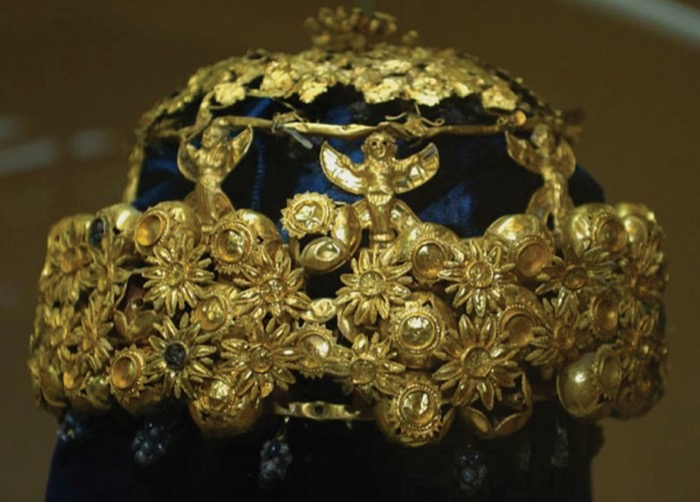
The finds offered a rare glimpse into the lives and burial practices of the ancient Assyrians, giving clues to social structure, physical health, daily life, and how they projected their positions. Queen Hama died young and was found wearing the beautiful gold crown that is the best-known image of the finds. Exquisite craftsmanship was displayed in the numerous gold pieces inlaid with precious stones.
According to an article on Wikipedia, the Queen’s tombs are the only Neo-Assyrian royal burials discovered that are complete with burial dress and objects of interment. It is thought that the large amounts of jewelry and other objects of adornment arranged in or around layers of clothing owed to the Neo-Assyrian belief that these tombs were portals to the afterlife, where each queen would need to pay a toll to appease the deities of the afterlife.
These finds are not well known to the public in the West due to the war and chaos in Iraq over the last few decades. Islamic State (ISIS) forces took control of the ancient ruins of the Northwest Palace for a while in 2015 and bulldozed much of the site.
A New Approach to Discovering the People of Assyria
For the last 200 years, exploration of Assyrian history has focused on the grand palaces of its kings and queens. However, outside Nimrud’s Northwest Palace lie the remains of the 840-acre Lower Town, which has been largely ignored. Now, new research from an Italian archaeological team from the University of Udine is seeking to bring the wider population and their urban development into view.
Called the Nimrud Lower Town Archaeological Project, or NiLTAP, the team is using both older and more recent technology to probe the residential neighbourhoods of the city. The opportunity is unique because unlike other Assyrian cities that fell to a coalition of Babylonians and Medes in 612 BC, after Nimrud was destroyed it was never significantly rebuilt. Additionally, modern farming that takes place on some of the site only plows down a few inches into the ground. This means that the site has been largely undisturbed and the ruins of the town remain under the surface.

The team is using declassified U2, CORONA and HEXAGON imagery dating from 1967 to 1974 to map the outlines of fortifications, city gates, and streets. This was added to results from surface survey, drone mapping and magnetometry allowing them to map the ancient terrain. Preliminary results were published by Cambridge University Press. It appears that there were areas of dense settlement alongside more dispersed occupation, and even open spaces. Highly organized street layouts and larger building complexes point to different zones and how the population lived and moved around the city.

New artifacts have already been found in the surveys, including fragments of inscribed royal prisms. One significant early finding is that Nimrud’s main water source was likely not the canal built by Ashurnasirpal II as had been previously thought. Instead, the main source was a canal system farther north that had significant development organized around it.
There are indications that several changes in living patterns took place over the long occupation of the city. This information will help target areas for more indepth archaeological work in the years ahead. Even in this early phase of research, investigators are already expanding their knowledge far beyond what was going on in the palaces and temples of Nimrud.
Conclusion
The rich archaeological evidence from Assyria helps us better appreciate what was going on in the world of the Bible. In response to the destruction caused by ISIS, there has been a concerted effort to resume archaeological work at the acropolises of the Neo-Assyrian capital cities. The work initiated at the Lower Town of Nimrud promises to provide new insights into the urban fabric of the entire site, not just the royal quarters. This will provide more context and perhaps more Bible-history-related evidence from these people who were the primary opponents of Israel during the Divided Kingdom period. Keep thinking!
TOP PHOTO: Golden crown from the tomb of the Assyrian Queen Hama, wife of Shalmaneser IV, at Nimrud. (credit: SSgt Noreen L. Feeney / U.S. Army, public domain via wikimedia commons)


