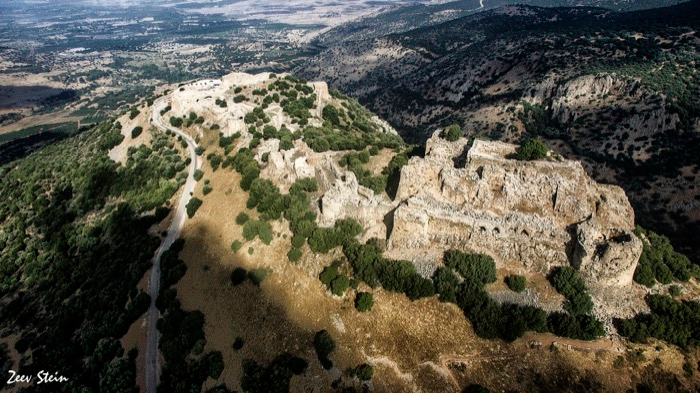
Summary: Archaeology at Caesarea Philippi where Jesus declared, “On this rock I will build my Church,” shows that more may have been more going on than we realize.
Now when Jesus came into the district of Caesarea Philippi, he asked his disciples, “Who do people say that the Son of Man is?” – Matthew 16:13 (ESV)
The Origins of Anti-God Religion
The Bible depicts wickedness spreading over the world again after the Tower of Babel with the various people groups (Genesis 10:32, 11:9, Romans 5:12). The details of how this played out and the explosion of anti-God religions is a much more mysterious story.
Today’s Thinker article features a discussion between Timothy Mahoney and Biblical archaeologist Prof. Thomas Winder, Director of the Holy Land Research Institute. They explore the episode in the Gospels where Jesus and his disciples visit the area of Caesarea Philippi, which was at the foot of Mount Hermon, about 30 miles north of the Sea of Galilee (as opposed to the Caesarea on the Mediterranean sea coast, between Tel Aviv and Haifa). It was here that Jesus stated “on this rock I will build my church…” Discoveries at Mount Hermon show that it was also connected to false religious systems going back thousands of years and the dark spiritual world that may have been a key part of Jesus’ message. So, let’s jump into the conversation.
THOMAS WINDER: Okay, all those giants were born right here on Mount Hermon. In fact, Charles Warren in 1865 actually found a stela up on top of Mount Hermon that was the oath, the promise that these bad angels took amongst themselves to corrupt mankind. It’s the blood contamination, of course, that the dark forces, Satan, we call him the Devil, but he’s always trying to stop Messiah from coming. So these giants were born right here like Ba’al. I call him the head dog of the pagan pantheon.
So when Jesus comes here, he actually knows exactly what he’s doing. He has a purpose and he has a plan, and he comes to Mount Hermon on purpose because he knows this is where all the corruption started before the flood. The flood was made to get rid of them. However, there’s giants afterwards. But the point is that the giants pre-flood, they rule the world. They actually become the pagan gods like Ba’al, we call them Ba’al with the horns. So those big giants become the pagan gods.
So when I got there, all of that became clear because I had the time on my hands to search out those other pagan temple sites on Mount Hermon that I had never seen before. In fact, I had never even contemplated any of that. My original work was strictly based on topography. But once I saw, this is important, once my eyes were trained to see what a pagan temple site consisted of … one of those sayings are pits. You hear about pits throughout the Bible, but the pits for the pagan world is a spring of water coming up from down below. That’s a gateway to the underworld. So every single pagan temple site has a pit that they can dig out and line with rocks to make a pool of water. Basically, that’s where they throw their gifts to the gods.

THOMAS WINDER: So every one of these things had pits, which I didn’t know before. They all have standing stones, which I didn’t know before. They all have niches cut into the stones for statues of the gods, little “g.” And they have military type walls around, not for agriculture, but for protection, so they can throw rocks at anybody trying to come up the hill. They’re all on mountaintops, high places we call them. And they all have tombs underneath where, apparently, people wanted to be buried close to their gods. They all had the same thing.
…and all Lebanon, toward the sunrise, from Baal-gad below Mount Hermon to Lebo-hamath, – Joshua 13:5
These are the nations: the five lords of the Philistines and all the Canaanites and the Sidonians and the Hivites who lived on Mount Lebanon, from Mount Baal-hermon as far as Lebo-hamath. – Judges 3:3
THOMAS WINDER: Well, that opened up a whole new world for me. All of a sudden I see the pagan world at work. I see what they’re doing. I see what every single site has. So when I went back to Nimrod’s fortress hilltop, which is the hilltop directly above Cesarea Philippi. I don’t know if you’ve been there, Tim, but that’s where every tourist comes to Israel as far north as they generally get is Caesarea Philippi, because they all want to see where Jesus declared his church upon the rock.

THOMAS WINDER: Now that’s where this story begins. And there is the gate to Hades. Now let’s backtrack just a little bit for everyone’s information because in Greek mythology, you have Zeus, you have Poseidon, and you have Hades, who is the pagan god of the underworld. So at the district of Caesarea Philippi, which is outside the city limits, you have this gate to Hades at the base of Mount Hermon where literally the Jordan River comes out of the ground and spills out and starts the Jordan River. It’s the big pit of all paganism where Pan the goat demon, he’s half man and half goat, that’s where his altar was. That’s where he was worshiped by the pagans with public orgies and human sacrifices, which took place at all these other cultic temple sites. But of course that is one of the biggest. It’s right at the base of Mount Hermon and the water comes out of that rock and literally begins the Jordan River.
So then why is Jesus going to a pagan altar to declare his church? Very, very mysterious. Well, afterward I found out that Jesus went to Mount Hermon in the first place to basically reverse the curse of those pagan gods and to tell them there’s a new sheriff in town.
The Transfiguration
THOMAS WINDER: But not only that, this is the one you like the best. This is the one everybody likes the best. Because in the story, everybody can read the story in three different gospels, Matthew, Mark and Luke. Mark doesn’t add a thing, but Luke adds a whole bunch of color. You have to turn to Luke to find out some really important bits and pieces of information that complete the puzzle. One of those things is that they came down from the mountain the very next morning. Six days later, Jesus takes his crew, Peter, James, and John up to this high mountaintop.
And, of course, Moses and Elijah show up and we have the great cloud. Jesus basically is glorified. I don’t think it’s just a little cloud by the way. I think it’s the very pillar fire. And I’ll explain that in a few minutes.
TIM MAHONEY: And for some people who might be new to the Bible, we’re getting testimonies of God acting in history. What you’re telling us and what we’re trying to help people understand is that prior to the time of Christ coming, this area and before even the Jewish people from the Exodus came into the land, there were people that were worshiping gods – foreign gods.
THOMAS WINDER: The entire land of Canaan, the Hittites, the Perizzites, the Girgashites, all the “ites.” You can read all about that in Genesis chapter 15, where the Abrahamic Covenant is described and all these lands from the river of Egypt all the way to the river of Euphrates given to Abraham and his promised descendant.
TIM MAHONEY: So what’s happening here is that you’re uncovering something that happened previously that these gods were worshiped and now there’s a spiritual and a theological event that’s happening more than I think most people and myself ever understood. That’s what’s profound about that, about the Mount of Transfiguration it’s answering a big question.
THOMAS WINDER: Yes. Not only earlier history, because remember what Ephesians 6 says; our struggle is not against flesh and blood, but the powers and principalities of the dark forces of this world.
So where did those dark forces begin? How did they corrupt the world? Well, it all happened on Mount Hermon. The Greeks just give new names and new faces to the same old god. You can go from Ishtar to Astarte to Aphrodite with the Greeks, to Venus and the Romans. It’s all the same spirits of these despots, these demons, literally demons. They are the giants, pre-flood giants that literally are worshiped as the pagan gods. So with that understanding we see why Jesus went to Mount Hermon in the first place. Now this is mind-boggling stuff because it’s been 2000 years and no one has figured this out. This is like I just fell into it.
TIM MAHONEY: Let me read this portion from Luke to help the audience understand what’s going on here. This is Luke 9:27-36. “But I tell you truly, there are some standing here who will not taste death until they see the kingdom of God.” Now, about eight days after these sayings, he took with him Peter and John and James and went up to the mountain to pray. And as he was praying, the appearance of his face was altered, and his clothing became dazzling white. And behold, two men were talking with him, Moses and Elijah, who appeared in glory and spoke of his departure, which he was about to accomplish at Jerusalem. Now, Peter and those who were with him were heavy with sleep, but when they became fully awake they saw his glory and the two men who stood with him.
And as the men were parting from him, Peter said to Jesus, “Master, it is good that we are here. Let us make three tents, one for you, one for Moses, and one for Elijah” –not knowing what he said. As he was saying these things, a cloud came and overshadowed them, and they were afraid as they entered the cloud. And a voice came out of the cloud, saying, “This is my son, my Chosen One. Listen to him!” And when the voice had spoken, Jesus was found alone. And they kept silent and told no one in those days anything of what they had seen.
So this is what has captivated you for …
THOMAS WINDER: Thirty years now. And Luke is wonderful because he fills in a lot of the mysteries that Matthew misses. For instance, Matthew tells us there’s a conversation between Jesus, Moses, and Elijah. But he doesn’t tell us what that conversation is. You have to turn to Luke, because Luke tells you that they’re talking about his departure from Jerusalem six months later, i.e. the crucifixion resurrection. Of course, the disciples, that’s the story they hate the most, that Jesus has to die. They don’t want that Messiah. They want the Messiah just like the Jews of today and even the Muslims. They want the Messiah to come rule the world and put them in charge. The disciples read the fine print. They don’t have spiritual minds. All they can do is argue about who’s going to be in charge. You hear it all the time.
And when they’re going north after Jesus fed the 4,000 with seven loaves of bread, they can’t cast out a demon. So they have to bring that demon-possessed person to Jesus. And Jesus, of course, casts out demons every day. No problem for him. Then the next thing they do is complain about where lunch is coming from. And Jesus literally scolds them up and down because they don’t know what he’s talking about. And he says, “Beware of the leaven of the Pharisees and the Sadducees.”
As they’re walking north, it’s funny. You just read that Peter wanted to build, well, your translation says “tents.” The translation is supposed to say “tabernacles” in the Hebrew. There’s only one time a year that Jews ever build tabernacles. And that’s the Feast of Tabernacles. There’s never a single place anywhere else where they’re building just a place to spend the night. No, no, no. This proves that it’s the Feast of Tabernacles. It would be in the fall. It’s always somewhere around the end of September to mid October for us.

THOMAS WINDER: The other thing you mentioned is that Luke says approximately “eight days later.” I don’t want to confuse everybody, and it sounds like a contradiction, however, Matthew and Mark say “six days later.” So is that a contradiction? Actually, it sounds like one to you and I because we’re Gentiles, but there are two “last days” of the Feast of Tabernacles. There’s the last day of tabernacles. And then there’s the eighth day, the day right after tabernacles that is Simchat Torah where they start the Torah reading cycle again.
They read it for a whole year. And on Simchat Torah, the day that we call the eighth day, they also call it the eighth day, means that there’s actually two last days of tabernacles. So hence, it’s not a contradiction at all. That’s the way the Jews think. They’re talking about the last day of tabernacles because Matthew and Luke, after this event at the gates of hell, remember, “Upon this rock, I will build my church and the gates of hell will not prevail against it”? After that incident, it says they walked up the hill. But six days after what? Six days after those sayings were made.
Mount Hermon and Peter’s Confession
TIM MAHONEY: When you first went to seminary in Jerusalem, the professor said that many of the locations were wrong because they were appointed by Queen Helena. So why do you think this Mount Hermon was so important? Because as I said, there is a theological and a spiritual significance because you’re the only person I’ve ever heard that has talked about this. This is the first time I’ve ever understood that there’s more to this than just this event happening. There’s something that’s being answered, correct?
THOMAS WINDER: Yes, yes. You nailed it. How does all of this start? When they first get to Caesaria Philippi to the Gate to Hades, Jesus asked the ultimate question, “Who do people say that I am?” And the reply was, “Well, you could be Elijah or Jeremiah, one of the prophets or just a great teacher.” And then he looks at them eye to eye and says, “But who do you say that I am?” And that’s when Simon Peter or Simon Kepha, “Kepha” is the name “Cephas” in Aramaic, he says, “Well, hey, you are now Simon Bar-Jonah,” which is the son of a prophet. So this uneducated Peter feels really, really good about himself. He gets a swollen head. I mean, he’s walking around all proud. “Hey, I finally got one right.”
And then Jesus introduces him, in our translations it says, “This is Peter, and upon this rock, I will build my church.” Well, he doesn’t say “Peter.” He doesn’t say “Kepha.” You’ve got to go to the Greek lexicon to find out what he actually said. He actually calls Peter “Petros,” which is a little tiny pebble, because he’s bringing Peter’s ego down. So he gets a promotion to the son of a prophet, and then immediately he gets a demotion as just a piece of gravel. And then Jesus says, “Upon this rock, I will build my church.”
So what you have is this division. Let me read you a Scripture that floored me after I figured all this out. A friend of mine sent me this. This is Isaiah 51:1. It says, “Listen to me, you who follow after righteousness, you who seek the LORD; look to the rock from which you were hewn and to the hole of the pit from which you were dug.”
When I was younger, I used to think Jesus was saying “upon this rock,” referring to himself. I was wrong. I was dead wrong. Because it turns out that Jesus is referring to the rock that they’re standing on, in front, literally, of the very altar of Pan right in front of the gate to Hades. All right? And so it turns out, and this will become totally clear when we find out what’s on top of that hill that you can see directly in front of Cesarea Philippi. But it turns out that you and I as sinners had to be cut out of the rock of sin. The rock of debauchery, the rock of lasciviousness, the rock that, literally, that gate to Hades and Pan’s altar represents. The church is built on sinners. It’s not built on Peter by himself. It’s not built on Peter’s confession by itself. No, it’s built on sinners within the same sentence.
THOMAS WINDER: Jesus says, “Upon this rock, I will build my church and the gates of Hades will not prevail against it. I will give it the keys to the kingdom of heaven. Whatever they bind on earth will be bound in heaven. Whatever you lose on earth will be loosed in heaven.” Well, that’s about casting out demons and healing the sick and taking charge, having victory over those dark forces of evil that we’re up against. Our struggle, our battle. He gave everyone in the church, all believers, they get the Holy Spirit to combat these things, to give us the power and the authority. The church is built out of sinners, redeemed sinners. But Jesus cut us out of the rock of sin to be the army against the captain of sin.

THOMAS WINDER: And then he takes his three captains, Peter, James, and John up for a little walk right up the hill. By the way, there is no other trail, and that trail is still there to this day. Just a couple days ago, I took a friend of mine up that trail. It goes straight from the gate to Hades, the grand pit. And it goes right straight up the hill to what today is Nimrod’s fortress. But you see Nimrod’s fortress was not there when Jesus came. Nimrod’s fortress is only 1,000 years old. Every wall and every tower, defensive towers, because it was built to defend the Damascus Road from the crusaders.
But if you look at it from the front, from the parking lot or right before the entrance, you’ll notice that there’s a huge pile of megalithic stones, a debris field of dolomite. That’s the blue stone in front of what is now the entrance. And you can tell that they fell off the roof because after all, if they had fallen down off the roof before the Islamists built the fortress, they would’ve cut them up into small stones.
But they didn’t touch those stones at all, because there was still the arch up there. And the arch, you can see it where it’s totally distinctive. There’s two big towers of megalithic stones that go up to basically nothing now, because the roof, the top of the arch, Ba’al’s Arch, the whole top has fallen off. There was a huge earthquake that rocked the entire castle and there’s earthquake damage all around. But you know arches are not square, they’re round. And so rocks are carved in a very, very specific fashion to create an arch. And all those stones are right before you. In fact, they’re all over, both in front and behind where they fell off during that earthquake because they are carved to hold up a big giant arch.
TIM MAHONEY: So Thomas, when we think about this, I think we’re going to have to come back for another podcast, but what you’re saying is that there is a connection to demonic activity and idolatry and giants that was around this area.
THOMAS WINDER: A hundred percent. This is where the giants were born. This is where they were first worshiped. That’s why there’s 27 cultic temple sites on Mount Hermon. That’s why everything in Greek mythology is based on what happened here on Mount Hermon. The whole mythology of the Greek Pantheon actually happened here. They just borrowed the stories and embellished them, of course.
Conclusion
Stay tuned for Part 2 of Trail to the Transfiguration in a future article. We hope you’ve enjoyed this latest article featuring excerpts from the Patterns of Evidence Podcast. If our films or other forms of media have had a positive impact on you or your family, please consider donating by going to patternsofevidencefoundation.org. Your donations are what keep our ministry running and help us continue to produce God-affirming media for a world desperately seeking a firm foundation. Please come alongside us today. Thank you. And as always, keep thinking.
NOTE: Not every view expressed by guests on Thinker podcasts necessarily reflects the views of Patterns of Evidence. We include perspectives from various sides of debates on Biblical matters so that readers can become familiar with the different arguments involved. – Keep Thinking!
TOP PHOTO: Nimrod Fortress above Caesarea Philippi. (credit: Heritage Conservation Outside The City Pikiwiki Israel, CC BY 2.5, via Wikimedia Commons)


.jpg)
