Summary: Destruction remains at the site of ancient Nineveh tell the story of the demise of two brutal regimes separated by over 2,600 years.
And he will stretch out his hand against the north, and destroy Assyria; and will make Nineveh a desolation, and dry like a wilderness. – Zephaniah 2:13 (KJV)
Evidence of Two Conflicts at Nineveh
Researchers at one of the most significant foreign cities in the Biblical account have uncovered dramatic evidence of strife from two violent clashes separated by more than 2,600 years. Nineveh was the ancient capital city of the dreaded Assyrian Empire, which dominated the Middle East in the days of the kingdoms of Israel and Judah. The first conflict was part of the downfall of Assyria, while the second conflict occurred in recent years, involving the defeat of another ruthless force, the terrorist group ISIS (the Islamic State).
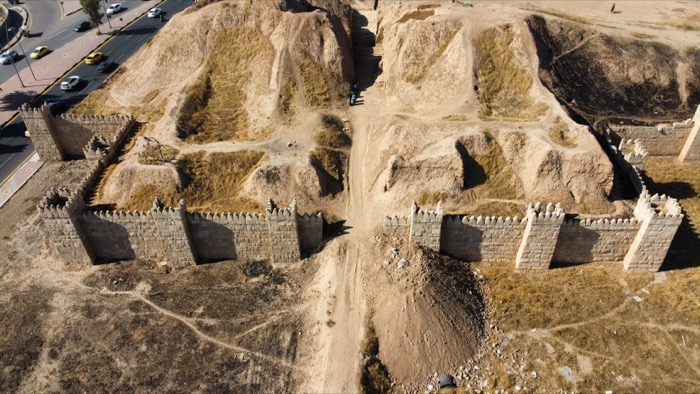
The discoveries occurred around the monumental eastern gate of ancient Nineveh known as the Shamash Gate. It was one of the most prominent and magnificent of the 18 gates controlling entrance into the enormous city. In 612 BC this gate witnessed the sack and destruction of Nineveh by a coalition of Babylonians, Medes, and Scythians, which had formerly been vassals to Assyria.
Nineveh would eventually be completely abandoned, but the remains of the Shamash Gate continued to protrude from the city mound for millennia. The gate area also dominates an important approach to the modern city of Mosul, which sits next door to Nineveh. This strategic location was converted into a defensive fortification by ISIS, including a network of tunnels that cut through the foundations of the gate, when they occupied Mosul beginning in 2014. In 2017 the site went through a second battle, this time to liberate Mosul from ISIS. At this unique site, arrowheads from 612 BC can be seen laying next to bullets from 2017.

Nineveh’s Biblical History
Nineveh is one of the oldest cities mentioned in the Bible (Genesis 12:13). It became part of the Assyrian Empire, which had a reputation as perhaps the most ruthless empire in history, with scenes of subdued enemies being impaled on poles and filleted alive displayed on their palace walls. For centuries the Assyrians were the arch enemy of the kings of Israel and Judah, as well as most of the Middle East.
In the days of Israel’s King Jeroboam II, the prophet Jonah was sent to the wicked city of Nineveh with warnings of judgment. Amazingly, the city repented and God relented of his judgment. But the Assyrians soon returned to their evil ways and were the ones responsible for destroying the northern kingdom of Israel (Samaria) in 720 BC.
Not long after Israel’s fall, a king of temporarily independent Babylon sent emissaries to Judah’s King Hezekiah (2 Kings 20:12-19) who foolishly showed them all of his treasures. Perhaps he wanted to impress his new ally and couldn’t imagine a time when their mutual enemy, the great Assyrian Empire, would no longer be his greatest threat.

Assyria’s King Sennacherib invaded Judah when Hezekiah was still its king, destroying its fortified cities. He was threatening Jerusalem itself before a mighty miracle from God saved the city by destroying the Assyrian army (2 Kings chapter 19). Hezekiah had thrown himself on the mercy of the Lord in the face of the seemingly unstoppable Assyrian invasion.

After he returned home from his Judah campaign, King Sennacherib would have many scenes of his conquests made into reliefs carved into the walls of his palace at Nineveh. These depictions are now visible in the British Museum and give us amazing insights into what some of the events recorded by the Bible actually looked like. His accounts were also recorded in his annals that were imprinted on prisms. They boast of shutting Hezekiah up in Jerusalem like a caged bird. His claim of taking 46 of Hezekiah’s strong cities lines up with the Bible’s account of Assyria capturing Judah’s fortified cities.

Scholars believe the Shamash Gate’s construction belongs to the massive expansion of Nineveh carried out by King Sennacherib, who ruled as sole king from 705 to 681 BC and made Nineveh the capital of Assyria.
The Biblical prophet Nahum spends three chapters prophesying the downfall of Nineveh. Since Nahum wrote at the time of King Josiah (Nahum 1:1), nearly a century after the fall of Israel, his words would have been a comfort to the people of Israel (who remained or were taken captive to Assyria) and the people of Judah, that although Assyria was threatening and had been used to chastise the people of Israel, because of their wickedness and violence, the capital Nineveh would in turn be judged. Other prophets, such as Zephaniah also prophesied the downfall of Nineveh and Assyria.
The final great ruler of Assyria was Ashurbanipal, the grandson of Sennacherib, who is commonly given the reign dates of 669-631 BC. He is also likely the last Assyrian king mentioned in the Bible. Ezra 4:10 says a king named Onsappar (Asnappar in some versions) moved people from beyond the Euphrates into Samaria. Most scholars believe Onsappar is a corruption (or alternate name) of Ashurbanipal. Ashurbanipal’s annals record a list of twenty kings who paid tribute to him, one of whom is Manasseh of the land of Judah.
Within a century of the Babylonian envoys’ visit to Hezekiah, in a stunning reversal, Assyria suffered several defeats, and the capital city of Nineveh was captured and destroyed in 612 BC. After the fall of Harran (Biblical Haran) in 609 BC, the Assyrian Empire was finished. The Babylonians had overtaken Assyria and ultimately under King Nebuchadnezzar they would destroy Judah and Jerusalem, taking its treasures and sending many of its residents into captivity just as Isaiah had warned.
Ancient Finds at Nineveh’s Shamash Gate
The scars from both the ancient and modern dramatic episodes were revealed in three seasons of excavations (2021-2023) conducted by the Iraqi-Italian Nineveh Expedition directed by Nicolo Marchetti. The findings of a research team led by Timothy Harrison from the University of Chicago were published recently in the journal Iraq.
The massive Shamash Gate was built to impress and intimidate residents and visitors alike. It was part of a fortification wall that stretched for 7.5 miles, encompassing a city of 1,900 acres. According to estimates, the city’s population may have grown to exceed 150,000 in the decades that followed. Sennacherib built his “palace without a rival,” and some propose he may also have been responsible for building the famous Hanging Gardens of Babylon.

The heavy traffic the gate experienced was evidenced by cart-wheel grooves worn into the stone pavement. The original pavement of large stone slabs at the entrance needed resurfacing (with layers of mudbrick, pebbles, and clay) at least once during its nearly century-long existence.

Evidence of the Assyrian city’s final destruction came from the discovery of a burn layer from the late 7th century BC. The central passage contained pockets of ash and charcoal from the time of the city’s demise. Items identified included bronze and iron arrowheads, a decorated bone button, and ceramics that helped date the remains.

More gruesome were the human remains. The disarticulated bones of at least four people were found in one area: a child around three years old, a male in his late teens, an adult female, and another adult of unknown sex. Just inside the gate, the remains of another adult were exposed, laying face down on the clay pavement. Surely, these tell part of the horrific story of massacre when the gate and walls were finally breached after a three-month siege.
Of great significance was the unearthing of a smashed stela connected to King Ashurbanipal near the human remains. So far, 196 burned fragments containing traces of organic matter have been recovered, suggesting intentional demolition, perhaps using heat as part of the process. The fragments indicate that the two sides of the approximately 6.5 foot high limestone monument depicted a royal standing figure with inscriptions talking about campaigns to Egypt that match those recorded for Ashurbanipal.
A Second Chapter of Destruction
ISIS turned the remains of the Shamash gate into a dump and a fortification during their three-year occupation. ISIS members used an area in front of the gate and along the exterior walls of Nineveh to stash looted items from Mosul’s homes. The report states, “The collected items include washing machines, air conditioning units, and toilet seats, among other appliances and household furniture. It is not clear what the intentions were behind this collection, which extends for approximately two kilometers along the exterior eastern face of the Neo-Assyrian city walls, forming a sprawling junkyard at the main entrance to the city, while limiting public access to this part of the gate complex and fortifications.”

The gate area also revealed signs of the 2017 battle for Mosul which expelled ISIS. This included shrapnel, shell casings, craters, bullet holes, burn marks, and the remains of exploded grenades.

Before their expulsion, ISIS members dug about 690 feet of tunnels inside and beneath the gate, to facilitate the movement of soldiers and munitions. The tunnels were cut through stone and brick structures, while destroying ancient remains. The fact that they cut through the foundations of the gate threatened to collapse the entire structure.

A 2021 survey using 3D laser scanning confirmed their concerns. The United Nations Development Program helped stabilize the tunnels in 2022 by backfilling them with sandbags using the very soil ISIS had excavated.
Conclusion
The stubborn survival of the Shamash Gate represents far more than an ancient ruin. It joins the remarkable archaeological remains of Nineveh’s palace to testify to the violent past of the city of Nineveh. It confirms the Bible’s historical record for the city, the empire’s invasion of Judah, and ultimately its fiery end. Additionally, this confirms the predictions of Biblical prophets like Isaiah, Zephaniah, and Nahum.
The remains of Nineveh’s downfall standing side-by-side with evidence of the destruction of ISIS also testifies to another truth taught in the Bible. Although evil and violence may look permanent and unstoppable at the time, in the end, you reap what you sow. Ultimately, God’s righteous judgment is what is unstoppable. This should spur us all to pause and keep thinking.
TOP PHOTO: Aerial view of the Shamash Gate from the east. (credit: T. Harrison et al 2026/Iraq – open access)


