Summary: Did the Israelites’ miraculous Exodus crossing really take place through the Sea of Reeds, and why does that matter?
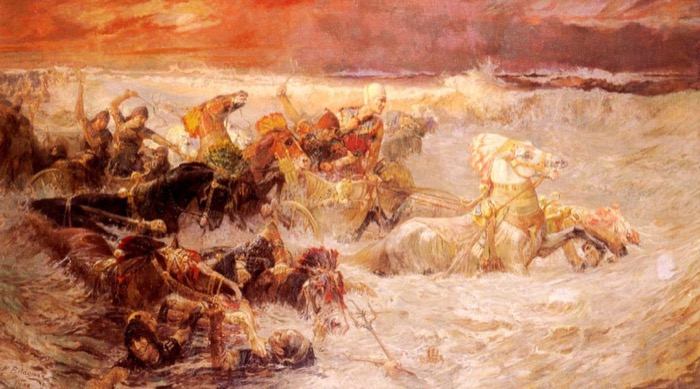
“Pharaoh’s chariots and his host he cast into the sea, and his chosen officers were sunk in the Red Sea. – Exodus 15:4 (ESV)
The Mystery of the Red Sea
One of the greatest Bible mysteries is the identity of the body of water crossed by the Israelites during their exodus from Egypt. Every possible marsh, lake, river, and sea between Egypt’s Nile delta in the west, and Israel/Arabia in the east (either surviving today or which may have existed in ancient times) has been proposed as the location. Many different Biblical clues have been employed in numerous arguments, but at the center of the debate are the various place-names, or toponyms, the Bible uses in the Exodus account. The challenge is that, with a few exceptions, knowledge of where these various place-names were pointing to has been lost over the centuries.
There is no place-name more important than the name of the sea itself. Called “Red Sea” in modern Bible versions, the original Hebrew name in the Biblical text is “Yam Suph.” There is widespread agreement that the Hebrew Yam Suph does not mean “Red Sea.” Instead, “Red Sea” may have been just an interpretation by ancient translators of which sea was being referred to, rather than a strict translation. So the questions remain, what does Yam Suph really mean and how has the consensus view of this matter affected opinions about where the sea crossing took place?
Knowing the correct location of the sea crossing is important for a proper understanding of the Exodus account. Of particular significance is the debate over the nature of the Exodus journey and the crossing itself. Was it a short journey to a sea crossing that involved entirely natural processes of wind, or a tsunami, or an earthquake? Was it a small shallow body of water – where the only supernatural element was the timing of the event? Or was it a distant location, where the parting of the deep waters could only be explained by the direct intervention of God’s power?

A Deep and Mighty Sea
The definition of Yam Suph has factored heavily in the debate about the nature of the crossing because the prevailing paradigm among Bible scholars has long been that the Hebrew name Yam Suph means “Sea of Reeds.” And among many (though not all), the thinking is that reeds (or papyrus) require shallow calm water to grow, therefore the crossing must have been through shallow waters. Commentators actually use the fact that the Delta lakes were shallow as evidence that the Exodus sea crossing took place at one of them. The fact that the two gulfs of the Red Sea (Suez and Aqaba) do not have abundant reeds and the proposed marsh lakes in the Nile Delta supposedly did, contributes to the view that these lakes must have been the site for the Exodus miracle.
However, the Bible in many places describes the sea crossing as going through deep and mighty waters, making it one of the most prominent and oft-noted features of the event:
the deeps congealed in the heart of the sea (Ex. 15:8)
they sank like lead in the mighty waters. (Ex. 15:10)
you cast their pursuers into the depths, as a stone into mighty waters. (Neh. 9:11)
the deep trembled… your path through the great waters. (Ps. 77:16, 19)
He rebuked the Red Sea, and it became dry, and he led them through the deep as through a desert. (Ps. 106:09)
Thus says the LORD, who makes a way in the sea, a path in the mighty waters, (Isa. 43:16)
Was it not you who dried up the sea, the waters of the great deep, who made the depths of the sea a way for the redeemed to pass over? (Isa. 51:10)
who stirs up the sea so that its waves roar (Isa. 51:15)
who led them through the depths? Like a horse in the desert, they did not stumble. Like livestock that go down into the valley … (Isa. 63:13-14)
I suppose one could wonder how deep the water would need to be to be considered truly deep or mighty. In these verses the Hebrew word for “deeps” (tĕhowm), according to Strong’s Concordance and the Hebrew scholar Gesenius, means the main sea, an abyss, or great quantities of water. The same word is used at the beginning of the book of Genesis for the primordial deeps that the Spirit of God was hovering over.
Reading the full passages related to the scale, impact and purpose of the miraculous crossing, it appears that very deep water from a true sea is in view, and not the shallow water of Egypt’s delta lakes that are in an extremely flat area.
who caused his glorious arm to go at the right hand of Moses, who divided the waters before them to make for himself an everlasting name, who led them through the depths? Like a horse in the desert, they did not stumble. Like livestock that go down into the valley, the Spirit of the LORD gave them rest. So you led your people, to make for yourself a glorious name. (Isaiah 63:12-14)
It should be noted that there is a vast difference between the depth of the lakes on the edge of the Nile Delta and the Gulf of Aqaba. The Delta lakes were generally less than 10 feet deep and were not seas. The Gulf of Aqaba as part of the Great Rift Valley has great depths, much of it over a mile deep. This matches the Biblical description of a sea of great depth. The event was so spectacular that the Canaanites were filled with fear at the report of it.
The following passage is not a direct account of the sea crossing, but the fact that David was using language and imagery straight from the Exodus to relate to his own troubles is clear when a careful comparison of 2 Samuel chapter 22 with other accounts of the sea crossing is made.
Then the channels of the sea were seen; the foundations of the world were laid bare, at the rebuke of the LORD, at the blast of the breath of his nostrils. (2 Samuel 22:16)
If the seafloor of the crossing could be compared to the foundations of the world, it calls into serious question the line of reasoning that, “Yam Suph means Sea of Reeds, and since reeds need shallow water, the Exodus crossing must have taken place through shallow water – most likely at the Delta lakes in Egypt.”

The Definition of “Yam”
Although held by many Bible believers (including conservative ones) the popular definition of Yam Suph as “Sea of Reeds,” also converges with a strong secular drive against spectacular miracles. But is this what the Hebrew really means? A closer look at Yam Suph shows that its proposed meaning of “Sea of Reeds” is not as certain as proponents claim.
The word “yam,” means “sea,” or “a large body of water,” in Hebrew – similar to the meaning of the English word “sea.” It does not necessarily mean “ocean,” but is a large body of saltwater or a large lake. Strong’s Concordance notes that the word yam comes “from an unused root meaning to roar; a sea (as breaking in noisy surf) or large body of water… “ This does not fit the small marsh-lakes on the border of Egypt’s Nile Delta.
Proponents of Yam Suph being a Delta lake typically drop the “large” aspect of yam’s definition, and just say that yam means a body of water. They like to point out that yam can apply to “small” bodies of water, such as the Sea of Galilee (called the Sea of Chinnereth in the Old Testament). However the sea of Galilee is a fairly large body of water, being 64 square miles (8 by 12.5 miles at its longest dimensions) and 141 feet deep. A parting and crossing of Chinnereth would actually be much more impressive than the traditional crossing place about 6 miles south of the Gulf of Suez’s north end.
Of the 396 uses of yam in the Bible, it is associated with the Nile in one verse (Nahum 3:8) where Thebes is said to have a sea (yam) around it like a wall of protection. However, here Thebes may stand for the entire nation of Egypt. The great city lay on both sides of the Nile and was not protected by the water of the river as a wall would. But the nation of Egypt was protected on the north side by the Mediterranean Sea, and on the east and west by large stretches of desert. Also, at the time of the annual inundation of the Nile, the floods spreading across the land, especially the vast Nile Delta would look like a sea.
Geographer, Glen Fritz, in his book The Lost Sea of the Exodus notes that If the crossing was through a swamp, there are other better words in Hebrew that could be used. The Hebrew word “agam” is typically used for these smaller bodies of water. The Red Sea fits yam much better than one of the small and shallow Delta lakes. However, it is conceivable that one of the largest lakes could possibly have been called a yam, which puts more weight on the other half of the term – “Suph.”
The Definition of “Suph”
Does Yam Suph really mean the Sea of Reeds? The best place to go to determine the meaning of Hebrew words in the Bible is the Bible itself. This is especially true since there are no extensive Hebrew writings as old as the Bible. The main reasons that the vast majority of scholars have accepted the suph = reeds equation are the Bible’s passages using the term suph. They believe that “reeds” fits the context of these passages well, and that view is hardly ever seriously questioned. But does a close look at these passages really support that thinking?
The word “suph” is used in the Bible 28 times. Of those occurrences, it is used as part of the name Yam Suph 24 times. But these occurrences all supply “red” for suph (as in “Red Sea”) which almost everyone views as a mistranslation or an interpretation of the sea crossed rather than a translation of the Hebrew word suph. In that sense these verses might be accurate designations for the sea crossed, by supplying a common name for it, but they don’t define what the Hebrew term suph means.
That leases just three passages (with four occurrences) in the Bible that use the word suph independently and apart from the word Yam. Suph is used on its own twice in Exodus 3, and once each in Jonah 2 and Isaiah 19. Proponents of the standard view insist that these instances prove a vegetation meaning for suph.
Suph-related Words
Before looking at each of the “suph” verses, it is helpful to look at a list of Hebrew words in the Bible related to suph from Strong’s Concordance. Hebrew nouns come from root verbs, and their meaning often follows the meaning of the root in some way. However, this is not always the case, which complicates things. Sometimes the meanings of Hebrew words are seemingly unconnected to other words in the same family of related words. Additionally, Hebrew words often have a wide range of meanings.

The above list highlights a striking reality – a vegetation meaning for suph seems out of place. Suph-like words are used (at least) 292 times in the Bible, but of those instances, 25 are interpreted as “red” as in Red Sea (accepted as not a direct translation). These are shown in red text above.
This leaves 267 other uses of suph-like words. Of those 267 occurrences, only the 4 independent “suph” verses are given vegetative definitions like “reeds” or “weeds” in modern English Bibles. These are in green text above.
The other 263 uses of this family of words are consistently given meanings related to “end,” “termination,” or “threshold.” Keep in mind that originally, vowels were not part of Hebrew writing, so in the earliest versions (for the first thousand years or more that Scripture was written) these terms would have all been spelled without vowels – so they would appear the same or very similar.
This raises the question of whether suph in the 4 green verses (above) is translated properly. Looking more closely at the 4 independent suph verses shows that the reeds/weeds definition is not required and they easily fit meanings related to “end“ like the rest of the suph family exhibits.
Moses in the basket
The first time the Bible uses suph independently from Yam Suph is twice in Exodus Chapter 2:
When she could hide him no longer, she took for him a basket made of bulrushes[papyrus reeds] and daubed it with bitumen and pitch. She put the child in it and placed it among the reeds[suph] by the river bank. And his sisterstood at a distanceto know what would be done to him. Now the daughter of Pharaoh came down to bathe at the river, while her young women walked beside the river. She saw the basket among the reeds[suph] and sent her servant woman, and she took it. (Ex. 2:3-5)
The two uses of suph in this passage are commonly translated as “reeds.” However, two points of interest arise. First, suph is singular, not plural. So the rendering of reeds (plural) seems awkward. Second, a different term for bulrushes, reeds, or papyrus is used in verse 3 for the material the basket was made from. This suggests that where Moses’ mother placed the basket was something other than reeds/rushes/papyrus. Indeed, Glen Fritz additionally notes that the Greek Septuagint translation (c. 250 BC) of this passage interprets suph as “elos,” which he defines as ooze, swamp or calm still water. There are several Greek words for reed, weed, sedge or papyrus, but these terms were not used by the Septuagint translators for suph.
Fritz proposes that the term “littoral” meaning “the zone of the shore” fits well with the idea of end, edge or border, which we have seen is a common definition for suph-related words. In this case it would be the place where the water ends and land begins.
But Fritz also states that one meaning of Saph (Strongs #5492 above) is a basin that could also connect with the Greek elos, which can mean pool. This would fit the idea that an Egyptian princess would not be bathing in a mucky swamp at the edge of the Nile River, but rather in a royal bathing pool at the edge of the Nile River. If suph in this passage means pool, then Moses’ mother would really be taking a leap of faith by putting the basket in the royal bathing pool. This also fits with the narrative stating in Exodus 2:4 that Moses’ sister Miriam “stood at a distance” in anticipation of what would happen to him, rather than Miriam walking along the bank to see what might happen.
The term for “in” or “among” (tavek) linked to where the Egyptian princess saw the basket (v. 5), carries with it the idea of “middle” or “midst,” which fits putting the basket in a pool or basin to be found. If it was put in the middle of a reed bank, it would likely never be seen by the princess or anyone else. The bottom line is that non-vegetative meanings for suph fit this passage very well.
The Nile drying up
The second place (and third instance) where suph shows up in the Bible is in Isaiah 19.
And the waters of the sea will be dried up, and the river will be dry and parched, and its conals will become foul, and the branches of Egypt’s Nile will diminish and dry up, reeds and rushes[suph] will rot away. There will be bare places by the Nile, on the brink of the Nile, (Isaiah 19:5-7a)
Here the idea of reeds works well, but so does the alternate meaning of littoral (or pool) for suph as part of what is “withering” away – another meaning for what is translated “rot.” Shallow pools and backwaters are full of plant material, which rot and become foul when the water dries up. So there can be a connection between suph and plant life without suph meaning “plants.”
Jonah at the Bottom of the Sea
The final instance of the word “suph” used in isolation comes from the account of Jonah at the bottom of the sea.
The waters closed in over me to take my life; the deepsurrounded me;weeds[suph] were wrapped about my head (Jonah 2:5b)
Many believe suph here means seaweed or kelp. However this causes a problem since seaweed only grows near shore in shallow water, typically less than 100 feet deep. The Mediterranean is exceedingly deep, with a maximum depth of 17,280 feet and an average depth of about 4,900 feet. This fits the Hebrew word for the deep (tĕhowm) where this verse puts Jonah, which means “the abyss.” If Jonah was at an average Mediterranean depth, this would be the last place you’d expect to find seaweed. So while “reeds” clearly does not fit this context, seaweed isn’t much better.
Fritz believes that suph in this verse is referring to the “end” of the sea or its bottom. And In fact, the Greek Septuagint once again does not use “reeds,” “weeds” or “seaweed” for suph in this verse, it uses “eschatou,” which means the lowest deep. Fritz’s proposed translation of Jonah 2:5 uses the understanding that suph means end, or in this case the end of the sea – the seafloor: “Waters surrounded me unto the depth of my soul; the lowest depths [suph] encircled me, surrounding my head.”
In these four verses (the only suph verses that don’t involve Yam), non-vegetation meanings for suph are either equally strong or superior. So, does Yam Suph really mean the Sea of Reeds?
Conclusion
There are numerous arguments involved in the debate over the location of the Red Sea crossing. One important one is the meaning of Yam Suph. While “Sea of Reeds” is possible, this definition is not certain and has caused opinions about the Exodus sea crossing to shift toward shallow-water options in opposition to the explicit biblical descriptions of a deep water miracle. Hebrew scholar Duane Garrett in his A Commentary on Exodus reminds us that Yam Suph is a proper name, so even if suph does mean reeds in some contexts (it certainly does not in Jonah, where suph is connected with the bottom of the abyss), we should be careful about assuming that this means it was a body of water filled with reeds. We don’t know why the early translators preferred to render Yam Suph as “Red Sea” but we know they chose not to call it the Sea of Reeds.
On the other hand, since a preponderance of meanings for suph-related words involve the concept of “end” or “termination,” a few scholars have proposed a translation for Yam Suph as the “Sea of End.” This would fit Yam Suph marking the end of the Promised Land at the north tip of Aqaba as expressed in Exodus 23:31: “And I will set your border from the Red Sea [Yam Suph] to the Sea of the Philistines, and from the wilderness to the Euphrates …” It would also fit the idea that this sea witnessed the end or termination of the Egyptian army.

Based on a careful examination of the Biblical text, Yam Suph meaning something related to “Sea of End” seems like a reasonable option that would fit with the Bible’s descriptions of a deep-water crossing through a mighty sea that was miraculously split to demonstrate the glory of the LORD. Keep thinking!
TOP PHOTO: Pharaoh’s army engulfed by the Red Sea. (Frederick Arthur Bridgman, c. 1900, Public domain, via Wikimedia Commons)


