Summary: Part 2 covers the remaining tests to tell a true prophet from a fake – in Biblical times and today.
The LORD thy God will raise up unto thee a Prophet from the midst of thee, of thy brethren, like unto me; unto him ye shall hearken. Deuteronomy 18:15 (KJV)
The Role and Tests of a Biblical Prophet
Last week, Part 1 of this article featured excerpts from an interview between Director Tim Mahoney and Dr. R. Brian Rickett, a professor of Bible and Apologetics at Brookes Bible College. Part 1 showed that revealing future events was just one aspect of the role of a Biblical prophet. Prophets functioned as mouthpieces, who saw visions of God’s message and truth, and then spoke forth that word from God to the people. As such, they had great authority in Israel. But that authority was often abused by false prophets who were not sent by God and only wanted to manipulate the people.
How were the people of Israel to know the difference between someone who was a true prophet that could be trusted and someone who claimed to be speaking for God but was, in fact, a counterfeit? The Old Testament gives about nine criteria or tests to know who was authentic and who was an imposter. Importantly, these tests were given by established prophets, and Moses met all the criteria.
In part 1, tests 1-3 were given:
- Test 1) Could Only Speak in the Name of YHWH (not the false Canaanite gods)
- Test 2) Could Only Speak by Divine Inspiration (not by divination etc.)
- Test 3) Personal Moral Character
For more details on these first three tests, you can check out Part 1. Now we can move on to Tests 4-9 to see how to verify the claims of a prophet.
TEST 4) Conscious of a Definite “Call” Experience
B.R.: A fourth characteristic of an authentic prophet, was he was conscious of a definite call experience. So if you remember in Exodus 3, at the burning bush, Moses was definitely conscious that he was being called. In fact, he tried to resist. He’s thinking, who am I that I could bring Israel out of Egypt? And God rebuked him.
Isaiah chapter 6, God called him. It was very dramatic. Isaiah pronounced a woe upon himself. When he said, “Woe is me, I’m undone.” But by the time God had cleansed him, God says, “Who will go for us? Who shall we send?” And Isaiah says, “Here I am. Send me.”
Jeremiah. He resisted, “I’m but a youth,” Jeremiah chapter 1. So, you had individuals being called into the role of a prophet. That was not their choice. They were not volunteering for that position. But they were called to it, because it was a difficult, long, hard road.
T.M.: Because weren’t the messages that prophets gave to people usually not popular?
B.R.: They were, yeah. Who wants to have somebody condemn their vices? To tell you to repent? “You’re exploiting the poor. Turn from that or you’re going to be judged.” Well, if you’re exploiting the poor, it’s because you like to exploit the poor. But notice that is a high moral standard. That’s the sort of standard you’re going to find in the Bible. The Old Testament. You’re not going to find that in other religious writings of the ancient Near East. The code of Hammurabi, it has a fairly high moral code, and you see some similarities to it, but it’s nothing like what you see in the Biblical text.
T.M.: Mm-hmm (affirmative).
TEST 5) Authenticated With Miracles or Signs
B.R.: Another example, another test. His commission was often authenticated with miracles or signs. So Moses, in his case, in Exodus 3, he was concerned about, “What do I do if the elders of Israel, the people of Israel, if they don’t believe me?” God gave him some miracles. “Put your hand in your bosom and pull it out,” it’s white as snow. “Throw the staff down,” it turns into a snake. “Pour water onto the ground,” and it turns to blood. Those are things that are pretty dramatic.
T.M.: That was a way of saying that I’m a messenger from God?
B.R.: It authenticated both the man and the message. So it wasn’t just to give this guy a position, but it was to authenticate the message that he was relaying as the mouthpiece of God to the community.

T.M.: I see you have a number of them listed here; Joshua, Samuel-
B.R.: Yeah, I wrote examples. All these guys, Moses, Joshua, Samuel, Elijah, Elisha, Macaiah, Ezekiel, etc. These guys did things that authenticated their call. The miracles they performed were of such a nature, that even the skeptic or critic could not deny that something supernatural had occurred. They might not like it, they may not accept, but they didn’t deny that it happened.
TEST 6) A Message Consistent With Previous Revelation
B.R.: It’s important to note though that there were false prophets. This brings us to Test #6 – whether his message was in harmony with previous revelation. So the Deuteronomy 13 passage makes a point. If there is a dreamer of dreams, or one of these guys, he rises up and he gives you a sign and the thing comes true, but then he counsels rebellion, don’t listen to him. There were times in which somebody might claim to be a prophet and do something that looked authentic, but you could test whether or not he was authentic by his message.
So was his message consistent with previous revelation? Or was he counseling rebellion against God? Just because he looked like he was performing a miracle, maybe he was, you could listen to what he said. You could have a bogus prophet who looked pretty authentic.
We have a lot of bogus prophets today. They pass themselves off as prophets. They say that they can perform miracles. Listen to what they say, measured against Scripture, and you can see in fact that they are bogus. That’s a pretty powerful way to authenticate them. A true prophet isn’t going to contradict something that has already been authenticated.
TEST 7) Historical Confirmation of His Prophecy
T.M.: The next test?
B.R.: The seventh test for an authentic prophet was that historical confirmation would authenticate him. So this is really important. If he gave a prophecy, the fulfillment of that prophecy gave evidence of its authentication. So the confirmation of the prophets word over time would differentiate between him and another. Because, if a prophet ever gave a prophecy and it didn’t occur one time, that was proof that he was not authentic.
So in Deuteronomy 18 it says this, “I will raise up a prophet from among their countrymen like you.” This is God speaking to Moses. “And I will put my words in his mouth.” So this is the mechanism by which that prophet comes to have God’s word.
T.M.: Mm-hmm (affirmative).
B.R.: God says, “I will put my words in his mouth.” “It will be like a fire in his bones.”, says Jeremiah. “And he shall speak to them all that I command him and it shall come about that whoever will not listen to my words, which he shall speak in my name, I myself will require it of him. But the prophet who shall speak a word presumptuously, in my name, which I have not commanded him to speak, or which he shall speak in the name other gods, that prophet shall die. And you may say in your heart, how shall we know the word which The Lord has not spoken?” Here it is. “When a prophet speaks in the name of The Lord, if the thing does not come about or come true, that is the thing which The Lord has not spoken. The prophet has spoken it presumptuously, you shall not be afraid of him.”
So that’s a pretty clear statement. If a guy ever says something is going to happen, and it doesn’t happen, that disqualifies him right there.
T.M.: Mm-hmm (affirmative). But weren’t there false prophets throughout the nation of Israel.
B.R.: Mm-hmm (affirmative). Oh yeah, there’s a bunch of them. It always happens when you are bent on doing a certain thing or going a certain direction, and someone stands up to you and says, “God says, you can do it.” You are inclined to listen to him because he’s giving you what you want to hear.

T.M.: Do you think that some false prophets thought they were prophets, and they were filled with an evil spirit or something that would deceive them into thinking that they knew the future?
B.R.: You know I think a lot of people think that they’re telling you the truth and they don’t necessarily need Satan or an evil spirit to be a liar. They can lie on their own initiative without any help. It doesn’t mean that there wasn’t a spiritual influence. We read about a so-called lying spirit. There were cases where people were inspired or motivated by the enemy, but I have enough trouble being good on my own, I don’t need Satan or anybody to make me sin. I struggle with that just in and of myself.
T.M.: Mm-hmm (affirmative). The idea of prophets today, do you think we have people that are in business or different areas are trying to predict the economy, they’re trying to predict the weather, they’re trying to predict, and some people listen to them. They have shows and they are the guru saying, “I see this.” Is that the same thing as a prophet or having some kind of superior knowledge of how things would go or … I mean people want to know what the future is today, right?
B.R.: Yeah.
T.M.: And they’re looking for someone to tell them what to do.
B.R.: It depends on what you mean. If you have a person who says, “I have received information about something that’s going to happen in the future, through a supernatural means”, okay that person’s going to be a false prophet. However, if you have a person that says, “I have been observing trends and I’ve been able to analyze certain trends, make calculations about them, and make predictions that are within a certain risk, ratio, or percentage. That’s a person who’s not a prophet in a supernatural sense. That’s a person who’s developed a skill – at least if he’s any good at it.
T.M.: Mm-hmm (affirmative).
TEST 8) The Moral Quality of the Message
B.R.: Two last ones. The moral quality of what the prophet says, the moral quality of the message differentiated between true and the false. So this is really significant because false prophets are motivated by two things, at least in Scripture. They were motivated by an overzealous sense of nationalism or they were motivated by a desire for personal advantage.
So they calculated to appeal to the people. So they might be nationalistic in that they wanted Israel to succeed and they were willing to say whatever they needed to do, to promote Israel, in the case of the Old Testament; or that they knew that they could get some gain out of it. They were motivated to say certain kinds of things. Because they weren’t concerned about the truth as their primary concern. You could tell by listening to them that they weren’t concerned about the truth as their primary concern.
T.M.: Does the Bible have some indication of what a false prophet was speaking about?
B.R.: Yeah there’s a number of passages. There’s a whole lot of passages, actually. I’ll take us to some … How about Jeremiah 23. Lsten to this criticism of false prophets from Jeremiah 23. “Whoa to the shepherds who are destroying and scattering the sheep of my pasture, declares The Lord.”
T.M.: Who are the shepherds?
B.R.: They are the spiritual leaders, they were prophets, priests.
T.M.: And the sheep were?
B.R.: The people.
T.M.: Okay.
B.R.: “Therefore, thus says The Lord God of Israel, concerning the shepherds who are attending my people. You have scattered my flock, and driven them away, and have not attended to them. Behold, I’m about to attend to you, for the evil of your deeds, declares The Lord.”
T.M.: And Jeremiah, is he the prophet who’s saying these things?
B.R.: Yeah. You have some more comments about the prophet, the false prophet. Jeremiah 23:11, “Both prophet and priest are polluted. Even in my house, I have found their wickedness, declares The Lord. Therefore, their way will be like slippery paths to them. They will be driven away into the gloom and fall down in it, for I shall bring calamity upon them, the year of their punishment declares The Lord.” …”Moreover, among the prophets of Samaria, I saw an offensive thing, they prophesied by Baal and led my people astray. Also among the prophets of Jerusalem, I’ve seen a horrible thing. They are committing adultery, and walking in falsehood, and strengthening the hands of evildoers so that no one has turned back from his wickedness. All of them have become to me like Sodom and her inhabitants like Gomorrah.”
So here, prophets are being condemned because they were adulterers. They were condemned because they lied. They walked in deceit. They were critiqued because they weren’t doing their primary job of turning people back from their sin.
T.M.: Mm-hmm (affirmative).
B.R.: In Biblical morality, righteousness is a virtue. You have the turning of people from sin, from evil to righteousness and to justice. You’re not going to see that in the polytheistic systems. Because in those systems people engaged in worship, illicit worship, in order to manipulate the gods to get them what they wanted. Whether it was rain for their crops, or fruitful crops, or something else. They wanted something from the gods, and in Biblical morality and monotheism, you have people worshiping God, which means they are serving him, emphasizing obedience and righteousness. Incredibly unique.
TEST 9) Hearer’s Discernment
B.R.: Then we’ll have one last indicator of an authentic biblical prophet. The hearer’s discernment was an indicator of the true prophet. This is on the part of the covenant community. When collectively they heard a prophet, their discernment, taken together when they knew the word of God, allowed them to make a judicious evaluation about the authenticity of a prophet.
T.M.: So in common speak, it’s saying that the community … were resonating when they heard something from a new prophet. Let’s say it was a prophet. Well, let’s say Moses. When they heard the words that Moses said to them, they had to talk about it and they had to decide, do we listen to this man who came out of the wilderness, right?
B.R.: Mm-hmm (affirmative).
T.M.: And they discerned that what he was saying was resonating with what they had known about their family.
B.R.: That, and he performed authenticating signs, and then he went and confronted Pharaoh. Moses was authenticated in an extraordinary way in front of the people of Israel.
T.M.: Because of the signs.
B.R.: Because of the signs, and in combination with that, if you look at the things which Moses declared, he was concerned about righteousness, justice, honoring God, leading the people to obedience and faithfulness.
Conclusion
B.R.: That’s the thing that makes the Bible unique. A prophet from God could only speak in the name of YHWH, and by divine revelation. He was characterized by high moral qualities. He was aware of a divine call experience and sometimes was authenticated with miracles and signs. He could never contradict previously given revelation. He could be verified by the fulfillment of his own prophecies and his message was concerned about Biblical morality, such that the covenant community could discern its legitimacy. These are the Biblical tests for a true prophet.
Keep Thinking!
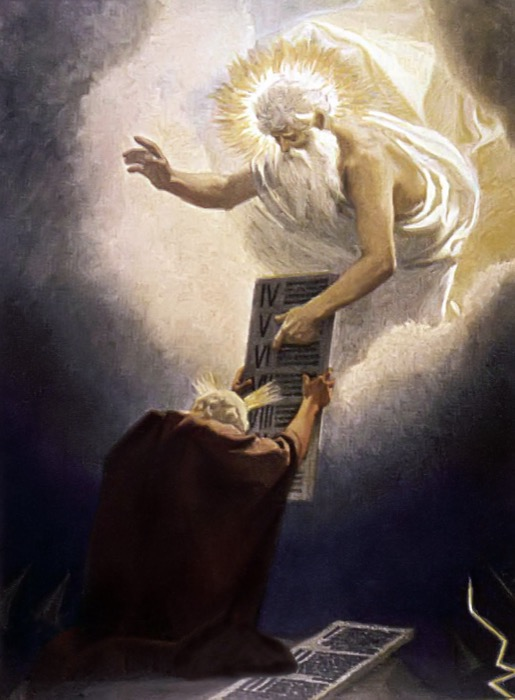
TOP PHOTO: Moses receiving the tablets. (Gebhard Fugel 1863-1939, Public domain, via Wikimedia Commons)


