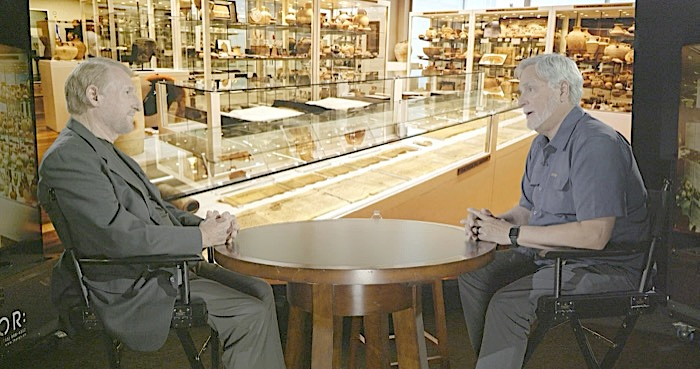
Summary: Dr. Randall Price continues to profile his Bible museum and to explain why seeing these ancient artifacts impacts faith.
Then he said to Thomas, “Put your finger here, and see my hands; and put out your hand, and place it in my side. Do not disbelieve, but believe.” Thomas answered him, “My Lord and my God!” – John 20:27-28 (ESV)
Biblical History on Display
Why are physical artifacts related to Biblical history important? They help emphasize that Biblical faith is rooted in reality, and not just a philosophy. This week we conclude the series with Dr. Randall Price who has built up an extraordinary collection of over 3,000 artifacts that he now wishes to pass on, so that it can continue to inspire the next generation.
In Part 1 of the series, you can read the story of how Dr. Price’s collection was assembled over 40 years of living in and travelling to Israel before being displayed as a Biblical museum at Liberty University. This week, he continues to share some samples from the collection and the importance of Biblical archaeology. Items from all eras of Biblical history and from Israel and the lands surrounding it are represented.
If you or someone you know might be interested in acquiring his Biblical museum, see the information below on how to obtain more information and connect with Dr. Price. The breadth and scale of the collection is amazing and the following article contains excerpts from the podcast discussion between Tim Mahoney and Randall Price.

The Historical Connection to the Bible
TIM MAHONEY: Why is it important that a museum like this would be seen by people?
RANDALL PRICE: History is important because the present is a result of the past and the future will be built upon the present. If you don’t know the past, you’re going to have a difficult time understanding how things came to be. With the Bible, God gave us a revelation through time. If you come to a museum like this, you walk through the actual history of the Bible, you can see the changes in history, you can see what’s happened. I mean, so many of these artifacts are mentioned by name in the Bible. Not the specific artifacts, but the kind of artifacts.

RANDALL PRICE: For example, we have a sickle sword or khopesh from the 15th century BC. It was found in Israel but it is Egyptian, not a Canaanite one. How did it end up in Israel? Well, in this time period of the exodus, it may have come from the spoils of Egypt that were brought by the Israelites to Jericho. If that were so, think about what history this sword witnessed from the plagues of Egypt to the crossing of the Reed Sea to the miracle of the walls falling at the battle of Jericho!
TIM MAHONEY: I think as I remember it, the Egyptians were laying on the shore, and the Israelites gathered the weapons from them.
RANDALL PRICE: Perhaps, though I think it may have only been the bodies of the Egyptians and their chariots and weapons probably sank to the bottom of the sea.
TIM MAHONEY: You have a helmet in one of these displays as well.

RANDALL PRICE: That is one of replicas and is part of a whole Roman soldier uniform created on a mannequin. The replica armor is actually an antique in its own right having first been worn by Robert Taylor in the 1951 film Quo Vadis and then repurposed for the 1956movie Ben Hur. I was able to purchase this from a man who was the consultant for MGM and collected such items as he could. It’s 70-year-old armor but you are able to see what a Roman soldier would’ve looked like down to the smallest detail. For Christians, we use this display to give them an accurate background to the “spiritual armor” spoken of in Ephesians 6:10-17, which is based on the physical armor of a first-century Roman officer.
Passing on the Biblical Museum
TIM MAHONEY: Well, how would people, if they’re interested in a Bible museum, in investigating this collection, how would they get ahold of you?
RANDALL PRICE: We have posted all pertinent information about the museum collection at a secure website, worldofthebible.com/museum. My ministry website is worldofthebible.com, but worldofbible.com/museum is where those interested in the collection should go. Then they can contact me through worldofthebible.com and leave a message. There is also at the secure site a contact for my broker who can handle all business-related questions on acquisition or donation. We really want to see this collection in the right hands, someone who cares about this and would preserve it.

Archaeology and the Bible
TIM MAHONEY: So we probably have young people or others that are thinking, “I would like to be involved with Biblical history and archeology.” What advice would you give to them?
RANDALL PRICE: There are online resources and films like yours that are available for people to get initial education. I’ve written a number of books and handbooks, as have many others, on biblical archaeology. It was a book by Edwin Yamauchi called The Stones and the Scriptures that got me initially interested back in 1972. So that would be a first step to just start to get educated.
If someone wanted to actually go do archaeology, well the first step would be to volunteer for the many archaeological excavations that are being done in Israel and other Bible lands. Usually you can get information on these online. This will help you know whether or not you may want to pursue a career that would include excavation. For that you would have to either major in history, especially ancient history or in biblical studies. Obviously, if you’re going to work in this field you have to know the history of the Bible. You have to have at least a master’s degree in archaeology or an equivalent that touches on archaeology. I and many others have a PhD that is not directly in archaeology, but Jewish or biblical studies. However, while we majored in archaeology our degree doesn’t reflect that because our universities didn’t have a PhD in that field.
There are many schools now that do. I would caution a person that if you’re going to do biblical archaeology as a foreign archaeologist (i.e., doing archaeology in Israel as a citizen of another country) that you’re going to have to support yourself through a teaching career. This is usually necessary because antiquity authorities that grant permits to dig expect one to have a masters in archaeology and to be connected to a faculty of a university that they approve. I hope that doesn’t deter someone, but if this is what God is calling you to, the means are available. And we have a lot of institutions, Christian-oriented institutions, that have biblical archaeology programs and can give opportunities to learn how to do field work as part of their program and give professional guidance.

TIM MAHONEY: That’s great. Let me ask, is there a favorite verse of yours as we close this podcast?
RANDALL PRICE: I like Proverbs 25:2 which says, “It is the glory of the LORD to conceal a matter, but the glory of kings is to search it out.” For me, the history of the Bible in a sense is concealed because of time and so much of the past being buried. But the glory of a king, and I consider myself a child of the king, is to search it out and to find these things that God has left behind as testimony to His truth. And then to make that known to people because just like John said, these are the things which we have seen and heard and handled. This adds a new dimension to faith, that is a faith founded on facts, has a real world context. And these are things surely to be believed.
TIM MAHONEY: Well, thank you Randall for all you’ve done and your wife Beverly. I know she is part of your whole mission and the work that you’ve done and she’s a delight. And I just want to thank you for all the books that you’re writing. What’s the name of the new book again?

RANDALL PRICE: The Comprehensive Illustrated Survey of Biblical Archeology. You can find it on Amazon, but it’s published by Harvest House Publishers. It’s a full-color book that has everything in it to acquaint you with the latest discoveries and why they’re important to our faith.
TIM MAHONEY: Yeah, absolutely. I think Patterns of Evidence has a few photos in there too.
RANDALL PRICE: Yes it does, and thank you for the use of those! I do want to again mention my wife because she was involved in many of our archeological excavations,working alongside me as well as some of our family. So sometimes archaeology can be a family affair.
TIM MAHONEY: I know you’ve got a son who’s been involved in the digs. I’ve seen the video footage of him on the side of a mountain putting up safety wires and everything.
RANDALL PRICE: Yes, our son, Jon. He actually met his wife, who was my graduate assistant, on a dig. So archaeology can have other benefits as well!
Conclusion
TIM MAHONEY: I want to thank you Thinkers for being a part of this podcast and reading our articles. Once again, the secure website with information about the museum is worldofthebible.com/museum. Randall Price’s website where you can leave him a message is worldofthebible.com. Let’s pray for this wonderful resource to be passed on to the next generation so that they can keep on thinking!
NOTE: Not every view expressed by those interviewed for our films and podcasts necessarily reflects the views of Patterns of Evidence. We include perspectives from various sides of debates on Biblical matters so that readers can become familiar with the different arguments involved. – Keep Thinking!
TOP PHOTO: Podcast recording with Dr. Randall Price and Timothy Mahoney. (© 2026 Patterns of Evidence Foundation)


