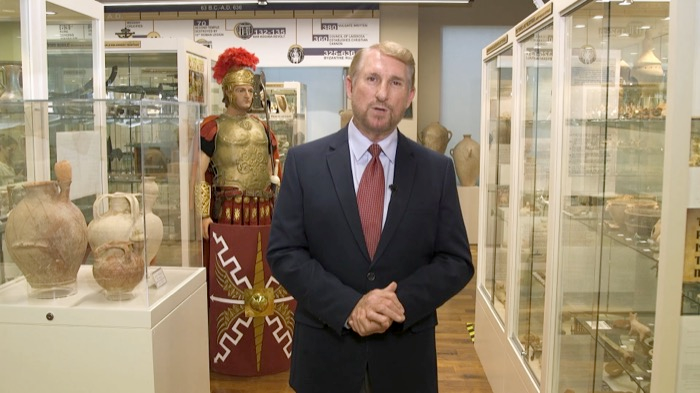
Summary: Dr Randall Price’s museum containing thousands of artifacts that bring the Bible to life, is looking for a new home.
That which was from the beginning, which we have heard, which we have seen with our eyes, which we have looked upon, and our hands have handled, of the Word of life; – 1 John 1:1 (KJV)
A Faith-Building Museum
Dr. Randall Price has a long history as an archaeologist, Bible teacher, author, and head of the Judaic Studies Department at Liberty University. As the former Director of Qumran Excavations (where the Dead Sea Scrolls were discovered) he has appeared in several Patterns of Evidence films. Over his long career, spending much of his time in Israel, Dr. Price has built up an impressive museum of amazing Bible-related artifacts. The collection features over 3,000 items and now Dr. Price is looking to pass on this testimony to the historical roots of biblical history.
Look for more information in this article, as well as next week’s Part 2. The following contains excerpts from the podcast discussion between Tim Mahoney and Randall Price. Let’s get right to it.
TIM MAHONEY: I have the privilege of being with Dr. Randall Price. And we’re going to be talking about museums, and specifically one belonging to one of the world’s leading biblical archeologists. And I would say “biblical apologists” because of all the work that you’ve done, Randall. And we’re surrounded by pictures and images of your museum that you have. And we’ll just let everyone know that there’s an opportunity. We’re going to be talking about museums today and why they’re important. In fact, what possessed you to collect all of this historical archeological information?
RANDALL PRICE: First and foremost is a passion for the Bible, because I love the Bible and the world of the Bible. My wife and I once lived in Jerusalem and I have had, as an archaeologist, an opportunity to acquire most of these things from legal sources there. This has been over a period of 45 years in which I have made 116 trips to Israel, and anybody who does collecting realizes that once one starts it is almost impossible to stop. But in this case, we had a ministry based on the world of the Bible located in Texas and I started a small museum there for the public.
Later I was called to Liberty University to start a center for Judaic Studies and as part of that program the museum was essential to helping students understand the history and the heritage of the Jewish people. During the 15 years I was there I had the opportunity to enlarge the collection and curate it to tell Israel’s biblical story.

RANDALL PRICE: As to the collection, there are about 3,000 plus artifacts, largely from Israel, but also from Jordan, Egypt, Greece, Turkey, Rome and the ancient Mesoptamian world. These artifacts start with the fossil evidence of the biblical Flood (which is a part of biblical history), then to early post-Flood periods (Chalcolitic to the Bronze age) continuing through all the biblical periods to the early Church (Byzantine period). This is to tell the story – but not just tell the story, to show the story of God’s historical revelation through time. The epistle of 1 John starts by saying, “What was from the beginning, what we have heard, what we have seen with our eyes, what we beheld and our hands handled, concerning the Word of Life — and … what we have seen and heard we proclaim to you also.” So the Apostle was trying to say that it’s just not enough to hear the message, he and others saw it in person and even had physical contact with it.
People today can’t go and physically touch things related to Jesus in His life and He has said, “Blessed are those who have not seen and yet believed” (John 20:29). But if you have the opportunity to see – and even handle the proof from the past – even better! That’s why I began a tour ministry to take people to the Holy Land to show them these things both on site and in their many museums. I observed that these encounters with the world of the Bible were life-changing for many people because they had a preconceived idea of what the lands of the Bible were like and where the whole history of the Bible took place. But it is often nothing like many people conceive, even if they see documentaries on TV, it’s not the same as being part of that real world context.
However, while I love taking people to the world of the Bible, I am aware that most people will never get that opportunity. So I felt I should bring the world of the Bible to people and the only practical way to do that is through a biblical museum. The content of the Bible has a context and people need to understand the original world of the Bible context before they try to export and apply the meaning of a text in their 21st century world. Seeing through a curated collection examples of the daily life of the Bible from the actual artifacts of that time helps the Bible come alive, but with a more accurate interpretation.
The Connection Between Faith and Fact

RANDALL PRICE: I remember many times students coming into the museum and asking, “Are these things real?” And I said, “Absolutely!” For example, I showed them a wicker basket from the time of Moses. As a baby he was put in one like that, and this gave an impression of reality to students who only thought of it as a story.

RANDALL PRICE: We also have an Authentic Last Supper exhibit with all of the pottery from Jerusalem in the time of Jesus. It is possible that any of those items could have been part of the original Last Supper, and when this sinks in you hear the students say, “Wow, no way!” People today hear a lot of stories, including Bible stories, they don’t consider whether those stories are real or not. They think it doesn’t really matter as long as the application is something they can live with.
But it does make a difference because there are a lot of rival religions that have their own stories and we must ask “which ones are true?” They can’t all be true because they contradict each other. However, one must be true and the fact is our faith is only good if it is anchored to a story confirmed by history that can be trusted as the word of God.
In a biblical museum you see the world where it happened, the artifacts that came from a real historical context. Consequently, it compels you to have a real faith, because faith is in an object. We don’t have faith in our faith. The object of faith is all important. If it is not real and historically reliable it cannot do for us what it promises. The object of faith in the gospel is an historical figure who hung on a Roman cross, paid for our sins, rose from the dead, ascended to heaven and said, “I’m coming back!” These are all the sure promises of God we can believe.

RANDALL PRICE: And if these things didn’t historically happen, our faith is unfounded. It is axiomatic that for Christianity, unlike other religions, faith must be founded on facts or as the Bible says “Things surely to be believed.” When Luke is writing to Theophilus in the book of Acts, he starts by saying these things have been carefully researched. He did interviews to get to the facts of a matter so that Theophilus – and us -could know what was true. Throughout the Bible we are told “this is the record that God has given to us, eternal life,” and “this life is in His Son,” and “these things are written that you may know you have eternal life.” We’re not to be uncertain or think that these are just stories. If we were there, we could have seen it happen. We couldn’t be there, but in the providence of God these things from the past have been preserved and in the museum we can have evidence that supports the Scripture.
TIM MAHONEY: Well, you really have become quite an apologist with all the books that you’ve written. Do you remember how many?
RANDALL PRICE: Fifty or so. Mostly contributions in co-authored books, but I have produced a number of books myself in the field of biblical archaeology and other biblical studies.
The Backstory of the Museum
TIM MAHONEY: When did you decide that you would start pursuing the historical side of the Bible? These images around us are images of a museum that you have. And by the way, people, it’s actually a museum for sale that you have.
RANDALL PRICE: I got interested in all of this because of my passion for the Bible. As it grew I wanted to learn things about the Bible and I came to the place in my life where I felt I had to get more education. I went through seminary and at the end of that training, I said, “Well, if I become a pastor, I’m going to be talking about a place the rest of my life I’ve never seen.“ So, it only made sense for me and my family to move to Israel and study in Jerusalem at the Hebrew University. It was there that I first really learned about archaeology, though I had taken courses in seminary. But in Israel, you’re there, and our classes were in the form of field trips to the biblical sites. There was nothing like learning right on location!
TIM MAHONEY: Was that quite a time of life?
RANDALL PRICE: I was in my 20s and physically I could do anything and run anywhere. I got a job at the Shrine of the Book which was part of the Israel Museum. It was the place where the Dead Sea Scrolls were on exhibit and I had them all around me during my work hours! We had to return to the States after our second daughter was born in Jerusalem, because we needed to make money to live. In time I got a pastorate and started taking people to the Bible lands and showing them the things that had changed my understanding of the biblical world and increased my trust in the Bible.
Eventually, I went on to get a PhD in a school with a Jewish department where my graduate advisor was an archaeologist in Israel. I became his research assistant and he said, “You’ve got to come with me to Israel on our school’s archaeology dig.” I did, and that put me in the field where I realized the importance of finding things and learned archaeological methodology.

RANDALL PRICE: Of course, in an archeological dig everything is registered and is the property of the state. I wanted to have some antiquities to use in my teaching and fortunately there were plenty of antiquity shops in Jerusalem licensed to sell surplus material. Israeli digs produce an abundance of common items. They’re not common to us, of course, but they make excellent examples of daily life in ancient times. I didn’t have a lot of money, but I started investing in antiquities where I could and over 45 years of concerted collecting you can – with the knowledge and opportunity that comes from being an archaeologist and frequenting the shops – build a good collection.
My motivation came from how these artifacts affected people who, for the first time, could hold in their hand something from the time of Jesus. It was like they were transported back in time. Everything became real. It was sort of a spiritual-physical connection that’s hard to explain. The closest I can come is saying, it is a move from “storybook” faith to “real life” faith. And as I saw the confidence it gave people I said, “I think we could have a real ministry through this.”
I started this first in Texas, and when I was called to Liberty University and the founder, and later his son who succeeded him, embraced the idea of the museum, I worked hard to expand the collection through purchases from antiquity auctions, other museum’s deaccessions and donations from private collectors. We basically put all of our retirement savings to do this while there was an opportunity to acquire more things. It served a wonderful purpose for the many years I was at the university, but when I retired, the school’s interim administration had lost the vision, and packed up the collection and said, “We’ve got to find the next home for it.” My hope now is that someone will catch the vision for this because as far as I know, there aren’t many collections like this available in our country. One man who is an appraiser said, “You have one of the finest collections of private hands in the United States.”

Looking to Pass on a Museum with a Mission
TIM MAHONEY: So the reason we’re talking about this right now is because you would like to see this happen. Right now, it’s packed up and in storage, but you’d like to see this museum collection go somewhere. So if you’re listening to this podcast and you’re thinking, “Well, I didn’t know there was a Bible museum that might be for sale” or “we could get something together,” there’s an opportunity for that.
RANDALL PRICE: I realize this is usually the type of thing an institution acquires. And if someone knows of an institution that may be interested please let me hear. However, there are other ways to help. Right now there are some interested parties but they just don’t have the funding. But they are charitable organizations and can receive donations in lieu of a tax donation receipt. What is needed is an anchor donor who would be joined by other invested partners to make the museum operate commercially. This should be something seriously considered today as antiquity laws in Israel have become more stringent for buyers and the war has forced many shops to close. So it will be more and more difficult to obtain the kind of things that are part of this collection.
TIM MAHONEY: The value of having a museum is that it brings the Bible to life. I mean, not that you can always touch all this, but you can see it and just realize it, and it tells the story of the Bible. That’s how you’ve arranged it, right? There’s sort of a chronology of history in this museum.
RANDALL PRICE: We created a visual timeline that lined the walls above our exhibits. The artifacts followed this timeline from the Flood to the early church and this in itself was a great tool for instructing people on how to follow the history of the Bible.
Conclusion
For those interested in more information about how you can help pass on Randall Price’s biblical museum to the next generation, stay tuned for next week’s article with more remarkable artifacts. You can also check out the following websites. Randall has a secure website with information about the museum at worldofthebible.com/museum. His personal website where you can leave him a message is worldofthebible.com. Until next time, keep thinking!
NOTE: Not every view expressed by those interviewed for our films and podcasts necessarily reflects the views of Patterns of Evidence. We include perspectives from various sides of debates on Biblical matters so that readers can become familiar with the different arguments involved. – Keep Thinking!
TOP PHOTO: Dr. Randall Price in his Bible Museum. (© Randall Price)


