Summary: Part 3 concludes a series using chronology to examine Jacob’s life to see how apparent Bible difficulties can have satisfying solutions.
And Dinah the daughter of Leah, which she bare unto Jacob, went out to see the daughters of the land. – Genesis 34:1 (KJV)
More Challenges in the Story of Jacob
Chronology (timing) was used in Part 2 to show how both younger and older ages than typical can explain the multiplication of Jacob’s family in Egypt. Doubts were also raised about the usual understanding of Jacob waiting 7 years before marrying Rachel and Leah, because the chronology shows that this forces too many events to fit into a short 7-year window before Joseph’s birth. But the chronological issues don’t stop with the time in Haran.
Things actually become more surprising and potentially troublesome when diving into the next part of the account. Things like youngsters killing all the males in a village and fathering children when they may have been 10 or 11 years old. Was the author of the Bible confused, or were the numbers meant to have no meaning, removing all connection to historical reality? Can a closer look at the chronology presented in the Biblical text help solve these problems?
A Second Theory
Some Bible scholars attempt to solve the chronological challenges surrounding the events of Jacob’s life by proposing that Jacob’s stay in Haran was not 20 years, but 40. They believe linguistic clues hint that Jacob’s two references to his 20-year stay in Haran (Gen. 31:38, 41) are actually about two separate 20-year periods, with a 20-year block between the first 14 years and the last 6, to add up to 40. Joseph would then have been born at the end of the extra 20-year period, and before the final 6 years, to give more space for Leah’s children to be born.

But while this may be a possibility, the narrative after Joseph’s birth (Gen. 30:25-30) strongly implies that the 14 years of service for the privilege of marrying Leah and Rachel (the bride price) had just been completed. This is when Jacob makes the deal to work 6 more years for the spotted sheep of Laban’s flock. Jacob expresses that he now needs some gain to provide for his own household. However, if Jacob the opportunist had been working an extra 20-year period (after the 14 years for Leah and Rachel), he no doubt would have been doing that very thing for the previous 20 years. So, it just doesn’t seem to fit.
Since there is no trace of this extra 20 years during the account in Haran, it seems much more natural to read Jacob’s request for the marriage to Rachel because his “days” were now fulfilled, as just that – the days of a customary waiting period and not the full 7 years. Seven years was not the customary waiting period for marriages in the ancient Near East, and also not the time Jacob needed to wait for his second marriage.
And Jacob said unto Laban, Give me my wife, for my days are fulfilled, that I may go in unto her. – Genesis 29:21
Putting the marriage to Leah at the beginning of Jacob’s initial 7-year agreement, allows the births of Leah’s children to fit into the 14-year span before Joseph’s birth. It is a tight fit by modern norms, but as will be shown below, it aligns with how tight the births of Juduh’s descendants are during the 33-year period in Canaan – a period both sides of the debate define in the same way.


Suspicious Events in Canaan – Tragedy in Shechem
Two series of events in particular, which happened during the family’s stay in Canaan after leaving Haran, have troubled Bible readers and stoked skepticism among critics. Both are impacted by the common view that Jacob waited 7 years before marrying Leah and Rachel in Haran.
First comes the problem that Jacob’s children seem to be too young when they come into Canaan for the events that are said to take place there. Dinah is said to have gone out to visit the women of Shechem. When there, Hamar, a resident of Shechem, became enamored with her and raped her. Yet if she was only 7 or 8 years old, this seems to be much too young to make sense of these things.
Additionally Simeon and Levi are said to have taken revenge for this act by slaughtering the entire male population of Shechem causing Jacob’s family to flee. But if they were only 10 or 11 years old, this again seems much too young for such an event.
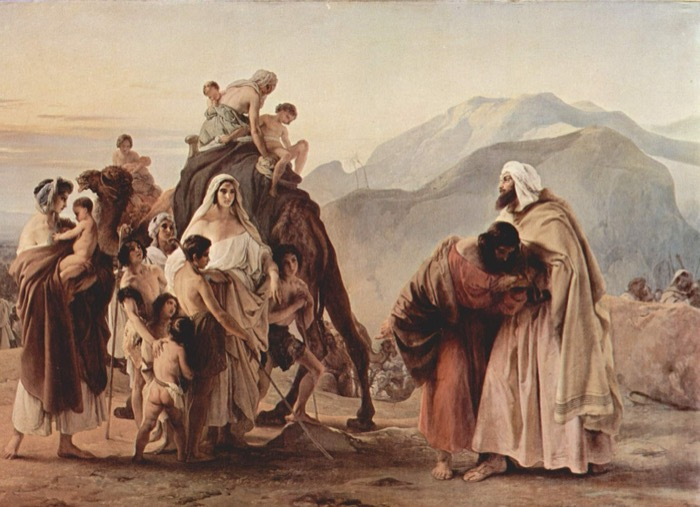
The common perception for the youth of Jacob’s children can be seen in the painting at the top of the article. This is Jacob and Esau meeting just before Jacob returns to Canaan to begin the 33-year period. Notice how young the children of Jacob are depicted. If Jacob had to wait 7 years before marrying Leah and Rachel, the oldest son, Reuban, would have recently turned 12 at that point. The ages in the paragraph above are based on Simeon and Levi being Leah’s second and third child. Some that follow the compressed timing in Haran put Dinah’s birth well after Joseph’s, making her potentially much younger than 6 upon entry into Canaan.
After arriving in Canaan, the account has them staying in Succoth for a time before coming to Shechem. But even if there were two intervening years, the ages seem too young to fit the narrative. To help address these concerns, it is useful to lay out the events as we know them from the Biblical text to define this period chronologically to the best of our ability.

One major event that helps define this period is Joseph being sold as a slave by his brothers and being taken to Egypt. This happened when Joseph was 17 years old, after the family had reunited with Isaac in Hebron.
These are the generations of Jacob. Joseph, being seventeen years old, was feeding the flock with his brethren …And he [Jacob] said to him, Go, I pray thee, see whether it be well with thy brethren, and well with the flocks; and bring me word again. So he sent him out of the vale of Hebron, and he came to Shechem. – Genesis 37:2, 14
This divides the 33 years in Canaan into 11 years before Joseph was sold (Joseph’s ages 6 to 17 in Canaan) and the remaining 22 years in Canaan before the family moves to Egypt (when Joseph is 39 as was determined in Part 1 of the series).

Five places of settlement are mentioned for the family up through their time in Hebron where Isaac was centered, all of which happened before Joseph was enslaved at the end of the first 11 years in Canaan.
1) Living in Succoth for some time because it says they built a house (Gen. 33:17)
2) Living near Shechem where Dinah was raped and her brothers Levi and Judah cut down the settlement’s men (Gen. 33:18-34:31)
3) Staying in Bethel where Jacob built an altar and Rebecca’s nurse died (Gen. 35:1-15)
4) They traveled south toward Hebron to reunite with Isaac, and on the way Rachel died giving birth to Benjamin near the town of Bethlehem (Ephrath), and they stayed beyond the tower of Edar (Gen. 35:16-22)
5) The family moves to Hebron and is with Jacob’s father Isaac before he dies. In Hebron, when Joseph is 17, he dreams his dreams and is sent to the area near Shechem to report on his brothers, where they sell him into slavery. (Gen. 35:22-29, 37:1-14 and afterward)
By examining the layout of events, we see two factors that can help. First, the family may have been much longer in Succoth and Shechem than just two years, because all five places of settlement have a fairly broad period of almost 11 years in which to fit.
Second, if it is the case that Jacob married Leah and Rachel right away in Haran, then a year or more can be added to Dinah, and 7 years to the boys’ ages, which helps greatly to resolve the difficulty. Dinah’s going out to visit the women of Shechem, her rape, and Shechem requesting to marry her, works much better if she was of marrying age – in other words a teenage girl, rather than an 8 or 9-year-old. Likewise, the killing of the men of Shechem works much better if Simeon and Levi were in their early 20s rather than around 12 years old.
Suspicious Events in Canaan – 3 Generations in Judah’s Line
More evidence that Jacob did not wait 7 years before marrying Leah and Rachel is seen in the soap opera account of Judah’s sons and grandsons born in Canaan in Genesis chapter 38. Simply put, there just is not enough time for all the events listed unless Judah was of sufficient age to marry and have children during the first year or so in Canaan. However, being Leah’s 4th child, the oldest Judah could have been upon entering Canaan in the standard view is a boy who just had his 9th birthday. Was a young 9-year old really fathering children? This apparent error is added to the list of problems that have caused many to question the Bible.
Commentators have noticed that when chapter 38 begins with the phrase ”at that time,” it must not mean after Joseph was sold to Egypt, which occurs in chapter 37; it must mean “in those days” when they were in Canaan. The main reason for this is that the sequence of events for Judah in chapter 38 are so extensive, they must have filled up the entire 33 years in Canaan.
As seen in our series on the documentary hypothesis, ancient Semitic thinking and writing did not always operate in the same ways as modern Western writing. The account of Judah’s fall into immorality with Tamar was not placed in chapter 38 because it happened after Joseph was sold (in chapter 37), but for other reasons – perhaps because, thematically, it contrasts Joseph’s high morality in resisting temptation with Potiphar’s wife, which follows immediately afterward in Chapter 39.
Sequences of events being reported out of chronological order are also seen elsewhere in Moses’ writing (and throughout the Bible). A few examples include Genesis chapter 2 going back to focus on the forming of the man and woman after the seven days of creation were already completed in the previous section. The genealogy of Esau in Genesis 36 goes back in time before the events of the previous chapter and then forward many generations after the death of Esau, but then the text returns to the time when Esau was still living in the next chapter – 37. And in Exodus chapter 18, Jethro visits Moses at “the mountain of God” (v.5), but then the next chapter records the Israelites arriving at Mount Sinai. Other examples include siblings being listed in order of prominence, or in order of significance to the story, rather than in birth order.
These out-of-order accounts and information have been used to argue for the documentary hypothesis, though it has since been shown to be a typical hallmark of ancient Semitic writing.
A careful reading of the events in Canaan shows Judah fathering 2 generations of children (the 2nd generation being twins), plus a waiting period of an unspecified number of years for his 3rd child, Shelah, to come of age. Not only this, when the family moved to Egypt from Canaan at the end of the 33-year period, one of these twins, Perez, was old enough at that time to have fathered two sons (Gen. 46:12). So that’s the beginning of the third generation, all of which needs to fit within 33 years in Canaan. So, even if Perez’s two sons were newborn twins, this puts some very tight restraints on this time period.

In the standard view, when the family entered Canaan it would be a minimum of 4 or 5 years before Judah would be old enough to father children and begin the sequence of events reported in chapter 38. Since 9 months of pregnancy are needed at the start of each generation (Er, Perez, and Perez’s sons), it would mean that Perez would have been about 10 years old when he fathered his sons (who may or may not have been twins as well). Too strained to be realistic.
Laying out all the timeframes for the 33 years spent in Canaan in the tightest way possible does not leave enough room by the time we get to Perez fathering sons (step 6 below), who in the best-case scenario would have been twins, which do tend to run in families, otherwise another year (at least) would be needed:
1) 4.5 years for Judah to come of age and marry at age 13
2) .75 of a year for Er to be born
3) 14.25 years for Er to marry and be killed at nearly the same time as his younger brother Onan (who needed to be at least 13 at the time) was killed for refusing to raise up children for his dead brother
4) 2 years waiting for the youngest brother Shelah to come of age and Tamar to realize that Judah was not following through on his promise
5) .75 of a year for Perez to be born to Tamar
6) 10 years for Perez to grow up and marry
7) .75 of a year for Perez’s sons to be born when Perez is still 10 years old
8) Total = 33 years
The crux of the problem is largely based on the thinking that Jacob waited 7 years in Haran before marrying Leah. If he instead had married right away, Judah would not have been 9 when he arrived in Canaan but 7 years older (or 16). If Judah married Shuah shortly after arriving in Canaan, his firstborn son, Er, could have been born by the end of Year-1. Then Er and Perez could both have been around age 15 when they were killed or fathered their first child. Although strange by today’s norms, this makes the reported sequence of events feasible.
Conclusion
Our perceptions of Biblical accounts don’t always match what the text is conveying. This seems to be the case with Jacob’s age when he arrived in Haran. He was not a youth, despite popular depictions showing otherwise. And when Jacob arrived in Haran where he worked 20 years for Laban, he did not have to wait 7 years before he married Leah (and Rachel). He married her almost immediately. While this may seem to be odd according to the way we normally read the text with modern Western assumptions, several chronological factors in the account bear this out, with three being foremost. First, all the children needed to be born before Year-14 of the Haran sojourn. Second, the events in Shechem make more sense if Dinah was a bit older, and Simeon and Levi were 7 years older than in the standard view. Third, for the births of Judah’s offspring to work in the time allowed, he must have been of marrying age when they arrived in Canaan.
The history reported in these accounts is not in error or evidence of contradictions, as many have claimed. When examined more closely, some of the troubling aspects in Jacob’s story can be seen to be misunderstandings about chronology. Other aspects, though surprising, become reasonable when considered in light of the larger context of the Genesis narrative and ancient historical realities. Here, the importance of chronology can be demonstrated not only to alleviate doubts about the story, but as a doorway to enrich our understanding of the account and its messages better. Keep thinking!
TOP PHOTO: The meeting of Jacob and Esau. Note the young ages of the children in the caravan. (Francesco Hayez, 1791-1882, Public domain, via Wikimedia Commons)


_-_Jacob_Peeling_the_Rods_-_RCIN_406088_-_Royal_Collection.jpg)

