Summary: Part 2 completes the basic framework needed to construct a complete Bible timeline with the remaining four steps.
But when the fullness of time had come, God sent forth his Son, born of woman, born under the law, to redeem those who were under the law, so that we might receive adoption as sons. – Galatians 4:4-5 (ESV)
The Basic Bible Timeline
In Part 1 last week, the topic of time and its vital role in history was looked at. The author(s) of the Bible frequently spends a lot of time expressing chronological information, so it must be something of great importance. However, the information required to produce a rough framework for a complete Bible timeline can be gleaned from a relatively small number of passages that involve just eight main steps or segments.
The first four segments were covered in the previous article. While the possible variations in these segments are vigorously debated, it is feasible to come to the following sub-totals based on just one or two passages for each segment:
- 1) From Adam to the Flood (1656 years)
- 2) From the Flood to Abraham (427 years)
- 3) From Abraham to Exodus (430 years)
- 4) From Exodus to Solomon’s 4th Year (480 years)
For more details on these first four segments, you can check out Part 1. Now we can move on to steps 5-8.
5) From Solomon to Temple Destruction (426 years)
The time of the kings in Israel and Judah is one area that is complicated, and it could take many hours to come up with even the simple beginnings of a framework. It is not quite as easy as adding up the reign lengths the Bible records for each king in the books of Kings and Chronicles to come up with a total. This period has long confounded scholars. However, it may be that a single enigmatic verse holds the key to understanding its length.
After the death of Solomon, Israel split into two kingdoms – Israel in the north and Judah in the south. Israel’s first king, Jeroboam, quickly built two golden calves in the cities of Bethel and Dan for his people to worship so they wouldn’t go to Solomon’s temple in Judah’s capital of Jerusalem. He also replaced priests from the tribe of Levi and came up with a new counterfeit Feast of Tabernacles in the eighth month instead of the seventh as God had ordained. The repeated refrain in the Bible throughout Israel’s history is that Jeroboam “caused Israel to sin” or that future kings “did what was evil,” walking in the ways of Jeroboam and causing Israel to sin.
Israel would eventually be vanquished by the Assyrians, and about 135 years afterward, Judah would fall to the Babylonians. While Judah was more stable and was ruled by a succession of 19 monarchs from one family – the line of David – Israel had 19 kings from nine different dynasties or ruling families (all of whom were said to have been wicked), and there may have been times during the turmoil when no king was on the throne for lengthy periods. There also may have been times when two kings were reigning at the same time. This could either be because a father and son were reigning at the same time, as the son gained experience or as the father faded in his abilities. Or there could be two rival kings reigning in different areas of the kingdom. Times of vacated thrones and kings reigning simultaneously have both been seen many times in the kingdoms of the world.
There is Biblical evidence for only one instance of two kings reigning at the same time in Judah. This was at the time of Jehoshaphat and his son, Jehoram in 2 Kings 8:16. One issue that arises is that during the period that Israel existed, the reign lengths recorded in the Bible for its kings when added up come out about 20 years less than the Kings of Judah in the same period.

In the most recent century, scholars have attempted to solve this chronology problem by using the Kings Lists (or Eponym Lists) from Assyria. These lists name each year for a king of Assyria or one of his officials who were honored by having the year named after them. They have been shown to be in agreement with the Biblical record in some portions, but are apparently not in harmony with the Bible in other areas. Most modern scholars have adopted a system that assumes the accuracy of the Assyrian lists for their entire length and then use them to “correct” the Biblical data.
For example, the chronological solutions of Edwin R. Thiele have been widely followed, and he certainly came up with some insightful ideas. However, even though Thiele recognized there was about a 45-year difference between a straight-forward tally of kings in the Biblical account compared to the Assyrian chronology, he went with the Assyrian source as the more reliable (suggesting that discrepancies may have resulted because of errors in the Bible), and adjusted the Bible’s numbers accordingly. This puts the span of the split kingdom at about 345 years and has become the standard dating view today. It puts the dates for Solomom’s reign at 970-930 BC based on the temple’s destruction date of 586 BC.
However, if looking at Judah’s reign-lengths in isolation and working backward from the temple’s destruction to the death of Solomon (and accounting for the single co-regency apparent in the Biblical text), it adds up to a total of 390 years.
This 390-year span for the split kingdom just happens to match Ezekiel 4:4-8 where Ezekiel is told to lay on his side, with each day representing a year of Israel’s wickedness, as a sign that the fall of Jerusalem was the work of the LORD. In verse 5 the total number of days (representing years) is given as 390. This means a single verse may define the length of the divided monarchy of Israel and Judah.
I have assigned you the same number of days as the years of their sin. So for 390 days you will bear the sin of the people of Israel. – Ezekiel 4:5 (NIV)
Combining the years of sinful acts for the kingdoms of Israel and Judah seems appropriate since mass movements of people from Israel to Judah are recorded on several occasions (2 Chron. 11:1, 13-17; 12:1,6; 15:8-9; 35:17-19). About a century after the fall of Israel, refugees from all Israel were said to be living in Judah (2 Chron 35:17-19). Judah also sinned, and the mixed population continued in the idolatry spurred by Jeroboam down to the time of Ezekiel. In fact those kings of Judah who did what was evil were said to be walking in the ways of the kings of Israel.
Ahaz was twenty years old when he began to reign, and he reigned sixteen years in Jerusalem. And he did not do what was right in the eyes of the LORD his God, as his father David had done, but he walked in the way of the kings of Israel… (2 Kings 16:2-3)
If Ezekiel didn’t mean the 390 days to represent the period of sin by the split kingdom, it’s difficult to come up with an alternative that makes better sense. In Thiele’s system, 390 years before the temple’s destruction puts you about five years before the end of King David’s reign and nearly a decade before work on the temple was begun – an odd place for the major starting point of Israel’s sins.
If looking only at the Bible and its tally of Judah’s kings, along with the support of Ezekiel naming a span of the same length for Israel’s sins, the total for the split kingdom down to the destruction of the temple comes to 390 years (pushing Solomon back to 1015-975 BC). To this total must be added the remaining 36+ years of Solomon’s reign after temple construction began (the endpoint of Segment #4 on our timeline), which results in a total of about 426 years for segment #5. If Thiele was correct, this total would instead be 45 years shorter, or 381 years.
6) The Babylonian Captivity and Daniel 9 (130 years)
The destruction of Judah would not mean the doom of the people of Israel – as might be expected if one looks at the histories of other nations. This is one of the amazing aspects of Israel’s story, which is unique in the history of the world, and a testimony to the hand of an all-powerful God directing its course.
The prophet Jeremiah famously predicted that the Babylonian captivity would last 70 years (Jer. 25:9-13). Specifically, Jeremiah said Judah and the surrounding nations would “serve the king of Babylon seventy years.” However, the deportations from Judah to Babylon took place in several waves. The first wave occurred about 20 years before the temple’s destruction. This included Daniel and his friends being deported to Babylon (Daniel 1:1-7).
Several decades after the Jerusalem temple’s destruction, King Cyrus made his decree to allow deported populations in his kingdom to return to their native lands and worship their gods as they saw fit. We don’t have an exact Biblical date for this event, we also don’t have an exact BC date for the Cyrus cylinder that records Cyrus’ decree. However, the general date assigned by scholars puts it about 50 years after the destruction of the Temple (it would also take a while for returning Jews to reach Israel), or about 70 years after Judah began serving the king of Babylon at the time of Daniel’s deportation. This aligns with Jeremiah’s 70-year prophecy.
While in Babylon, Daniel received the well known “seventy weeks” (or seventy sevens) prophecy that he recorded in Daniel 9:24-27. The main takeaway from this amazing prophecy is that it provided a clock for Jerusalem’s future and when the Messiah would come. He would come 483 years after a decree was given to rebuild Jerusalem.
The starting point of this prophecy is said to be “…from the going out of the word to restore and build Jerusalem …it shall be built again with squares and moat, but in a troubled time. ” (Dan. 9:25). There are four decrees mentioned in the books of Ezra and Nehemiah related to the restoration of the Jews from their deportations to Babylonia, and each has been offered as the correct one by advocates. However, three have to do with the rebuilding of the temple and say nothing about rebuilding the city. In contrast, the fourth decree concerned the building of Jerusalem and its wall. It came in the 20th year of Artaxerxes (Neh. 2:1-8, 13, 17).
There are many different views about which Persian king qualifies as the “Artaxerxes” mentioned by Nehemiah and the exact date this took place (another complicated debate). For the purposes of a basic timeline, it is enough to say that this took place sometime in the mid 400s BC, perhaps about 130-140 years after the Temple’s destruction.
7) From Daniel’s Prophecy to Messiah (483 years)
There are many disagreements about whether the 483 years of the prophecy in Daniel 9:25 end with the birth of Jesus, the beginning of his ministry, or with the Holy Week and his death in the crucifixion. Of course, the date one assigns to Artaxerxes’ 20th year from Segment #7 affects the exact aspect of the Messiah’s life that it pertains to. Daniel 9:26 along with the preceding information seems to say that after 62 and 7 weeks (or 69 weeks of years – 483 years) the anointed one/Messiah would be cut off. Additionally, arguments are sometimes made that the 360-day year of the Babylonians should be used for the calculation rather than years of 365.25 days.
Certainly, the various options all point to something in the lifetime of Jesus, early in the first century AD, which is one of the greatest evidences for his identity as the Messiah.

8) The Birth and Ministry of Jesus
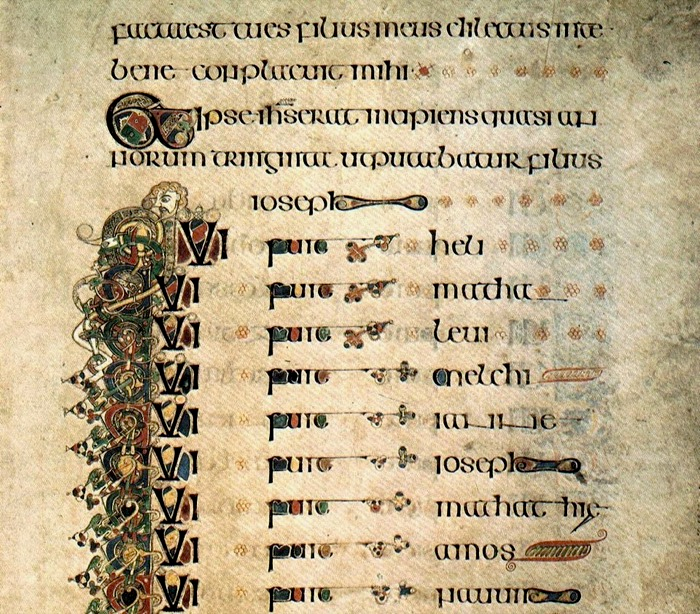
The chronology of Jesus’ life is important as a consideration in its own right, and the end-point of Daniel’s prophecy of 483 years also brings an end to the interlocking Biblical chain of dates – especially if it was pointing to Holy Week (the 70th week of Daniel’s prophecy being hotly disputed regarding which period it pertains to). The genealogies in Matthew and Luke connect Jesus to the previous history in the Bible, but don’t give any timespans. Of course, there are many disagreements about the exact timing of events in Jesus’ life, but the variations only differ by a few years. Since the exact date of Daniel’s prophecy is uncertain, here we must rely more on “known” BC dates to orient our understanding of timing rather than just relying on Biblical timespans.
Jesus’ birth year is tied to the end of Herod the Great’s reign who was still living when Jesus was born. But the date of Herod’s death is disputed and dates assigned to Jesus’ birth usually range from 6-1 BC. The time when Quirinius was governor (or ruler) of Syria and his registration is also a debated topic (Luke 2:2). Remember, that when making calculations, there was no year zero. So 1 BC was immediately followed by AD 1.
Luke 3:1-2 places the start of John the Baptist’s ministry (which immediately preceded Jesus’ ministry) in the 15th year of the reign of Tiberius Caesar who reigned from AD 14-37 (Luke 3:1). The ministry of John and Jesus also took place at the time of Pontius Pilate’s governorship of Judaea which has been dated to AD 26/27-36/37.
Jesus is said to have begun his ministry at about age 30 (Luke 3:23), and his ministry seems to have lasted about 3 and a half years. This is because he is recorded as attending at least 3 and possibly 4 Passover feasts. Also, Jesus’ parable of the barren fig tree in Luke 13:6-9 may hint that his ministry had been going for three years at that point.
The timing of events during Holy Week and post-resurrection offer fertile ground for exploration as well, but here the different options come down to days and hours, not years. The crucifixion date is most often put between AD 28 and 33, but the Tiberius Caesar reference for the beginning of John’s ministry in Luke 3:1 (see point above) seems to discount the early portion of this range.
Conclusion
Much more could be said about each of these major segments, and many books have been written on the subject. It can be seen that using the scheme above and adding up the years from the different segments comes to a rough total of about 4032 years from Adam to the crucifixion of Jesus.
1656 + 427 + 430 + 480 + 426 + 130 + 483 = 4032
Other schemes will come up with different numbers, and adding 2000 years will approximately bring us up to today. Once synchronisms with “known” BC dates can be linked to any Biblical events, all the other Biblical timeframes can receive BC dates as well, going back to the beginning. Although not precise, this overview can hopefully help sort out the big picture of God’s plan of history.
And he made from one man every nation of mankind to live on all the face of the earth, having determined allotted periods and the boundaries of their dwelling place, that they should seek God, and perhaps feel their way toward him and find him. Yet he is actually not far from each one of us … Acts 17:26-27 (ESV)
Keep Thinking!
TOP PHOTO: Luke’s genealogy of Jesus, from the Book of Kells, transcribed by Celtic monks c. AD 800. (public domain via Wikimedia Commons)


